Get the latest crypto news, updates, and reports by subscribing to our free newsletter.
Giấy phép số 4978/GP-TTĐT do Sở Thông tin và Truyền thông Hà Nội cấp ngày 14 tháng 10 năm 2019 / Giấy phép SĐ, BS GP ICP số 2107/GP-TTĐT do Sở TTTT Hà Nội cấp ngày 13/7/2022.
© 2026 Index.vn
REAL Shows Network (RSN) is a national TV network for top real estate professionals and influential local leaders, giving select hosts in each market the exclusive opportunity to lead a full 30-minute show showcasing their expertise, partners, and community. Created by an Emmy-nominated, Telly Award-winning production team, RSN delivers cinematic,…

Crypto markets saw a sharp “leverage flush” over the past 24 hours, with roughly $185 million in forced liquidations hitting derivatives traders while spot prices remained comparatively steady. The divergence suggested the day’s key story was risk being taken off the table rather than a decisive change in market direction.
Liquidations were concentrated in the two bellwether assets, pointing to a broader cooling in risk appetite rather than an altcoin-specific shock. Bitcoin (BTC) accounted for about $55.43 million in liquidations, while Ethereum (ETH) saw around $42.05 million.
Long positions made up the bulk of the damage. BTC long liquidations totaled roughly $34.46 million, or 62.2% of BTC’s liquidation figure, indicating crowded upside bets were unwound first. ETH’s presence in the largest liquidation cluster reinforced the shift from aggressive dip-buying toward a more defensive stance.
Despite the liquidation scale, spot markets stayed unusually calm. BTC edged up 0.18% to $66,775, while ETH rose 0.67% to $2,063. The resilience in spot pricing relative to the liquidation print suggested a positioning reset—an overheating cool-down—rather than a capitulation-driven selloff.
Major altcoins leaned positive but showed more dispersion than broad-based risk-on behavior. XRP rose 0.28% and Solana (SOL) gained 0.70%, while BNB slipped 0.54%.
In SOL, about $11.65 million was liquidated over 24 hours, with longs comprising 79.2% of the total. XRP liquidations reached roughly $3.72 million, with an even more lopsided 86.6% long share—evidence that positioning had become one-sided even though price moves were modest.
Market share metrics suggested rotation rather than outright capital flight. Bitcoin dominance dipped slightly to 57.99%, while Ethereum’s share ticked up to 10.81%, indicating some flows may have circulated toward ETH and select altcoins instead of exiting the asset class entirely.
Broader structure indicators pointed to a more cautious tone. Total crypto market capitalization stood near $2.3038 trillion, while 24-hour trading volume was about $83.2 billion, implying participation intensity softened even as valuations held.
Altcoin market cap came in around $967.7 billion with $49.4 billion in volume, consistent with a tentative rebound attempt rather than a surge of fresh inflows.
Derivatives activity, in particular, signaled a pause. Total derivatives volume fell to roughly $77.4 billion, down 14.26% on the day, indicating new leverage did not immediately rebuild after the liquidation wave. Stablecoin trading volume dropped to about $81.4 billion, down 17.08%, while DeFi volume slid to around $11.0 billion, down 13.52%.
On a four-hour basis, BTC liquidations totaled about $626,740, with short liquidations exceeding long liquidations—suggesting brief pockets of upward pressure persisted even as the broader session was defined by de-risking.
Cardano (ADA) rose 2.52% over 24 hours, and its four-hour liquidation mix also skewed toward shorts being squeezed, indicating certain corners of the alt market continued to punish bearish positioning.
One of the most notable thematic moves came from gold-linked tokens, which advanced in tandem: Tether Gold (XAUT) rose 1.54%, PAX Gold (PAXG) rose 1.62%, and silver-linked XAG rose 3.14%. The coordinated strength pointed to a drift toward safe-haven exposures inside crypto, aligning with a market mood that favored hedges over high-beta bets.
Geopolitical headlines appeared to reinforce the defensive bias, including reports that the U.S. military struck civilian infrastructure near Karaj, close to Tehran. While the news did not trigger immediate, broad-based contagion across risk assets, it tracked closely with the bid in gold-related tokens.
Traders also monitored liquidity repositioning following the Drift hack, with some activity believed to have routed through Jupiter (JUP). JUP trading volume surged and the token climbed 3.1%, highlighting how near-term focus shifted from the hack itself to where liquidity migrates next.
Institutional developments added another layer to the day’s crosscurrents. BlackRock’s spot Bitcoin ETF iShares Bitcoin Trust ($IBIT) was reported to have posted $16–$18 billion in daily trading volume, approaching levels typically associated with Binance. As spot ETFs increase their presence, they can raise the pricing influence of regulated flows, potentially making short-term derivatives liquidations less decisive in dictating trend.
On the supply side, miner behavior remained a variable. Riot Platforms ($RIOT) said it mined 1,473 BTC in the first quarter and raised about $289.5 million by selling 3,778 BTC at an average price of $76,626. Miner monetization can represent latent sell-pressure even when spot markets appear stable.
Regulatory signals were mixed. The Commodity Futures Trading Commission moved to sue three U.S. states over authority to regulate prediction markets, while Kentucky reportedly removed provisions that had raised concerns about effectively limiting Bitcoin self-custody. The policy backdrop did not crystallize into a single market-moving threat, but debates over custody, market structure, and jurisdiction continue to shape the risk premium around the sector.
Overall, the session was defined by a notable unwind of leverage—about $185 million—without a corresponding breakdown in price. Rather than a clean restart of a rally, the market appeared to be running a stress test on positioning and participation, with direction taking a back seat to durability.
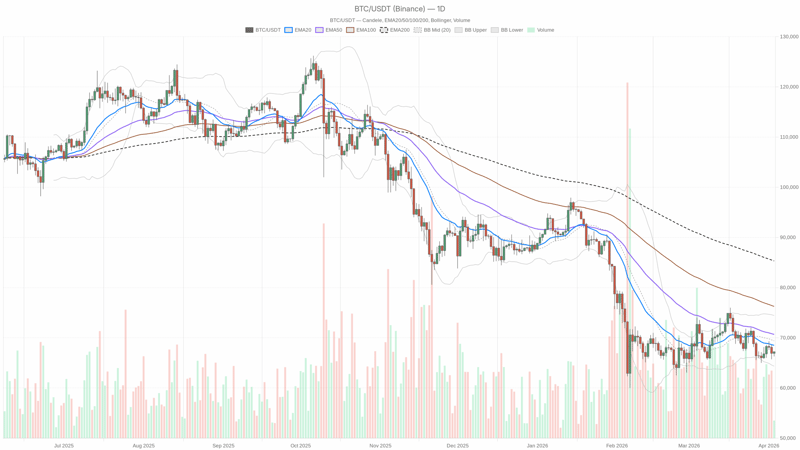





In brief\n\nBitcoin dropped to about $93,000, falling back below the EMA50 and putting its recent golden cross at risk of invalidation. The global crypto market cap stands at $3.15 trillion, down 2.38% in 24 hours. On Myriad Markets, 82% of the money is betting on Bitcoin pumping to $100K before…