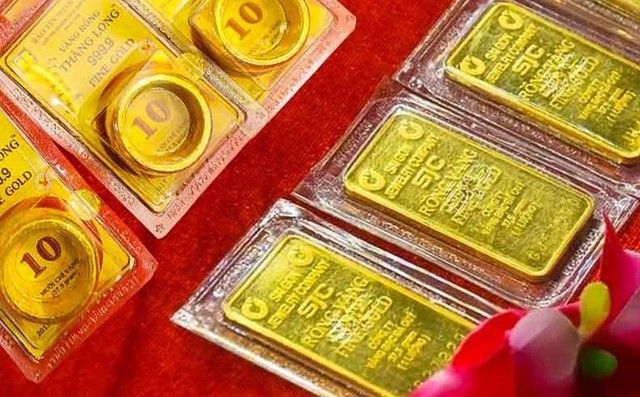
Gold prices in Vietnam vary across firms for both gold bars and plain gold jewelry, while the international market remains supported by recent developments in U.S.-Iran relations and expectations around Federal Reserve policy.
Bao Tin Minh Chau currently lists gold bars and plain jewelry at 148.0–150.5 million VND per tael.
At DOJI, gold bars are quoted at 148.0–150.5 million VND per tael. Plain jewelry is slightly higher at 148.5–151.0 million VND per tael.
At PNJ, gold bars are also listed at 148.0–150.5 million VND per tael, while plain jewelry is lower at 147.5–150.5 million VND per tael.
Some other firms show lower quotes. For example, Ngoc Hai Gold and Jewelry lists gold bars at 146.0–150.0 million VND per tael.
On the international market, spot gold is trading at around 4,337 USD per ounce, equivalent to about 138 million VND per tael at the current USD rate (excluding taxes and fees). The level is reported as the highest in six days.
Reuters reported that gold rose to the highest level in nearly a week after a peace agreement between the U.S. and Iran. U.S. and Iran officials said the two sides reached a deal to end the conflict and reopen the Hormuz Strait.
The preliminary agreement dragged oil prices down, but the future of Iran’s nuclear program will continue to be negotiated in upcoming rounds of talks.
UBS analyst Giovanni Staunovo said: “The market is reducing expectations of a Fed rate hike due to falling oil prices, and this is supporting gold prices. In the short term, I think gold could enter a consolidation phase until the market gets a clearer signal from the Fed later this week.”
In addition, the U.S. dollar fell to its lowest in 10 days, making gold priced in USD more attractive for investors holding other currencies. Oil prices also fell to their lowest in more than three months.
Gold has faced pressure since the U.S.-Israel conflict with Iran flared up in late February, as inflation concerns increased due to sharply higher oil prices and reinforced expectations that rates would stay high for a long time.
While gold is often viewed as an inflation hedge, it can be less attractive in a high-interest-rate environment because the opportunity cost of holding non-yielding assets rises.
According to CME Group’s FedWatch tool, after news of the peace agreement, the market now prices only a 53% probability of the Fed raising rates in December, down from 69% a week earlier.
Barclays analysts maintained a positive outlook for gold, citing medium-term supporting factors including persistent inflationary pressure, policy uncertainty, and central banks diversifying foreign-exchange reserves.
Separately, Singapore said it will build a decentralized gold clearing and settlement system (OTC) and launch gold custody services for central banks. The move is described as part of a strategy to make the city-state a major gold trading hub in the region and globally.