•
•
•
•
•
•
•
•
•
•
•
•
•
•
•
•
•
•
•
•
•
•
•
•
•
•
•
•
•
•
•
•
•
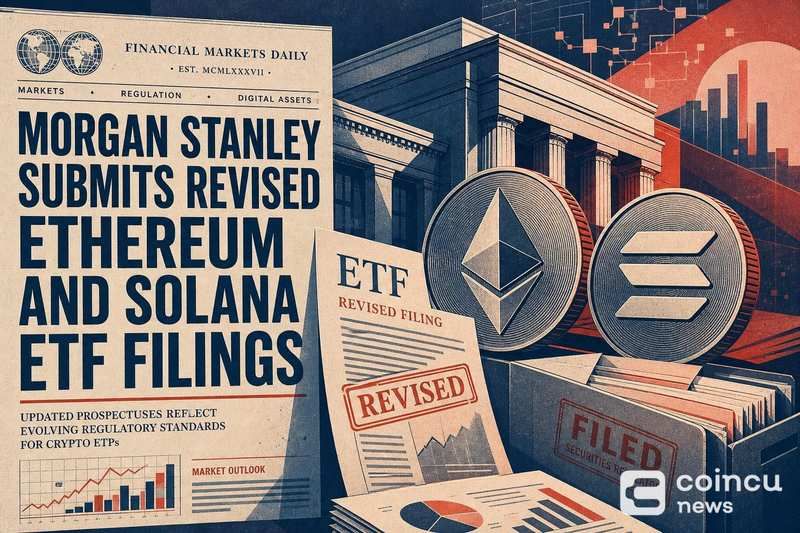
Morgan Stanley has submitted revised filings with the U.S. Securities and Exchange Commission for Ethereum and Solana exchange-traded fund products, underscoring continued institutional interest in bringing altcoin-based investment vehicles to market.
The revised submissions appeared on the SEC’s EDGAR database. The Ethereum-related filing was updated under Morgan Stanley’s name, while a separate Solana-related filing was also amended during the same window.
These are amendments rather than initial applications, suggesting the firm previously submitted draft materials that are now being refined. Revised filings in the ETF approval process typically reflect updates to elements such as product structure, risk disclosures, custody arrangements, or fee schedules.
They can also indicate that the issuer has received informal feedback from SEC staff and is adjusting the application accordingly. The simultaneous update to both products points to coordinated progress rather than isolated changes.
Ethereum and Solana are among the most closely watched altcoin ecosystems for institutional product development. While spot Bitcoin ETFs have already set a precedent in the U.S. market, altcoin ETFs remain earlier in the regulatory pipeline.
Morgan Stanley’s parallel filings reinforce the broader trend of ETF competition expanding beyond Bitcoin. A major Wall Street institution pursuing both ETH and SOL products at the same time adds weight to the view that institutional demand extends across multiple crypto assets.
The filings come amid volatility in broader crypto markets, with major tokens experiencing sharp price swings in recent sessions. Against that short-term uncertainty, the ETF filing activity suggests institutional players are focused on longer-term product timelines.
Revised ETF filings are generally scrutinized on several key areas, including custody solutions for the underlying assets, staking provisions, liquidity requirements, and the adequacy of risk disclosures.
Whether Morgan Stanley’s revisions address any of these specific points was not detailed in the available information.
Market participants often interpret amended filings as evidence of active dialogue between the issuer and SEC staff. However, a revised filing does not guarantee approval or imply that a decision is imminent.
The SEC maintains its own review timeline, and multiple rounds of amendments are common before a final outcome.
Investors tracking the altcoin ETF space may also watch for broader market positioning ahead of regulatory developments, including capital flow signals across exchanges.
Ethereum’s ETF narrative is often viewed as benefiting from greater network maturity and an established presence in regulated derivatives markets. Institutional investors evaluating an ETH ETF can point to years of price history, deeper liquidity, and existing futures contracts.
Solana’s ETF narrative is generally framed as higher-growth but higher-uncertainty. Its rapid adoption in decentralized finance and consumer applications has driven investor interest, but the regulatory framework for SOL-based products is described as less developed than for Ethereum.
Taken together, the two filings support a shared trend: major financial institutions are positioning to offer products across multiple digital assets rather than focusing solely on Bitcoin.
Key indicators include additional amendments from Morgan Stanley, competing filings from other issuers, and any public comments or SEC orders related to altcoin ETF applications.
A revised or amended ETF filing is an updated version of a previously submitted registration statement. It typically reflects changes to product terms, disclosures, or structure, often in response to regulatory feedback.
Not necessarily. Revised filings indicate the application is progressing, but the SEC can require multiple rounds of amendments before making a final decision.
ETFs backed by Ethereum and Solana would provide traditional investors regulated exposure to these assets without requiring direct custody of the tokens. They represent a next phase of crypto ETF development after Bitcoin spot products.
Investors may monitor further amendments from Morgan Stanley, additional filings from competing issuers, and any SEC communications or orders regarding altcoin ETF applications.
Disclaimer: This article is for informational purposes only and does not constitute financial or investment advice. Cryptocurrency and digital asset markets carry significant risk. Always do your own research before making decisions.

Bitcoin (BTC) investors who use steady dollar-cost averaging (DCA) may be underperforming versus strategies that adjust exposure to the market’s cycle, according to new research arguing that Bitcoin’s behavior differs from traditional long-duration assets.
In a report cited by Markus Thielen of 10x Research, Bitcoin’s market…