•
•
•
•
•
•
•
•
•
•
•
•
•
•
•
•
•
•
•
•
•
•
•
•
•
•
•
•
•
•
•
•
•
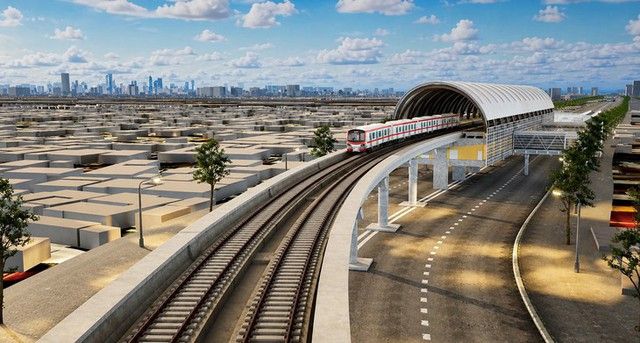
On the morning of June 18, during a meeting with press representatives, Mr. Phan Công Bằng, Head of the Ho Chi Minh City Urban Railway Management Authority (MAUR), provided an update on the progress of rail and metro projects in Ho Chi Minh City.
Under the 2025–2030 plan, Ho Chi Minh City aims to complete six urban railway lines with a total length of about 187 km. By 2035, the city intends to operate 14 lines totaling about 462 km, and by 2045 to complete a network of 19 lines with a total length around 700 km.
Mr. Bằng said that thanks to special mechanisms and an increasingly完善 legal framework, rail and metro projects in Ho Chi Minh City have seen faster procedures, with many lines currently under construction at project sites.
At the same meeting, Mr. Nguyễn Quốc Trung, Deputy General Director of Dai Quang Minh Real Estate Investment Joint Stock Company (a member company of THACO Group), shared information on strategies for domesticizing the rail sector.
According to the investor’s representative, on June 11 THACO signed a cooperation agreement with Hyundai Rotem (Korea) in Hanoi. On July 1, the 320-hectare Rail and diverse mechanical engineering industrial park in Bình Cơ ward will break ground.
The industrial complex is planned to include mechanical plants, an aluminum plant, a TBM hull components plant, and a carriage manufacturing plant. The stated goal is to gradually increase localization, adopt technology, and move toward mastering the capacity to manufacture carriage components to serve domestic rail projects. The unit is also collaborating with international partners to acquire and master TBM tunneling technology, which it described as an important step toward localizing tunneling equipment, reducing dependence on foreign sources, and improving Vietnam’s ability to deploy urban rail projects.
“According to the plan, in April 2027 THACO will manufacture train carriages at this plant, while also receiving technology transfer to localize and fully master TBM tunneling equipment for projects,” Mr. Trung said.
Regarding the Thu Thiem–Long Thành rail project, the feasibility study report is being finalized and is expected to be submitted to the authorities for appraisal on June 20. Related departments are also seeking opinions on route options, as well as technology and technical standards.
Company representatives said that because the route passes through Ho Chi Minh City and Đồng Nai, implementation requires agreement between the two localities. To date, Đồng Nai has basically provided feedback on route options, while parties continue to clarify the connection to Long Thành International Airport.
In a recent meeting, the parties broadly agreed on routing to the airport. The locations of stations will continue to be studied by consulting units, and opinions from the Ministry of Construction will be sought before finalizing the plan.
The investor said that under the original plan, construction was to start on January 1. However, due to legal procedures in both localities and the need for agreement from the People’s Councils and Standing Committees of the localities, the start date has been adjusted. The new start is expected on September 2, or another suitable date to be announced later.
The project is targeted to be completed by December 2030, in line with the Ben Thanh–Thu Thiem and Thu Thiem–Long Thành sections to form a connected network.
Bitcoin (BTC) investors who use steady dollar-cost averaging (DCA) may be underperforming versus strategies that adjust exposure to the market’s cycle, according to new research arguing that Bitcoin’s behavior differs from traditional long-duration assets.
In a report cited by Markus Thielen of 10x Research, Bitcoin’s market…