•
•
•
•
•
•
•
•
•
•
•
•
•
•
•
•
•
•
•
•
•
•
•
•
•
•
•
•
•
•
•
•
•
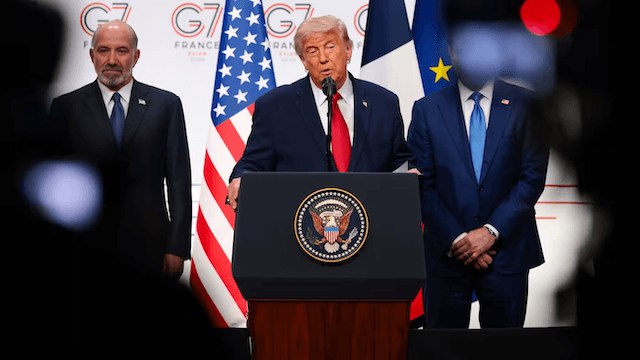
US President Donald Trump said he and Iran have electronically signed a temporary agreement to extend the ceasefire between the two countries. Trump made the remarks after a dinner with French President Emmanuel Macron at the Palace of Versailles on June 17, adding, “I signed it at Versailles.” Earlier that day, Trump said Washington would release blocked Iranian assets and lift sanctions “as soon as they behave properly.”
Trump said the US is holding Iranian funds and warned that failure to return them would undermine confidence in the US dollar. “We are holding their money, that is their money,” he said. “If we do not return that money, no one will invest in the U.S. dollar anymore.”
Pakistani Prime Minister Shehbaz Sharif also confirmed on X that the US and Iran had signed the agreement. “According to the Islamabad memorandum, the agreement takes effect immediately. The first step is Iran to reopen the Hormuz Strait immediately, while the US will lift the naval blockade on Iran,” Sharif said. He added that Pakistan and Qatar would co-host an official signing ceremony in Switzerland on June 19.
The Hormuz Strait, a chokepoint accounting for about 20% of global oil supply, had been nearly closed since the US and Israel launched military operations against Iran in February, contributing to a global energy shock.
Following the agreement, Brent crude fell another 1.2% in Asia trading to $78.62 a barrel.
Under terms disclosed by the United States, Washington will gradually lift all sanctions on Iran, including UN Security Council resolutions, if the two sides reach a final agreement on Iran’s nuclear program. Trump said the US has sanctions “strong enough to prevent their rearmament if necessary.”
Trump also said that if there is no deal, “91 million Iranians will live in poverty.” He added that Iran would be allowed to retain part of its ballistic missile arsenal, saying, “They still need some missiles because others have them too.”
According to terms previously disclosed by the Financial Times, the US will grant waivers allowing Iran to resume oil exports during the extended ceasefire for another 60 days from April 8. Iran would gradually reopen the Hormuz Strait, while the US lifts port sanctions on Iran.
Full release of frozen assets and comprehensive lifting of sanctions would depend on progress in nuclear talks. The 60-day period could be extended if necessary.
The memorandum states that both sides will seek a mutually accepted mechanism to manage Iran’s enriched uranium. Iran currently has more than 9,000 kg of enriched uranium, including about 440 kg at weapons-grade purity.
Under the deal, Iran would dilute this uranium under IAEA safeguards. A senior US official said, “The minimum is that they destroy the current stock of enriched uranium, and this is how to do it.”
The memorandum also proposed a $300 billion reconstruction and economic development fund for Iran, with US and regional partners participating. Trump later downplayed Washington’s role, saying the United States would not invest directly in the fund.
A source familiar with the talks said the fund is mainly intended to support companies seeking to invest in Iran if a final agreement is signed.
In addition, the US pledged to withdraw its forces from the region within 30 days after a final agreement is reached. Another US official said that after nuclear talks are completed, the two sides would continue discussing regional stability and support for Iranian proxy forces. “President Trump will spare no tool to secure a genuinely good deal,” the official emphasized.
The official also said the Switzerland signing ceremony planned for this weekend would be pivotal in determining whether the parties can move to the next round of negotiations.


Ready Card users outside the European Economic Area have reportedly faced an abrupt service halt after a transition involving the card issuer disrupted the USDC spending product, according to user notices shared on X.
A notice shared…