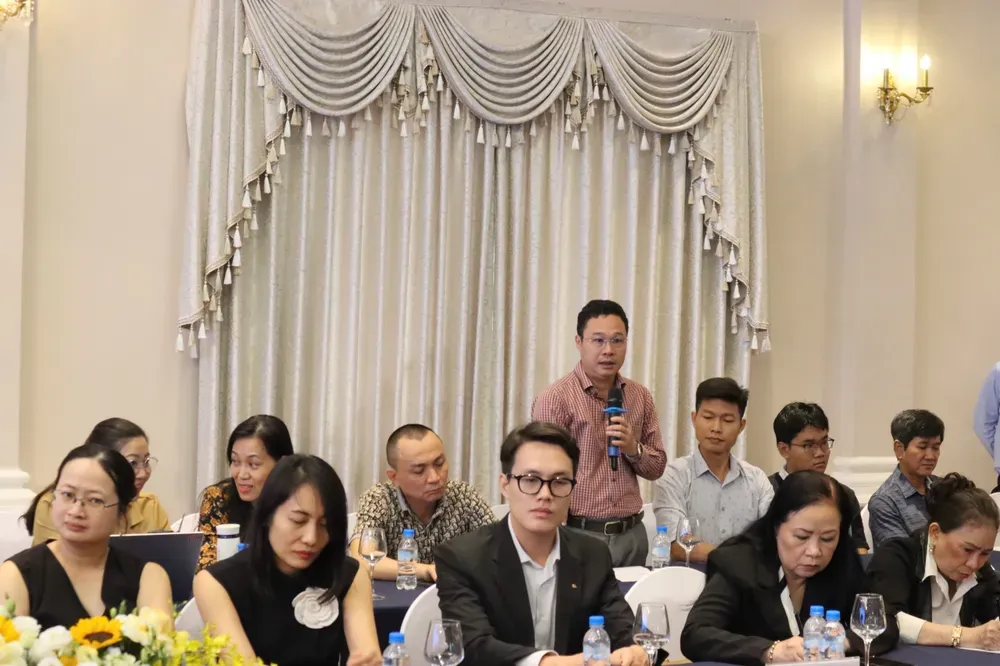
The Ho Chi Minh City Trade and Investment Promotion Center (ITPC), in collaboration with the State Bank of Vietnam (SBV) Region 2 Branch, organized the Ho Chi Minh City Enterprise–Government Dialogue Conference on the banking sector on July 10 to listen to and address enterprises’ difficulties in implementing banking policies.
Ho Chi Minh City prioritizes dialogue with enterprises to promptly identify and resolve difficulties, facilitate stable production and business operations, and enhance competitiveness. While credit institutions have rolled out many measures to help enterprises access capital and favorable interest rates, obstacles remain related to loan conditions, collateral, credit documentation, interest-rate support mechanisms, and regulations related to credit provision.
During the conference, startups and exporters highlighted significant difficulties, such as access to capital and high loan interest rates, despite banks implementing numerous large-scale credit programs.
“Ho Chi Minh City places a premium on dialogue with enterprises to promptly identify and resolve difficulties, facilitate stable production and business operations, and enhance competitiveness,” said Mr. Le Anh Hoang, Deputy Director of ITPC.
Representative of Hasa Bio Foods Joint Stock Company (HCMC) said the company was established in May 2025, links with local organic rice farmers to process products such as vermicelli, pho, and rice paper. About 70% of output is exported, 30% consumed domestically. Revenue in 2025 reached nearly USD 2 million and is expected to double in 2026 as production expands. However, the company faces difficulties in accessing capital due to not meeting the requirement on 'operating history'.
Mr. Nguyen Van Hung, representative of Hasa Bio Foods, stated that banks require financial statements for three years, but Hasa Bio Foods only has 2025 with about half a year of operation. Although the business is profitable and expected to continue growing in 2026, it still has to borrow short-term working capital at relatively high interest rates. “We hope to access preferential credit programs for exporters and green enterprises,” Mr. Hung said.
Mr. Pham Dong Huy, Director of Sa Ke Toan Cau Global Co., Ltd., noted that after 14 years of developing the cassia project, the company has exported to the United States, Japan, Germany, and other markets. However, due to a lack of collateral, the company finds it difficult to access bank loans and thus cannot invest in further machinery and equipment to meet customer demand. Mr. Huy proposed a mechanism to help startup enterprises access capital without collateral but with contracts with partners.
Green lending is expected to be prioritized more heavily. Enterprises investing in energy-saving technologies, using renewable energy, or meeting sustainable development standards will have an advantage in accessing capital. In practice, cash-flow generation, the effectiveness of the business plan, and credibility in the supply chain have become more important criteria than collateral alone.
On regulatory approaches, Ms. Tran Thi Ngoc Lien, Deputy Director of the SBV Region 2, said that to contribute to achieving a two-digit growth target, SBV Region 2 requires credit institutions to proactively approach enterprises, set up advisory points at wards, communes, and special zones, and introduce suitable financial solutions. SBV Region 2 will coordinate with departments, agencies, and localities to implement a rapid feedback mechanism to promptly receive and address enterprises’ difficulties in accessing capital, thereby strengthening bank–enterprise connections and promoting production and business activities in the area.
The banking sector is implementing comprehensive monetary and credit measures to support enterprises in accessing capital. Notably, the 185 trillion-dong forestry and fisheries credit package carries lower interest rates than usual by 1–2 percentage points; the 145 trillion-dong package targets social housing, workers’ housing, and rehabilitation of old apartment buildings; and the 500 trillion-dong package supports infrastructure investment and digital transformation with lower interest rates by 1–1.5 percentage points. These measures accompany Ho Chi Minh City’s own program to aid enterprises in essential goods sectors.
Regarding collateral, banks indicated that collateral remains a lending criterion but is not the sole factor. In supply-chain financing models, a company that supplies to leading groups with solid finances may be granted credit based on the credibility of the upstream company rather than collateral alone. A company with productive capacity, stable output, and transparent cash flow still has a chance to access funds without collateral.