•
•
•
•
•
•
•
•
•
•
•
•
•
•
•
•
•
•
•
•
•
•
•
•
•
•
•
•
•
•
•
•
•
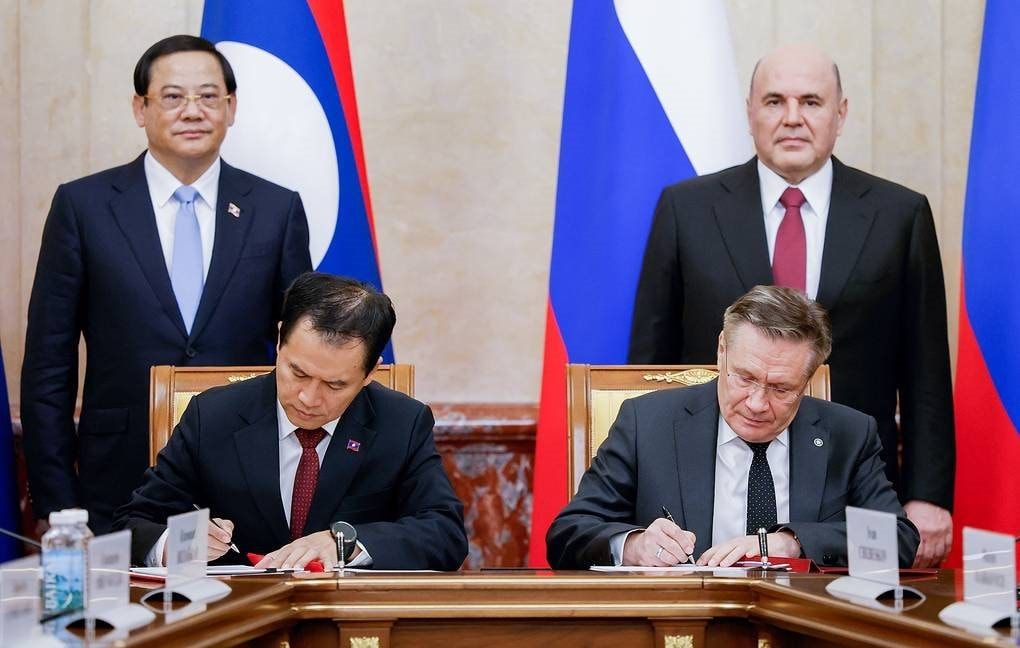
Rosatom will assist Laos in building a nuclear power plant under a framework of peaceful energy cooperation, according to an intergovernmental agreement signed by Rosatom chief executive Alexey Likhachev and Lao Minister of Industry and Commerce Malaithong Kommasith. The agreement was signed under the witness of the prime ministers of both countries.
Rosatom said the intergovernmental agreement is a foundational document to establish comprehensive Russia–Laos cooperation in the nuclear field and will enable the start of a project to build a nuclear power plant designed by Russia in Laos.
In the initial phase, a preliminary feasibility study will be conducted to assess how a future nuclear power plant could be integrated into Laos’s national energy system. The study will also determine the project configuration and potential sites, enabling Laos to make informed decisions regarding its nuclear energy program.
Before Laos, Rosatom signed an agreement on cooperation to build a nuclear power plant on Vietnamese soil. During an official visit to Moscow on March 23, 2026, Vietnamese Prime Minister Pham Minh Chinh and Russian Prime Minister Mikhail Mishustin witnessed the signing of an agreement between the Governments of Vietnam and the Russian Federation on cooperation to build a nuclear power plant in Vietnam.
Under the Vietnam–Russia agreement, the two sides plan to build two nuclear reactor units using the Russian-designed VVER-1200 reactors, with total installed capacity of 2,400 MW. The reference plant selected is Leningrad-2 (Units 1 and 2).
Rosatom said the document provides the legal basis for the project and sets the framework for Vietnam–Russia cooperation in nuclear energy. Rosatom chief executive Alexey Likhachev said the effort is not only about constructing two units, but also about establishing a long-term partnership to support Vietnam’s energy autonomy and create new avenues for growth.
In addition, the Ninh Thuan 1 nuclear power plant in Vietnam will use VVER-1200 technology. Rosatom described the reactor as among the most modern, powerful, safe and environmentally friendly. As of now, such reactors operate in four countries: Russia (two), China (two), Bangladesh (one) and Belarus (one).
Rosatom said it is not new to Vietnam, noting long-standing collaboration in energy, energy storage, logistics, container transport, and technology. In the nuclear energy field, Rosatom said the two sides continue to cooperate on the CNST project and operate the Dalat Research Reactor, using Russian fuel to produce and supply radioisotopes for medical use in Vietnam.
Bitcoin (BTC) investors who use steady dollar-cost averaging (DCA) may be underperforming versus strategies that adjust exposure to the market’s cycle, according to new research arguing that Bitcoin’s behavior differs from traditional long-duration assets.
In a report cited by Markus Thielen of 10x Research, Bitcoin’s market…