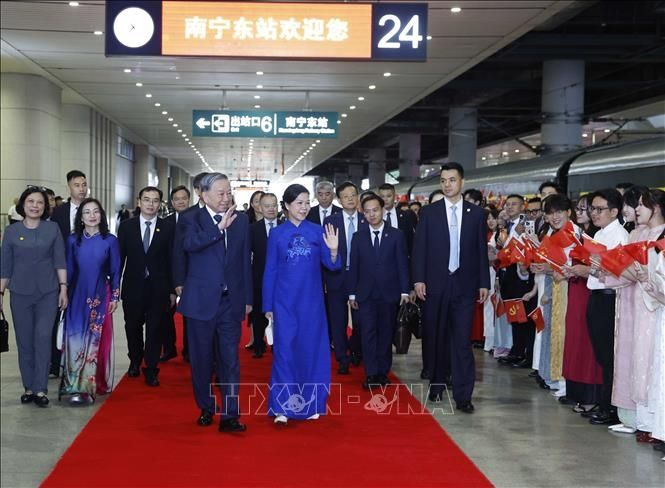
On April 17, 2026, Vietnam’s General Secretary and President To Lam and his wife, together with a high-level Vietnamese delegation, departed Nam Ninh in Guangxi, ending a state visit to China that ran from April 14 to 17, 2026, at the invitation of Chinese General Secretary and President Xi Jinping and his wife.
During the visit, To Lam held talks with Xi Jinping; met senior Chinese leaders; witnessed the signing of several key cooperation documents; delivered a policy address at Tsinghua University; and visited the Hung An New Area and the China–ASEAN AI Cooperation Center.
The two sides conducted broad and comprehensive exchanges on each country’s situation, on the relations between the two parties and two countries, and on regional and international issues of mutual interest. They affirmed positive progress in political, security–defense, economic–trade, investment, infrastructure connectivity, and people-to-people exchanges, emphasising the need to strengthen strategic trust, policy coordination, and to deepen Vietnam–China cooperation in a complex international context.
They also agreed to continue implementing the goal of deeper cooperation, maintain high-level exchanges, broaden substantive cooperation, address existing issues and differences, and officially launch the Vietnam–China Tourism Year 2026–2027.
In addition, the two sides signed multiple cooperation documents in key areas and issued a Vietnam–China joint declaration to deepen the comprehensive strategic partnership and to advance the construction of a shared future for Vietnam and China with higher strategic significance in the new era.
The state visit was described as successful, contributing to the consolidation of traditional friendship, enhanced political trust, and strengthened bilateral cooperation for stable and sustainable development.