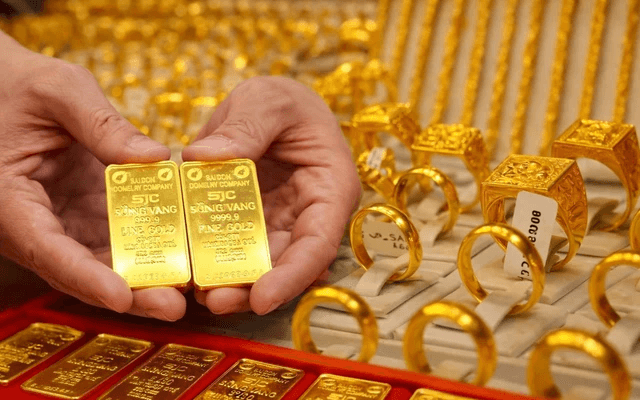
Gold prices in Vietnam continued to ease after a peak on April 15, with the decline amounting to about 3.5–5 million dong per tael. By the end of April 16, gold had retreated to around 171 million dong per tael.
At SJC, the price of gold bars was quoted at 167.7–171.2 million dong per tael, down 2.3 million dong per tael from the previous day and down 4.3 million per tael from the April 15 peak. Jewelry prices fell to 167.2–170.7 million dong per tael.
At DOJI, bullion and jewelry prices also declined to 167.7–171.2 million dong per tael.
On the international market at the same time, spot gold was at 4,816 USD per ounce.
In the afternoon of May 16, domestic gold prices continued to drop. SJC bullion was commonly quoted at 168.5–172.0 million dong per tael, down 0.5 million dong per tael from the late-morning level and down 3.5 million per tael from the previous day.
Jewelry prices varied among firms, with reductions around 2.5–3 million dong per tael. Bao Tin Manh Hai quoted 168.0–170.8 million per tael; DOJI listed 168.5–171.8; and Bao Tin Minh Chau quoted 168.0–171.3.
At 10:00, domestic gold prices fell across the board. Although the world price remained above 4,800 USD per ounce, it eased by about 20 USD to 4,820 USD per ounce.
At SJC, bullion fell by 1.5 million dong per tael on the buy side and by 1 million per tael on the sell side to 168.5–172.5 million dong per tael. Jewelry prices were adjusted similarly to 168.2–172.2. BTMC also adjusted both bullion and jewelry by 1.5 million dong per tael, leaving bullion at 168.5–172.5 and rings at 168.5–171.8.
Earlier on the morning of April 16, SJC and other major firms quoted bullion at 170.0–173.5 million dong per tael. DOJI and Bao Tin Minh Chau quoted bullion at 169.8–172.8; for rings, 169.8–172.8. BTMC quoted bullion at 170.0–173.0, while SJC quoted 169.7–173.2. Internationally, spot gold remained above 4,800 USD per ounce.
Kitco News reported that expectations of a long-term peace deal in the Middle East are helping stabilize markets. The USD is losing its safe-haven appeal, and reduced volatility supports stocks. However, the gold market has not benefited from the improved sentiment and remains challenged to hold above 4,800 USD per ounce.
In an interview with Kitco News, Michael Brown, senior market analyst at Pepperstone, said 4,800 USD/ounce is the first barrier gold must clear to reinforce investor confidence in an upside move. Brown added that even as the market looks toward a potential peace deal, gold investors remain cautious and need to digest speculative factors that pushed prices to record highs in January.
He said gold continues to face difficulties even as the USD trades around 98 points, near a new low since late February, and that gold is trading more like a high-beta risk asset than a safe-haven. Brown noted that the outlook depends on whether the Middle East conflict cools; if it does, he expects gold to remain supported and the near-term trend to stay upward.
Looking ahead, Brown said gold could regain appeal if attention shifts from the current crisis to assessing the damage. He also pointed to differences across regions: the US economy is in better shape to withstand the shock due to a healthy consumer base and ongoing wealth effects from Wall Street, while Europe and the UK—more reliant on energy imports—remain more vulnerable.
Brown further said central banks face greater policy risks as inflation persists, and the market may react either positively to tighter policy through higher currency and yield gains, or negatively if higher rates constrain activity. He also referenced earlier commentary that gold could perform positively if investors seek hedges against slower growth.