•
•
•
•
•
•
•
•
•
•
•
•
•
•
•
•
•
•
•
•
•
•
•
•
•
•
•
•
•
•
•
•
•


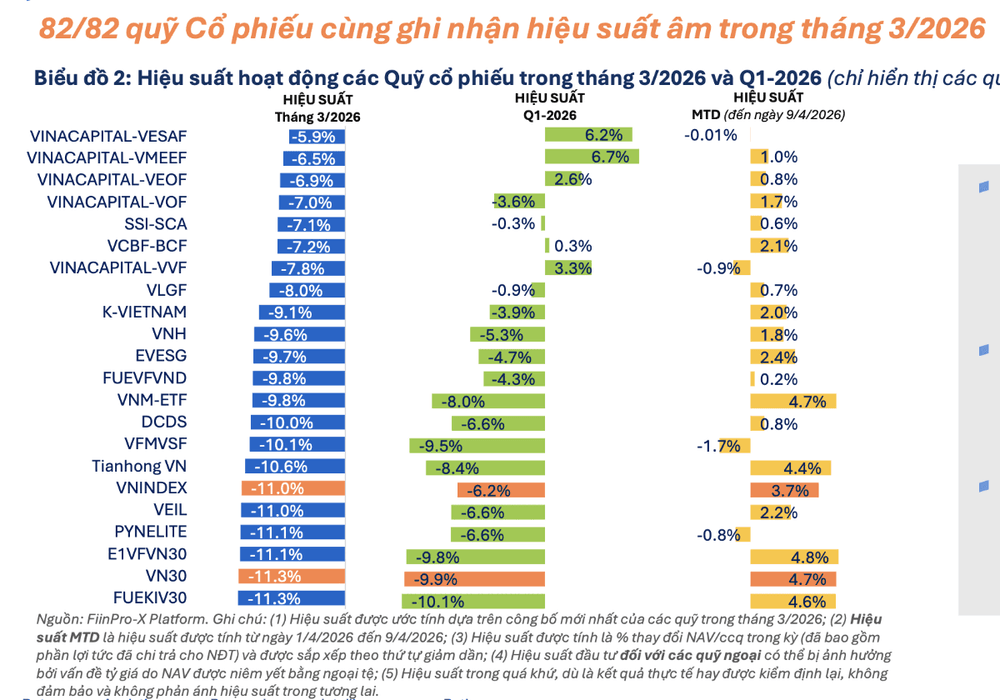
Broad declines swept across Vietnam’s fund market in March, with all 82 equity funds recording negative returns as the VN-Index dropped 10.95% month-on-month. Performance also remained weak for both stock and bond funds during March and across the first quarter of 2026.
In March 2026, 82 of 82 stock funds posted negative returns. For bond funds, 12 of 13 reported returns that were lower than in February 2026.
FiinTrade data showed equity funds averaged -9% in March, down from a +1.7% gain in February 2026—described as the weakest performance since October 2022.
The broad-based decline reflected market-wide adjustments, with losers outnumbering gainers (320 out of 404 stocks declined) as selling pressure broadened and liquidity weakened.
Unlike February’s rebound, the March decline was concentrated in foreign ETFs and VN30-tracking ETFs, which fell by more than 10% in most cases due to large holdings in VIC, VCB, and SSI.
For Q1 2026, equity funds posted an average return of -4.3%, deeper than -0.7% in the same period of 2025. This came as the VN-Index fell 6.2% in Q1 2026 versus a 3.2% rise in Q1 2025.
Despite the overall weakness, 52 of 82 equity funds fell less than the VN-Index, mainly among open-end and closed-end funds.
Open-end funds managed by VinaCapital maintained positive performance in Q1 2026, supported by holdings in BVH and REE since the start of the year.
In March 2026, 12 of 13 bond funds recorded lower returns than in February 2026, including large funds such as Techcom Bond Fund (TCBF), DC Bond Fund (DCBF), and DC Income Fund (DCIP).
Lighthouse Bond Fund (LHBF) led with a +0.7% return, the best since November 2025, after the fund recognized income from selling NAB shares. An Bình Bond Fund (ABBF) followed with steady performance around 0.5%–0.6% in recent months, though net outflows continued even as the outflow magnitude narrowed.
Across Q1 2026, bond funds remained relatively stable, averaging about 1.5%, compared with 1.3% in the same period.
However, the attractiveness of bond funds weakened as deposit rates rose again. While still positive, the yield premium versus bank deposits narrowed significantly: the average 12-month term deposit rate at state-owned banks increased to 4.9% per year (about 0.48% per month) in March 2026 from 4.2% per year (about 0.42% per month) in February.
With deposits yielding around 1.4% in Q1 2026, the yield premium of most bond funds was no longer sufficient to offset costs and risks, helping explain continued net outflows despite relatively stable performance.
In March 2026, 11 of 12 balanced funds posted negative performance, concentrated in funds with high equity exposure such as ENF (66.4%) and VCAMBF (59.1%), both affected by the stock market adjustment (VN-Index -10.95% in March).
The Techcom Balanced Fund (TCFF) was the only balanced fund to post a positive return in March 2026, at +0.1%. However, net cash outflows continued for the third consecutive quarter, totaling more than VND 18.3 billion in Q1 2026, despite leading the balanced category (+7.2% in Q1 2026).
Net outflows intensified in March 2026, totaling more than VND 5.4 trillion, up 59% versus February 2026. Net flows remained primarily concentrated in the equity funds group (64%), with emphasis on ETF funds.
In the bond funds group, cash outflows were recorded for the seventh consecutive month, with the outflow value rising 78% versus the prior month.
For Q1 2026, total net outflows exceeded VND 14.4 trillion, up more than 2.6 times year-on-year and marking the fifth consecutive quarter of net outflows in negative territory. The scale was significantly higher than Q4/2025 (+48%) and accounted for about 41.7% of total net outflows in 2025, indicating that the capital withdrawal trend is accelerating rather than cooling.
The outflows were concentrated mainly in stock funds, with major contributions from closed-end funds and ETF funds.






Premium gym chains are entering a “golden era” that is ending or already in decline, as rising operating costs collide with shifting consumer preferences toward more flexible, community-based ways to exercise. Long-term memberships are shrinking, margins are pressured by higher rents and facility expenses, and competition from smaller, more personalized…




