•
•
•
•
•
•
•
•
•
•
•
•
•
•
•
•
•
•
•
•
•
•
•
•
•
•
•
•
•
•
•
•
•
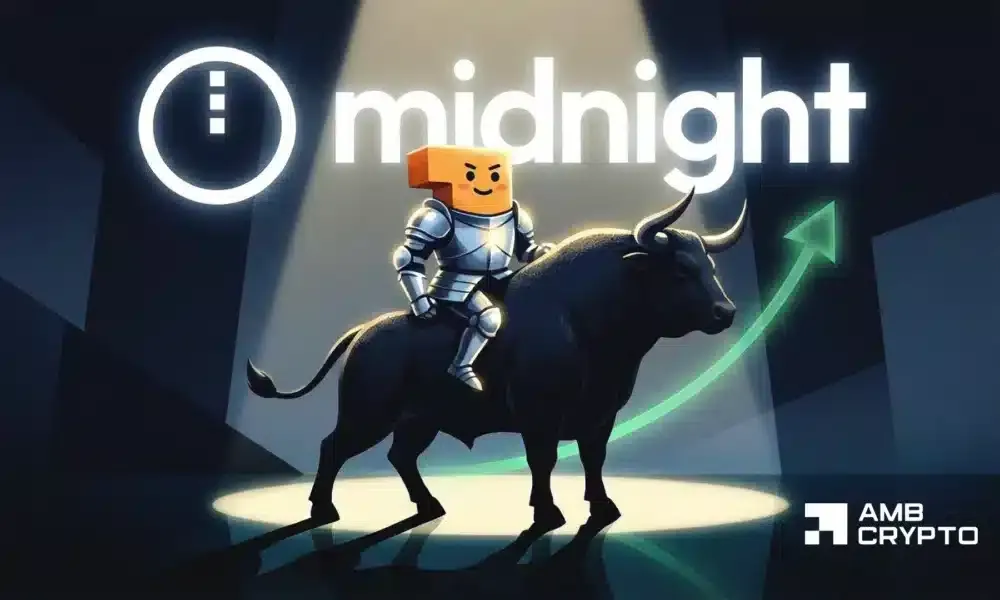
Midnight [NIGHT], the privacy-focused Cardano [ADA] sidechain, is scheduled to go live in the final week of March. Ahead of that update, the utility token NIGHT posted strong gains recently.
According to CoinMarketCap, NIGHT was up 8.78% over 24 hours and up 23.78% over a week at press time. AMBCrypto also reported that a former resistance level at $0.5 has been flipped to support.
A closer look at the price charts shows that $0.056 to $0.060 is a key area for NIGHT bulls. After reclaiming this range, the question is whether buyers can push the token toward $0.10 and beyond.

On the 6-hour timeframe, the internal structure was bullish since NIGHT pushed above $0.05 on Friday, 06 February. Since then, the price has formed higher highs and higher lows.
However, momentum on the higher timeframe was not strongly bullish. The deep retracement to a local low at $0.04 highlighted seller strength during the recovery process.
The CMF returned to +0.01 after rising to +0.23 on 18 February, suggesting buying pressure may not be sustained and could limit further upside. The DMI indicated that a strong uptrend was in progress, aligning with the bullish internal structure.
Bitcoin [BTC] has been oscillating between $65,000 and $71,000 over the past two weeks. If BTC moves higher, it could renew enthusiasm among altcoins, including NIGHT. Until then, swing traders were advised to stay cautious.

The 1-month liquidation heatmap showed NIGHT tagging a significant cluster of short liquidations at $0.063 to $0.065. The lack of clear, sustained demand, along with early candlestick signs of buyer exhaustion in that zone, was described as a concern.
The article suggested that a sweep of the magnetic zone at $0.065 could be followed by a move down toward the $0.054 area. Traders were cautioned against going long early.
Disclaimer: The information presented does not constitute financial, investment, trading, or other types of advice and is solely the writer’s opinion.