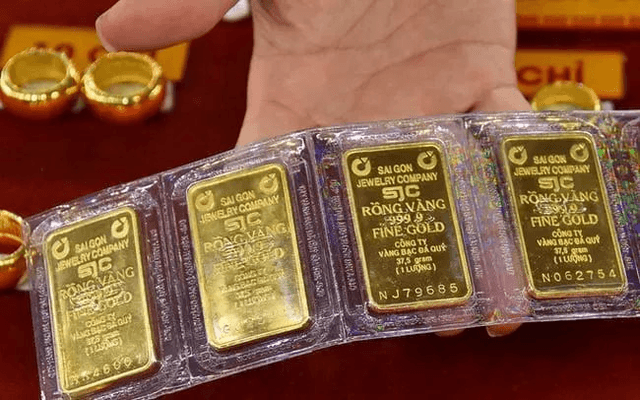
Gold prices in Vietnam rose across major brands in the afternoon of April 14. By that time, SJC gold was quoted at 170.5–173.0 million VND per tael at firms including DOJI and PNJ. Bao Tin Minh Chau reported buying at 170.0 million VND per tael and selling at 173.0 million VND per tael.
For bullion coins, price differences across brands remained small. DOJI listed bullion coins at 170.0–173.0 million VND per tael, while PNJ and Bao Tin Minh Chau quoted 169.7–172.7 million VND per tael. SJC traded at 170.2–172.7 million VND per tael.
Earlier in the morning of April 14, SJC gold prices from major brands were quoted at 168.5–171.5 million VND per tael. Plain gold ring prices also increased to 168.5–171.5 million VND per tael at many firms, while SJC and PNJ quoted 168.2–171.2 million VND per tael.
On April 13, domestic gold prices had fallen by about 700–900 thousand VND per tael.
Internationally, spot gold was at $4,754 per ounce, equivalent to about 151 million VND per tael based on the current USD exchange rate used in the report.
Robin Brooks, senior fellow at the Brookings Institution and former IIF Chief Economist and FX strategist at Goldman Sachs, said gold is currently showing characteristics of a high-beta asset—one that amplifies sell-offs rather than hedging. He pointed out that over the past six weeks, gold has not behaved like a traditional safe haven.
“Traditionally, gold is a safe-haven asset where investors hide when other assets fall. But that has not held in the six weeks. Gold has fallen about 10%, while the S&P 500 has fallen less than 1%. A high-beta asset cannot be considered a hedge if it falls more than equities in a negative shock. Then it becomes the opposite.”
Brooks offered two hypotheses. First, he said central banks in emerging markets may have sold gold during the shock, noting this was only evidenced in Turkey, where reserves fell 128 tonnes to defend the lira. Second, he said the recent rise in gold as a hedge against currency depreciation may have attracted new investors who are more sensitive to volatility and withdraw during turbulent periods.
He concluded that gold’s safe-haven role may not be permanently gone, but temporarily distorted, suggesting that once this investor cohort exits, gold could return to its traditional behavior.