•
•
•
•
•
•
•
•
•
•
•
•
•
•
•
•
•
•
•
•
•
•
•
•
•
•
•
•
•
•
•
•
•
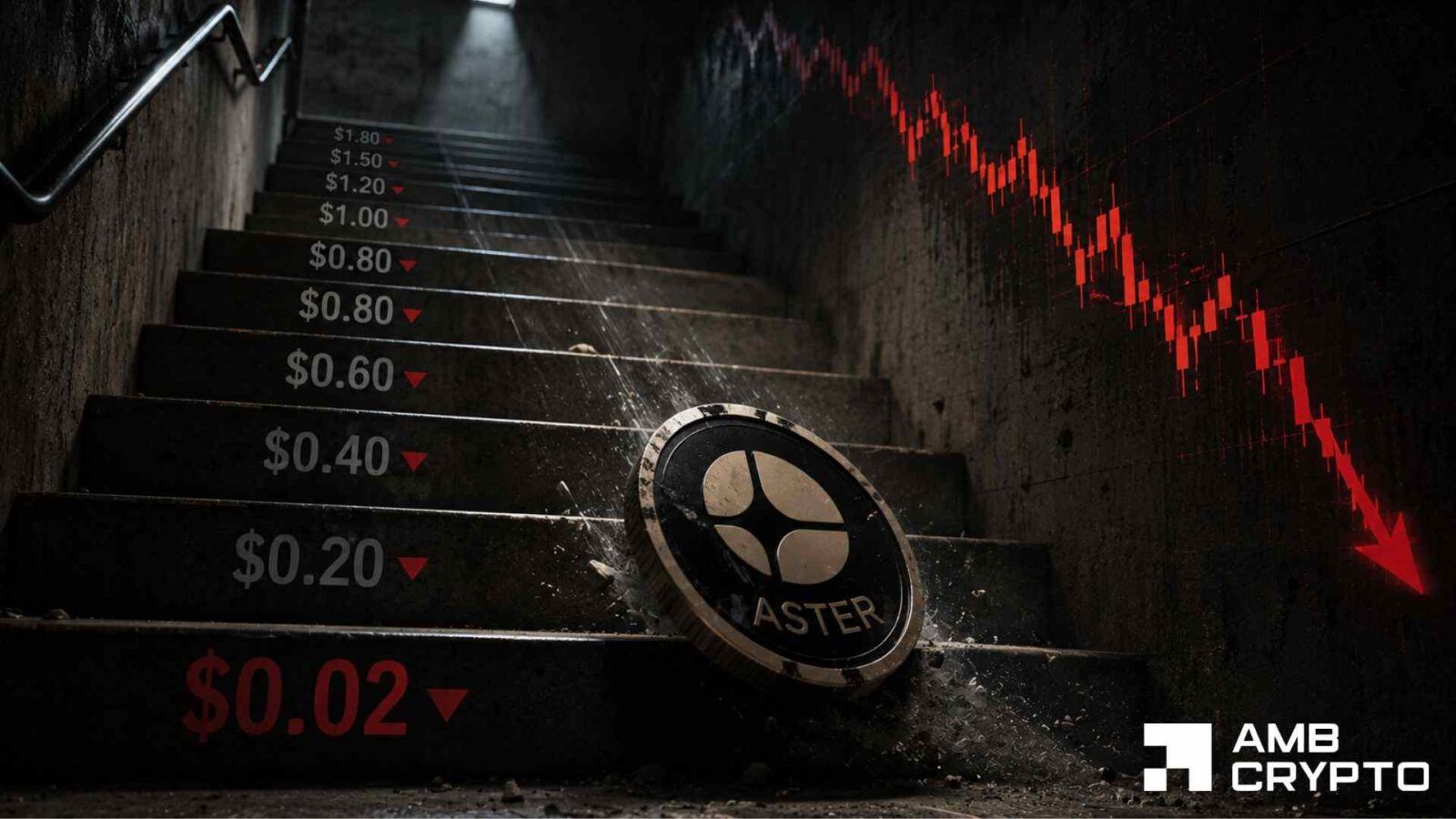
Binance Labs-backed Aster (ASTER) has erased its weekly gains as the broader crypto market pulled back. After the token surged 28%—rising from $0.63 to above $0.82—its momentum weakened following the tokenomics update and a broader 2026 market correction.
The latest tokenomics revamp directs 99% of Aster revenue toward token buybacks, modeled on a similar approach used by Hyperliquid. The update is designed to support a burn of 5 billion ASTER tokens.
On the 12-hour charts, ASTER’s momentum is bearish, indicating that short-sellers still hold market dominance. After falling 24% from its recent levels, the token is approaching its June support area around $0.60.
If the broader correction extends, an additional drop toward $0.55 is possible. In the near term, $0.55 and $0.60 are positioned as key support levels.
Should a relief rally develop, the immediate upside target highlighted is the 200-day moving average (200-day MA) at $0.70. That level would represent roughly 16% upside, particularly if the 5B ASTER token burn program begins.
Aster has leaned further into tokenization, a narrative that could be supportive for underlying tokens over the long term. However, a broader “altcoin season” may remain difficult for some assets.
One commonly used gauge for altcoin momentum is the ETH/BTC ratio, which tracks Ethereum’s relative performance versus Bitcoin. After rallying between Q2 and Q3 2025, the ETH/BTC ratio has been in a downtrend—typically a sign that BTC is retaining market focus.
Even so, ASTER has outperformed BTC over the past 30 days. Over that period, BTC fell about 18%, while ASTER declined about 9%. Other altcoins cited as having stronger recent performance include Hyperliquid and Worldcoin, both showing double- and triple-digit gains.
Final Summary: ASTER reversed its 28% weekly gains amid a crypto market sell-off. The tokenomics revamp—centered on revenue buybacks and a 5 billion token burn target—could be a key bullish catalyst in the medium term, though near-term direction remains constrained by current market sentiment.

Bitcoin (BTC) investors who use steady dollar-cost averaging (DCA) may be underperforming versus strategies that adjust exposure to the market’s cycle, according to new research arguing that Bitcoin’s behavior differs from traditional long-duration assets.
In a report cited by Markus Thielen of 10x Research, Bitcoin’s market…