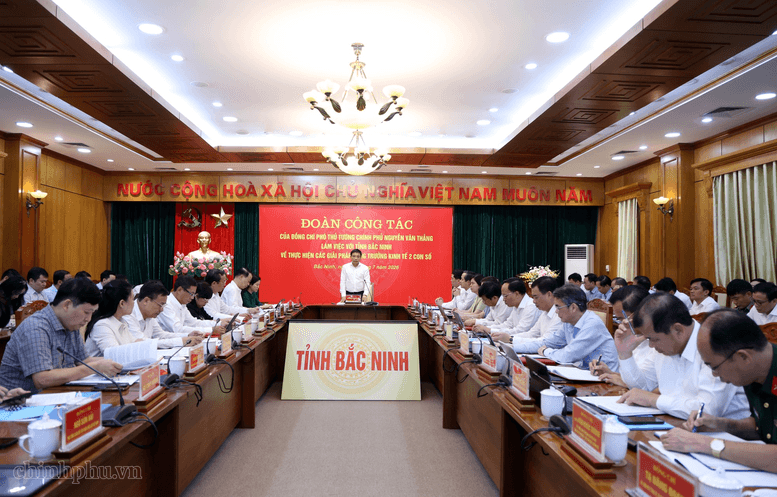
At a government briefing in Bắc Ninh on July 9, 2026, Deputy Prime Minister Nguyễn Văn Thắng announced that the province should shift from a large-scale production and assembly base to a high-tech industrial center capable of deeper involvement in high-value-added stages of the global value chain.
The move signals a shift from relying on broad-based manufacturing to building a knowledge-based economy focused on high-value-added production, advanced manufacturing, research and development, and digitalization, with an aim to participate more deeply in the global value chain.
Progress on the Gia Bình International Airport project includes completed land clearance as of June 19, 2026 and handover to the investor for construction. The social housing program encompasses 133 projects totaling more than 152,000 units, with roughly 32,000 units already completed.
Authorities aim to accelerate administrative approvals for the city’s direct provincial status and the urbanization criteria, fast-track road and airport infrastructure projects (including Vành đai 5 and other beltways), and raise disbursement rates for capital projects.
The province posted robust early-year growth: in the first half of 2026, Bắc Ninh’s GRDP grew by 10.56%, with 9.88% in Q1 and about 11.14% in Q2, ranking sixth nationwide among localities achieving double-digit growth. The import-export value reached about 106.4 billion USD, and it attracted over 9.86 billion USD of approved or adjusted investment, with FDI ranking fourth nationwide. State budget revenue reached 53,133 billion VND, and disbursement exceeded 6.3 trillion VND, about 32.63% of the plan.
To hit the GRDP target of 12.5% or higher for 2026, the province must sustain strong growth into Q3 and the second half of the year, aiming for quarterly gains around 13.35% and six-month growth of 14.3%. The government emphasizes leveraging Gia Bình Airport’s potential to attract high-tech and space-economy activities, promoting advanced manufacturing, research and development, and domestic supplier development to reduce dependence on foreign direct investment. There is also emphasis on strengthening power supply, expanding logistics, promoting e-commerce, and improving the investment climate for local enterprises, including housing for rent for workers in industrial zones.
While Bắc Ninh has posted impressive early-year growth, authorities warn of risks such as reliance on FDI, import surges, and the need to boost domestic value-added and local supply chains. They urge continued reform, faster project implementation, and a shift toward high-value-added production and a knowledge-based economy built on digitalization, green development, and strong local entrepreneurship.