The Ministry of Home Affairs is studying the establishment of a commune-level urban core as a special administrative unit at the commune level to serve as a nucleus for coordinating development, connecting infrastructure, and delivering public services.
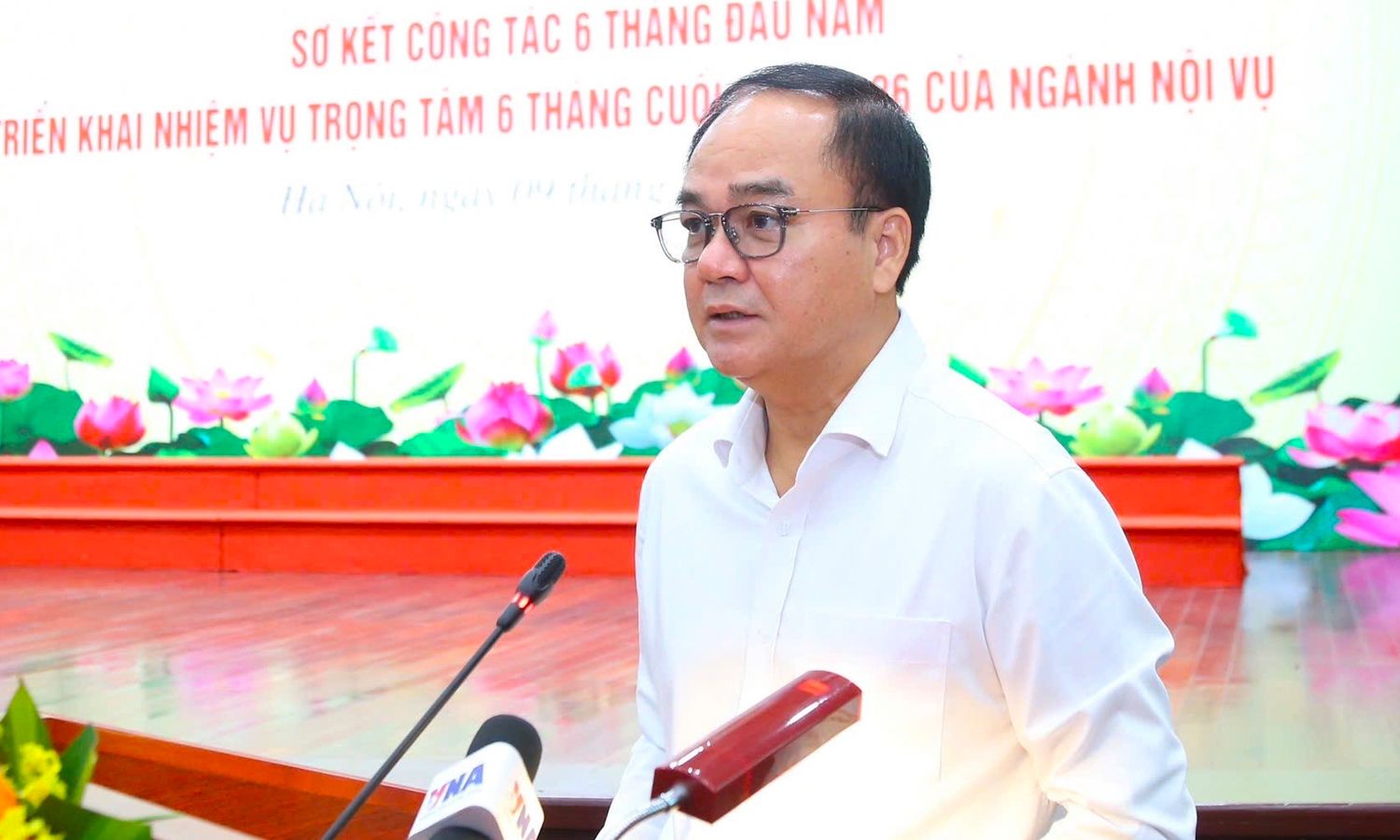
This forms one of the ministry’s key priorities for the near term, highlighted at the mid-year review of the ministry’s work and the implementation of tasks for the second half of 2026, on the morning of July 9. Deputy Minister Vu Chiến Thắng stated that in the second half of the year the Ministry will promptly consolidate difficulties and bottlenecks, and propose remedies to ensure the local government apparatus operates stably, smoothly, and effectively. The Ministry will guide and resolve issues related to regimes and policies for those who perform non-professional duties.
“Focus on completing the database on administrative units, administrative boundaries, and local government organization. Continue reorganizing commune-level administrative units that do not meet standards, and establish urban administrative units, especially special-category commune-level urban areas that act as nuclei to drive development, creating a breakthrough model and leading according to the direction of the Central Committee and the Politburo,” the ministry’s report states. The Ministry will also propose to the Government a Resolution on the natural area of 34 provinces and cities.
The Ministry will prioritize fundamental and comprehensive reform of personnel, treating personnel evaluation as a key breakthrough. It will build a cadre of officers, civil servants, and public workers with strategic thinking, modern governance, organizational and execution capacity, and the ability to handle new, difficult, and complex issues arising from practice; with a spirit of daring to think, to act, and to take responsibility for the common good.
Recruitment, assignment, and appointment of cadres must ensure the right person, the right job, the right capability, the right specialty, and the right authority. The Ministry is determined to overcome the practice of leveling in cadre assessment; timely removal of cadres who dodge responsibility; not recognizing, protecting, or using cadres who dare to think, act, and take responsibility, and who produce credible outputs. In particular, the policy of “in, out” and “up, down” must be implemented seriously and substantively; it will promptly remove from office or replace cadres with limited capabilities or low credibility, through quarterly and annual cadre evaluations. Emphasis will be placed on identifying, training, nurturing, assigning, and utilizing capable, proactive, decisive cadres, including young cadres, female cadres, cadres from ethnic minority groups, and science/technical cadres.
The Ministry will prioritize building a strategic cadre corps and grassroots cadres. Strategic cadres must have vision, intellect, resolve, systemic thinking, and the capacity to plan and handle large, new, difficult, and complex issues; grassroots cadres must be close to the people, understand the people, and possess negotiation, dialogue, and problem-solving skills to serve the people.
The ministry says, study mechanisms and policies to promote inter-agency mobility within and outside the state sector; have policies to attract, use, and deploy talents, especially in strategic fields. There must be new thinking and new vision for internal political protection that is tight, proactive, objective, and comprehensive.
Another important task highlighted by Deputy Minister Vu Chiến Thắng is to focus on researching and proposing a resolution to replace Resolution No. 27 on wage reforms and Resolution No. 28 on social insurance reform for submission to the Politburo, as required. Alongside this, the agency will advise on policies to reform social insurance to ensure social safety nets, stabilize workers’ lives, and contribute to a more coherent and sustainable social policy system.
The ministry aims for a stable, smooth, and effective local government apparatus; the establishment of urban cores as nuclei for development; and a more coherent and sustainable social policy system through social insurance and wage policy reforms.
“There must be new thinking and new vision for internal political protection that is tight, proactive, objective, and comprehensive.”
The ministry also stresses building capable cadres, improving personnel evaluation, and advancing reforms to ensure effective delivery of public services and governance at the commune level.