•
•
•
•
•
•
•
•
•
•
•
•
•
•
•
•
•
•
•
•
•
•
•
•
•
•
•
•
•
•
•
•
•


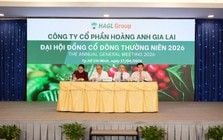
At the 2026 annual general meeting of Hoang Anh Gia Lai Joint Stock Company (HAGL, ticker HAG) on April 17, Chairman Bau Duc addressed shareholders’ questions on production activities, funding plans and business performance, including the company’s 20,000-hectare coffee project.
Regarding financing for the 20,000-hectare coffee project, Bau Duc said the project will be implemented through 2028. He noted that, in addition to coffee cultivation, HAGL also needs investment in a wet processing plant, a coffee extract plant and a decaffeination plant.
The total capital required for these components is estimated at 14,000–15,000 billion VND.
Bau Duc said the company will draw on three main funding sources: profits; proceeds from an initial public offering of the subsidiary Hoang Anh Gia Lai International Investment JSC (HGI); and raising capital from the parent company through bonds or borrowings. He added that the general principle is not to borrow more than 50% of equity.
On land readiness, Bau Duc stated that 85% of the project area has been prepared in Laos (Bolaven Plateau), at elevations above 1,200 meters, which is suitable for Arabica coffee.
For 2026, HAGL targets revenue of 8,624 billion VND and after-tax profit of 4,202 billion VND.
On the expected profit increase, Bau Duc said only about 50% of profit comes from operating activities, with the remainder attributed to financial activities.
Specifically, HAGL records an interest expense recovery of about 1,600 billion VND after repaying debt to a debt-trading company. The rest of the financial contribution is expected to come from divesting stakes in subsidiaries.
More than 2,000 billion VND of 2026 profit is expected from production activities, including bananas, durians, silkworm cocoons and pigs.
For bananas, Bau Duc said cash flow is strong but labor intensity is high. With 7,000 hectares of bananas, the company employs about 10,000 workers. He said labor-dependent crops pose long-term business risk.
Bau Duc described coffee farming as less exposed to market risk, citing trading platforms in London and New York. He added that coffee requires significant labor mainly during harvest.
Bau Duc also increased his HAG stake. On April 17, he announced the purchase of an additional 4 million HAG shares, after previously reporting the purchase of 4 million shares.
He currently owns about 314 million HAG shares, equivalent to 24.77% of outstanding capital (excluding the newly registered 4 million shares). At the annual general meeting, Bau Duc said he would continue buying HAG shares in multiple transactions because his ownership stake remains relatively low, at times above 34%.




Premium gym chains are entering a “golden era” that is ending or already in decline, as rising operating costs collide with shifting consumer preferences toward more flexible, community-based ways to exercise. Long-term memberships are shrinking, margins are pressured by higher rents and facility expenses, and competition from smaller, more personalized…