•
•
•
•
•
•
•
•
•
•
•
•
•
•
•
•
•
•
•
•
•
•
•
•
•
•
•
•
•
•
•
•
•



Bitcoin saw sharp volatility this week as developments around the Middle East—particularly the Strait of Hormuz—drove rapid shifts in market sentiment. Price swings accelerated as the situation around the waterway changed quickly, with trading later reflecting both a risk-on impulse and a subsequent reversal.
After a chaotic morning in the Strait of Hormuz, both sides reportedly went quiet. Iran closed the Strait of Hormuz again, while President Trump said he would not be “blackmailed” by Iran.
On Friday, Iran’s foreign minister said the Strait of Hormuz would be accessible to commercial vessels throughout the duration of a ceasefire agreement. President Donald Trump corroborated the announcement, stating Iran committed to an “unlimited” halt of its nuclear activities.
The cryptocurrency market reacted quickly, pushing Bitcoin above the $78,000 threshold. Energy markets moved in the opposite direction, with Brent crude falling nearly 10% to about $85 per barrel.
The move above $78,000 helped trigger one of 2026’s largest short squeezes. CoinGlass analytics reported $762 million in aggregate liquidations across 168,336 traders. Short positions accounted for $593 million of those liquidations, including $381 million in bitcoin shorts.
CoinGlass also noted that bitcoin perpetual contract funding rates had been negative for several weeks, indicating short sellers were paying longs to maintain bearish positions. The Hormuz announcement acted as the catalyst that reversed that dynamic.
Alongside the price action, spot Bitcoin ETFs recorded their strongest week since January. SoSoValue data showed $996 million in net inflows over the week.
Friday delivered the largest single-day inflow, with $663.9 million entering the funds. Combined net assets across all spot Bitcoin ETFs surpassed $101 billion, while daily trading volumes approached $4.8 billion.
Ethereum-focused ETFs also saw inflows, adding nearly $276 million over the week, according to Farside Investors data.
Morgan Stanley’s newly launched Bitcoin Trust contributed to the trend, accumulating $120 million in assets within six trading days, surpassing WisdomTree over the same brief period.
Less than 24 hours after the Hormuz reopening announcement, Iranian authorities reversed their position. Nour state news reported the strait returned to “strict management and control by the armed forces,” attributing the change to a U.S. blockade targeting Iranian ports.
Multiple tanker operators told Bloomberg that they received Iranian radio communications instructing them to halt passage. One supertanker captain reported hearing gunfire and then reversing direction.
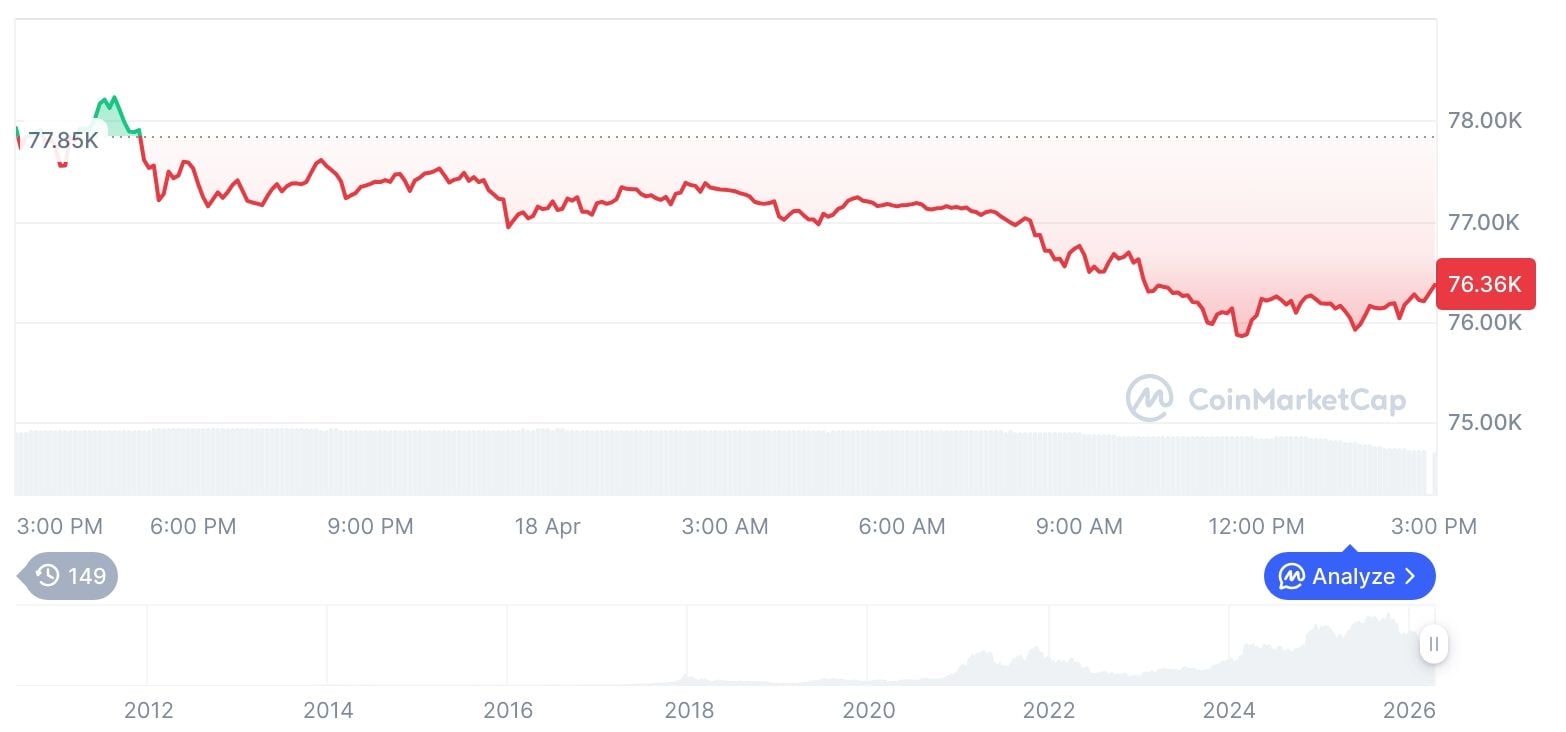
By Saturday evening in Asian trading hours, Bitcoin fell to $76,091, holding a 0.8% daily increase. Ethereum dropped 3% to around $2,365, Solana slipped 1.3%, and Dogecoin fell 2.1%.
On a weekly basis, XRP led among major cryptocurrencies with a 6.4% gain. BNB rose 4.6%, Ether increased 5.2%, and Bitcoin maintained a 4.7% weekly increase despite the weekend pullback.
Bitunix analysts said Bitcoin remains within a defined range, citing resistance above $75,000 and support near $72,000 in their latest assessment.






Premium gym chains are entering a “golden era” that is ending or already in decline, as rising operating costs collide with shifting consumer preferences toward more flexible, community-based ways to exercise. Long-term memberships are shrinking, margins are pressured by higher rents and facility expenses, and competition from smaller, more personalized…