•
•
•
•
•
•
•
•
•
•
•
•
•
•
•
•
•
•
•
•
•
•
•
•
•
•
•
•
•
•
•
•
•
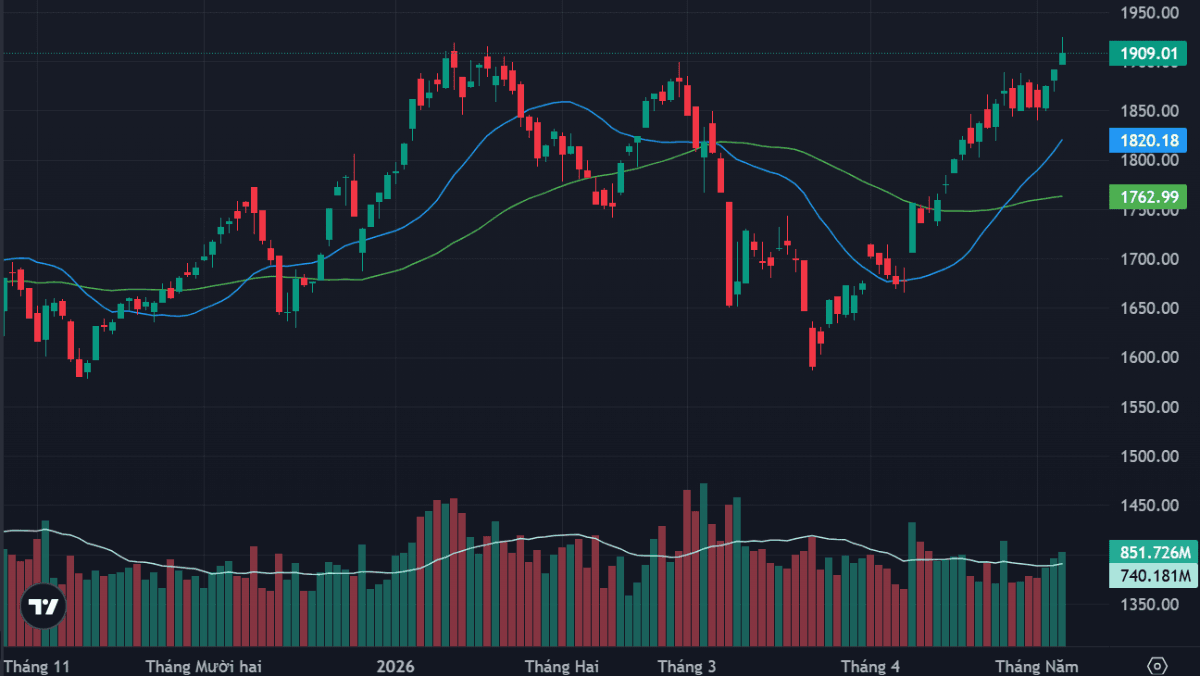
Closing the morning session on the HoSE exchange, 147 stocks rose and 142 fell. However, the afternoon session closed with 119 advancers and 191 decliners. The VN-Index rose 0.94% (17.81 points), outperforming the morning session’s gain of 0.8% (15.2 points), with the “leadership factor” playing a key role.
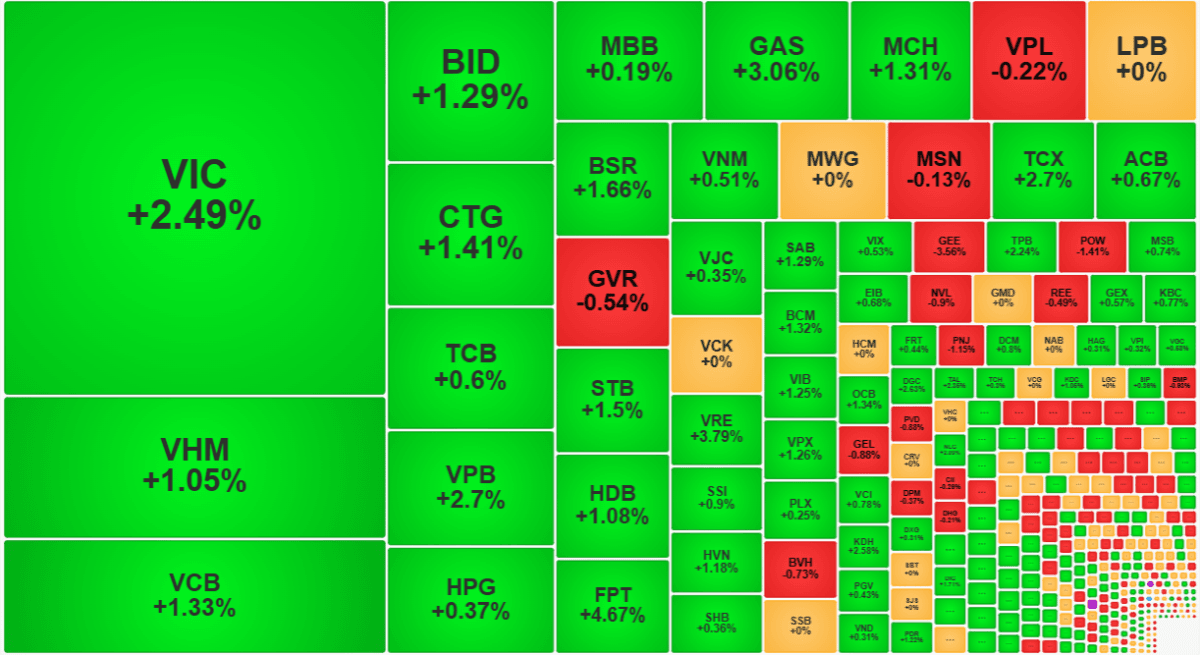
VHM recorded the largest market turnover in the afternoon session, at about VND 877.9 billion. The liquidity was driven by strong autonomous buying. After rising 3.11% by the morning close, VHM was pushed sharply higher at the start of the afternoon and, by the close, reached the ceiling price despite continued selling. For the day, VHM gained 3.73%, and the combination of price strength and high liquidity supported a decisive move beyond the previous peak.
Alongside VHM, VIC also rose strongly in the first roughly 20 minutes of the afternoon, reaching a high price up 5.24% versus the reference. However, VIC struggled to hold that level and was quickly pulled back. By the close, VIC finished only modestly above the morning level, up 2.05%. Even so, VIC and VHM remained key contributors in keeping the VN-Index above 1,900 points, together contributing over 17 points to the total gain of 17.81 points.
In the VN30, 18 stocks declined versus the morning, while 11 rose. Most gainers posted relatively small increases. Besides VIC and VHM, only STB and HDB stood out. STB rose to the ceiling at 1:37 PM and maintained it through the close, holding the ceiling from after 2 PM until the end of the session. HDB, similar to VIC, surged quickly in the first roughly 40 minutes, peaking at +4.51% before retreating to close up 3.38%. Stocks that were strong in the morning such as MSN and LPB changed little in the afternoon.
The VN30-Index closed up 1.25%, with 13 gainers and 13 decliners. Breadth was weaker than in the morning (15 up / 13 down), but the index gained more than in the morning (+0.97%). The main drivers were the strength of VHM and large components STB, HDB, and MSN. On the downside, declines—other than GAS—were limited to an impact of 4.04% or less.
Price action across the rest of the market was weaker than the VN30. Selling pressure pushed prices lower significantly. First, breadth narrowed to 119 advancers versus 191 decliners. Second, the number of stocks down more than 1% rose to 95 (compared with 51 in the morning). HoSE afternoon liquidity increased by 17.2% versus the morning, which the article links to price-denting selling.
This pattern runs counter to the positive momentum of the indices. Investors appeared less enthusiastic about the breakout of the 1,900 level. While the VN-Index has not fully broken out of resistance near the historical peak, breaking the psychologically significant round number of 1,900 is still described as an important development.
Among the biggest losers, around 20 stocks with liquidity above VND 100 billion fell by more than 1%. Blue chips in this group were limited to a few such as GAS, DGC, PLX, and TPB, while many were mid-cap names, including NVL (-3.5%), VCG (-3.66%), BSR (-4.49%), DXG (-2.22%), VCI (-2.26%), CTD (-6.93%), DCM (-3.52%), and PVT (-4.89%), with several trading at hundreds of billions per stock. Even among lower-liquidity names (a few billion to a few tens of billions), dozens still fell by more than 2%.
On the upside, price strength was not uniform, particularly across liquidity. About twenty stocks saw notable trading and price gains supported by liquidity. Besides blue chips, GEX, GEE, and HHP hit the ceiling with solid liquidity. Actively traded gainers included MSB (+1.96%), GMD (+1.4%), PAN (+1.86%), PET (+6.18%), PNJ (+1.62%), and DGW (+1.61%).
Overall, the close suggests that money can remain active in specific pockets, but it cannot sustain broad market momentum. The article notes that upward price movement followed by weakening, alongside rising liquidity, is unfavorable and points to selling pressure.

Bitcoin (BTC) investors who use steady dollar-cost averaging (DCA) may be underperforming versus strategies that adjust exposure to the market’s cycle, according to new research arguing that Bitcoin’s behavior differs from traditional long-duration assets.
In a report cited by Markus Thielen of 10x Research, Bitcoin’s market…