•
•
•
•
•
•
•
•
•
•
•
•
•
•
•
•
•
•
•
•
•
•
•
•
•
•
•
•
•
•
•
•
•


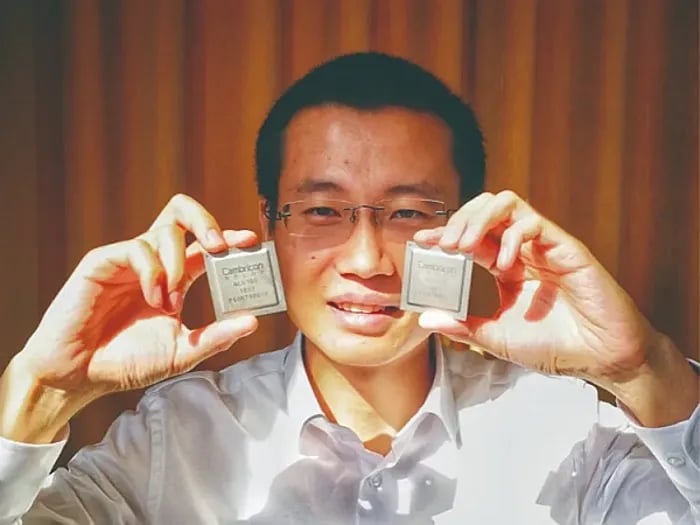
Cambricon Technologies, an AI chip design company nicknamed “China’s Nvidia,” has risen to become the most expensive stock on China’s mainland stock market after reporting strong first-quarter results.
As of around 14:00, Cambricon’s share price had jumped about 20%, to nearly 1,700 yuan (about $249). On Wednesday, the company reported Q1 revenue of 2.89 billion yuan, up 160% year-on-year. Net profit reached 1 billion yuan, up 185%.
Cambricon’s latest surge follows earlier milestones. In August 2025, the company’s stock temporarily surpassed Kweichow Moutai, the long-time “king” of China’s stock market. Earlier in February, Cambricon said it recorded net profit of 2 billion yuan in 2025, officially ending a streak of annual losses.
MetaX, a Shanghai-based GPU design company, also reported Q1 results. Revenue rose 75% year-on-year to 561.9 million yuan, but the company still posted a net loss of 98.8 million yuan in the quarter. Founded in 2020 by former AMD engineers, MetaX said revenue growth was driven mainly by a sharp rise in graphics processing unit (GPU) shipments. Cost pressures and ongoing investments, however, prevented it from turning a profit.
The broader pattern across these companies points to demand for domestic Chinese chips amid ongoing U.S. export-control restrictions on technology.
While U.S. President Donald Trump has “green-lighted” Nvidia to continue selling H200 AI chips to China, U.S. Commerce Secretary Gina Raimondo said last week that no H200 shipments have been made to China yet because Beijing has not granted the necessary licenses.
In a research note based on onsite surveys, Morgan Stanley said the GPU shortage for Nvidia in China is “opening up more room” for domestic substitute products. The bank also said accelerating commercialization of AI applications across consumer and enterprise sectors is becoming the main driver pushing China’s GPU market to accelerate.
China’s restriction on access to ASML’s advanced ultraviolet (EUV) lithography machines—key for producing modern chips—has also pushed the country toward domestic solutions. Morgan Stanley said this creates growth opportunities for domestic semiconductor equipment suppliers, including in lower-end technology segments.
Circuit Fabology Microelectronics Equipment, which is pursuing direct-write lithography, reported Q1 revenue of 514.7 million yuan, up 112%, while profit rose 190% to 108.4 million yuan.
Naura Technology Group, a Chinese chip equipment manufacturer, reported revenue up 25.8% year-on-year, and net profit rose 3.42%.
In chip design, VeriSilicon reported Q1 revenue rose 114.47% to 836 million yuan. However, cost pressures widened the firm’s losses to 341 million yuan, compared with 220 million last year.
In production, Hua Hong Semiconductor, China’s second-largest contract chip maker, reported record quarterly revenue of $660 million in Q4-2025. The company quickly became a new target in Washington’s controls.
According to Reuters, the U.S. Commerce Department has asked chip-manufacturing equipment suppliers such as Lam Research, Applied Materials and KLA Corporation to stop transferring some equipment to Hua Hong.
Jefferies analysts said the move is intended not only to curb China’s technological progress but also to help Washington gain leverage ahead of Trump’s upcoming visit to Beijing. They said equipment production is likely to be a key topic on the negotiation table.







Premium gym chains are entering a “golden era” that is ending or already in decline, as rising operating costs collide with shifting consumer preferences toward more flexible, community-based ways to exercise. Long-term memberships are shrinking, margins are pressured by higher rents and facility expenses, and competition from smaller, more personalized…