•
•
•
•
•
•
•
•
•
•
•
•
•
•
•
•
•
•
•
•
•
•
•
•
•
•
•
•
•
•
•
•
•


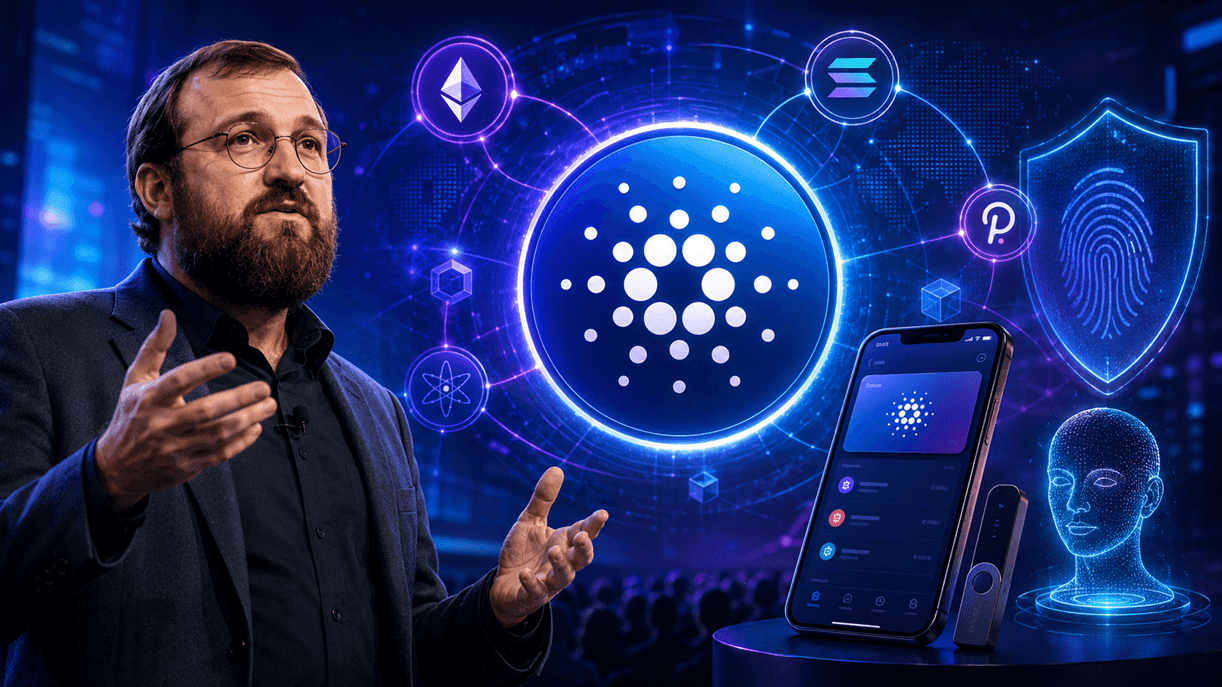
Cardano founder Charles Hoskinson used a Wednesday keynote at Consensus 2026 in Miami to argue that crypto’s next phase will not be won by another isolated chain, token or wallet. Instead, he said the industry must make self-custody, identity, privacy and multi-chain access simple enough for mainstream users, without returning control to centralized intermediaries.
Hoskinson said the main obstacle remains the user experience. He pointed to the need for users to manage seed phrases, navigate exchanges, wait for withdrawals, choose between networks, avoid fake applications and understand DeFi risk before they can do anything useful. He framed this as the barrier to bringing “the next few billion people” into crypto.
Hoskinson argued that crypto still requires too much user responsibility and decision-making, even for experienced participants. He contrasted the current experience with Web2 products such as Google Wallet, which he said has around 1.5 billion users and trains consumers to expect one-click setup, recovery and seamless mobile access.
In his view, crypto cannot keep insisting it is “different” if the product experience remains too punishing for ordinary users.
A central theme of the keynote was abstraction. Hoskinson credited Ethereum with advancing account abstraction and chain abstraction standards, arguing that these efforts became necessary as fragmented layer-2 environments created a poor user experience. He also cited Near Protocol as an example of embedding abstraction at the protocol level, pointing to $71 million in transaction fees in a year and billions of dollars traded through Near intents.
However, Hoskinson warned that abstraction shifts complexity to third parties. When users delegate tasks, those parties can gain visibility into assets, transactions, preferences, identity and business data. He argued that to scale without repeating what he described as the surveillance model of Web2, abstraction must be paired with privacy.
“When you abstract things, you delegate to people. You trust people. You give them something to do that on your behalf somewhere else,” Hoskinson said. “You don’t worry about the doing, but when they do the doing, they know you. They know what you’re buying. They know where you’re at.”
Hoskinson then outlined his pitch for Midnight Passport, describing it as a framework that combines mobile-native key management and recovery, self-sovereign identity, selective disclosure, wallet credentials, name services and multi-chain signatures.
According to Hoskinson, the approach is designed to let users scan a QR code, rely on trusted execution hardware already built into phones, encrypt off-chain data client-side, and create wallets across networks including Bitcoin, Ethereum, Solana and XRP.
He emphasized control over assets and identity, saying the goal is for users to custody their assets and manage their identity and data.
The keynote also expanded into AI agents, which Hoskinson described as an incoming force that could reshape internet commerce and crypto usage. He argued that agents may eventually handle most searches, transactions and online activity, leaving humans to interact with a smaller “human internet.”
For crypto, Hoskinson said this raises a practical issue: if users cannot safely evaluate DeFi protocols, counterparties or risks themselves, AI systems may become the layer that performs diligence and execution.
He linked this to privacy again, arguing that effective agents require deep personal context. Hoskinson said Midnight Passport is being developed not only for people but also for agents, with rules that can be set around identity, data access and execution.
At press time, Cardano traded at $0.2689.
Premium gym chains are entering a “golden era” that is ending or already in decline, as rising operating costs collide with shifting consumer preferences toward more flexible, community-based ways to exercise. Long-term memberships are shrinking, margins are pressured by higher rents and facility expenses, and competition from smaller, more personalized…