•
•
•
•
•
•
•
•
•
•
•
•
•
•
•
•
•
•
•
•
•
•
•
•
•
•
•
•
•
•
•
•
•


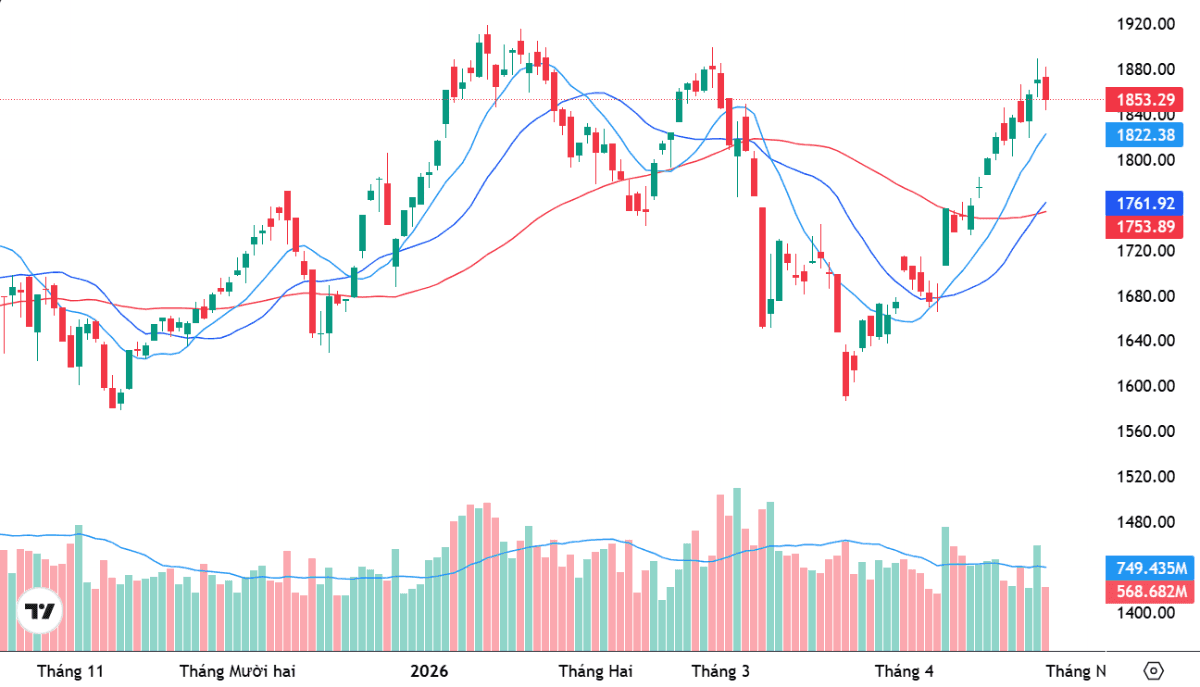
VN-Index ended the week up more than 36 points (+1.86%), driven largely by the heavyweight stock group. The index has returned to the late-February 2026 peak area and is near the historical high around 1,900 points. While first-quarter results were fairly positive, the global environment remains uncertain as the market enters a long “double holiday.”
Market data indicate that two large stocks, VIC and VHM, contributed more than 47 points—exceeding the total index gain. Analysts noted that this leadership effect does not necessarily reflect the broader market signal.
Trading next week will take place only two sessions, making it a sensitive period given the ongoing Middle East conflict and negotiations that have yet to reach consensus. Experts said investors should avoid chasing short-term profits from Q1 2026 results that have already been reflected in prices.
Liquidity typically declines during holidays, which can make price movements noisier and reduce the reliability of short-term signals. As a result, short-term opportunities are described as limited.
Under the influence of large-cap stocks, VN-Index rose for five consecutive weeks from around 1,600 to a peak near 1,900 at the end of February, before a sharp drop linked to the Middle East conflict. Analysts pointed to strong dispersion in this price region, particularly during the period when companies hold annual meetings and announce 2026 business plans and Q1 results.
This stage is when investors reassess valuations and growth prospects for 2026, as well as portfolio structure.
In the context of Hormuz Strait tensions pushing oil prices higher—along with inflationary pressures and rising costs—investors are expected to focus more on firms with continued 2026 growth plans and positive Q1 results.
Market capitalization is cited at about $420 billion, roughly 81% of 2025 GDP. VN30 capitalization is about $248 billion, roughly 59% of total market capitalization. VinGroup capitalization is about $97 billion, accounting for 23.1% of market cap and 39.5% of VN30.
Analysts said that after a prolonged adjustment, many tickers appear at relatively reasonable prices with investable opportunities and controlled risk.
Regarding leverage pressure, Q1 2026 earnings data show margin debt across securities firms estimated at about VND 415,000 billion by end-Q1 2026, up about VND 9,000 billion from end-2025. Margin lending alone was about VND 405,000 billion, up about VND 13,000 billion.
One view is that rising margin debt contributes to market dispersion and can amplify declines in some stocks when negative news emerges, especially as margin rates show signs of rising. Investors were advised to focus on quality, leading stocks with solid major shareholders, in reasonable price ranges, and with risk controls in place.
Another assessment said overall margin debt remained high but the pace of growth slowed. Total margin debt exceeded 400 trillion VND, while margin-to-equity ratios among large securities firms stayed safely around 100%, far below the 200% ceiling—reducing the risk of widespread margin calls, though localized stress could still occur in individual high-leverage stocks.
There was also a caution that margin debt composition may be misaligned. Some securities firms with large loan books may have trading shares on the exchange that do not match their lending scale, implying that part of margin debt could be linked to non-regular trading activities or specific “kiosks” or “deals.” This was described as a source of localized risk under adverse scenarios connected to geopolitical tensions.
On the question of whether it is a good time to re-enter state-owned bank stocks, analysts said valuations look relatively reasonable after a prolonged adjustment. However, growth potential was described as modest due to rising non-performing loans (NPLs) and narrowing net interest margins.
With only two trading sessions before a long holiday and geopolitical developments remaining unpredictable, analysts emphasized portfolio risk management. For investors holding large stock positions or using high leverage, the advice was to prioritize portfolio reviews and pruning. For those with more cash and fewer positions, the period could be used to screen for new ideas.
Defensive positioning was also highlighted. One expert noted that Middle East geopolitical risk—such as potential Hormuz Strait disruption—can create “black-swan” risks during market closure. Holding a high proportion of equities through the holiday was described as risky due to potential 10–15 day international logistics disruptions. The recommendation was to reduce margin and keep defensive sectors rather than chase short-term gains reflected in Q1 earnings.






Premium gym chains are entering a “golden era” that is ending or already in decline, as rising operating costs collide with shifting consumer preferences toward more flexible, community-based ways to exercise. Long-term memberships are shrinking, margins are pressured by higher rents and facility expenses, and competition from smaller, more personalized…