•
•
•
•
•
•
•
•
•
•
•
•
•
•
•
•
•
•
•
•
•
•
•
•
•
•
•
•
•
•
•
•
•


Copper is an essential metal for the global economy, used in construction, electric vehicles, and renewable energy systems. Over the coming decades, demand is expected to rise sharply as economies electrify transport and manufacturing, expand daily-life electrification, and as AI infrastructure grows and grids are upgraded.
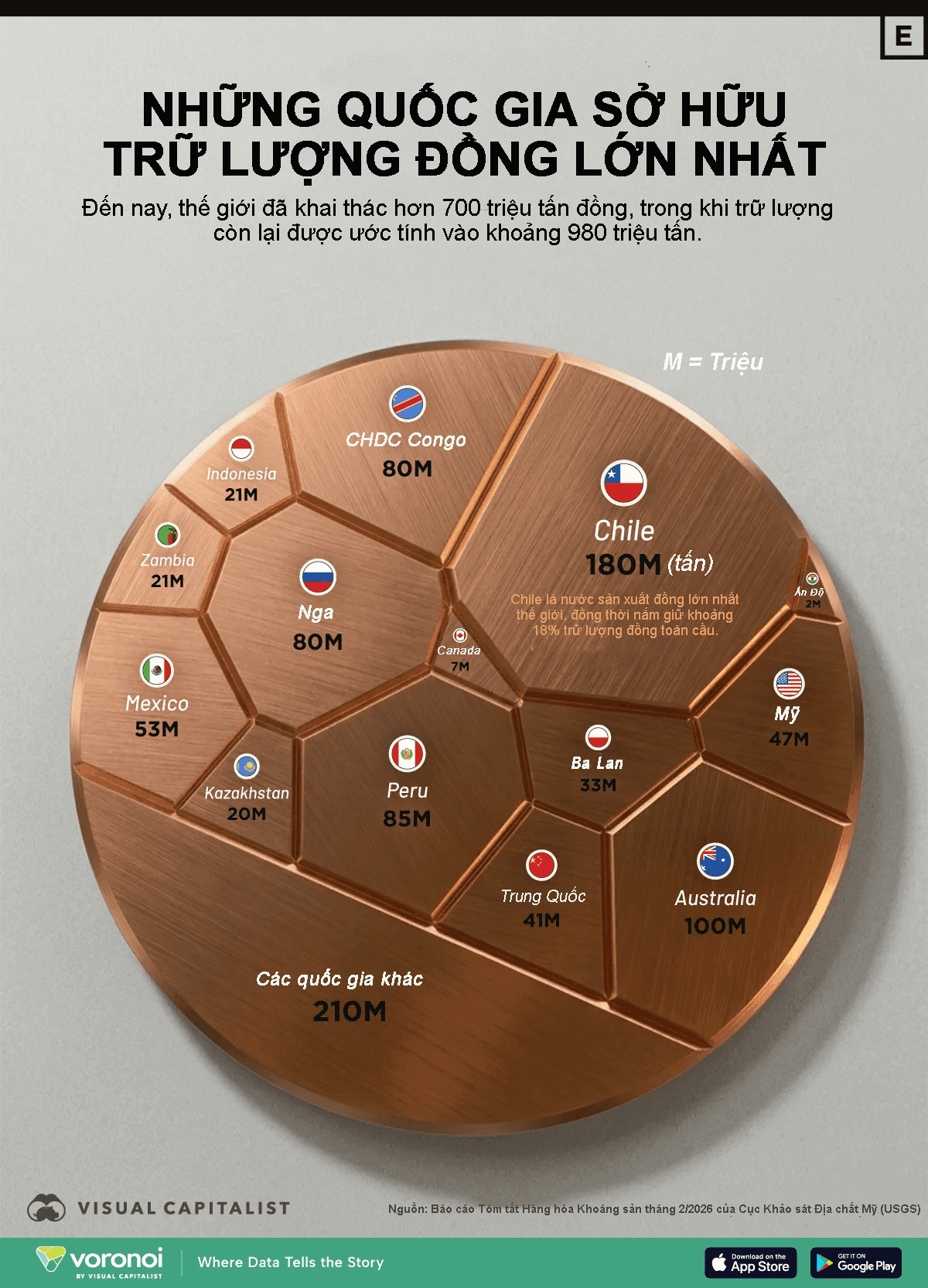
Based on 2026 data from the United States Geological Survey (USGS), the countries with the largest copper reserves include Chile, Australia, Peru, the Democratic Republic of Congo (DRC), and Russia.
Chile currently has the largest copper reserves, at about 180 million tonnes—nearly twice that of Australia, the second-largest country. This scale gives Chile significant influence in global copper supply chains, particularly as demand for the metal increases.
Chile’s copper reserves account for roughly 18% of total global reserves, reinforcing its position as the world’s largest copper producer. Large-scale mines, including those in the Atacama Desert, have made Chile a key link in the global copper supply chain.
Australia and Peru also hold large reserves, but they trail Chile by a wide margin. In reserves, the top five countries—Chile, Australia, Peru, the DRC, and Russia—hold more than half of the world’s proven copper reserves.
The reserve distribution highlights the importance of Latin America, alongside resource-rich regions in Africa and Eurasia, in supplying global copper demand.
To date, the world has mined more than 700 million tonnes of copper, while identified reserves remain close to 1 billion tonnes. This suggests substantial remaining resources, but it also points to the challenge of extracting them at reasonable costs.
Much of the remaining copper reserves worldwide are increasingly difficult and costly to mine. As demand accelerates from electric vehicles, power infrastructure, and energy systems, meeting future copper supply could become a major challenge for the global economy.






Premium gym chains are entering a “golden era” that is ending or already in decline, as rising operating costs collide with shifting consumer preferences toward more flexible, community-based ways to exercise. Long-term memberships are shrinking, margins are pressured by higher rents and facility expenses, and competition from smaller, more personalized…