•
•
•
•
•
•
•
•
•
•
•
•
•
•
•
•
•
•
•
•
•
•
•
•
•
•
•
•
•
•
•
•
•


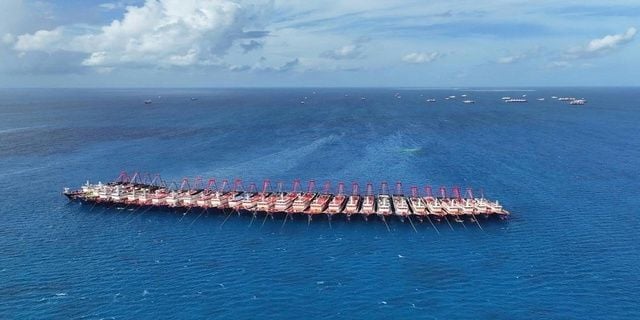
China's 10,000-ton electric-powered container ship, the first of its kind and the largest of the same class in the world, has officially entered commercial service on Wednesday afternoon. The vessel, named Ning Yuan Dian Kun, departed from Ningbo–Zhoushan Port to Jiaxing in Zhejiang Province. The route, which previously relied mainly on fossil-fuel vessels, is now clearly shifting toward electrification. The ship was independently developed and designed by the Shanghai Institute of Design and Research for Merchant Ships, and is equipped with an entirely electric propulsion system, offering carbon-free operation, smart navigation, and high efficiency. The ship is 127.8 meters long, 21.6 meters wide, with a designed draft of 6.2 meters and can carry 742 TEU. It is equipped with 10 battery containers with a total capacity of about 20,000 kWh, powered by two synchronous permanent-magnet propulsion motors, each rated at 875 kW. Annually, the vessel is expected to reduce CO2 emissions by about 1,462 tons and operate with zero emissions, no noise, and no pollution throughout its life. In terms of smart technology, the vessel integrates an intelligent propulsion and positioning system, enabling automatic collision avoidance, high-precision tracking, and integrated control among ship, shore, and cloud platforms. It uses a two-mode charging system, combining shore power with high voltage and rapid-container battery swapping for flexible energy replenishment. The open-deck design enhances cargo handling efficiency, while the bow is aerodynamically optimized to reduce wind resistance by 15–20%. The “Kun” in the ship’s name derives from a legendary giant in the classical Chinese text Zhuangzi. The sister ship Ning Yuan Dian Peng — with “Peng” being another giant in the same work — is expected to undergo sea trials in May and be delivered in June. When both vessels are in operation, they will form a large-scale green transport model on fixed routes. “This project demonstrates our commitment to the green transition of the maritime transport sector as well as China’s dual-carbon goals,” said Chen Xiaofeng, chairman of Ningbo Shipping Company, which operates the two vessels.

Premium gym chains are entering a “golden era” that is ending or already in decline, as rising operating costs collide with shifting consumer preferences toward more flexible, community-based ways to exercise. Long-term memberships are shrinking, margins are pressured by higher rents and facility expenses, and competition from smaller, more personalized…