•
•
•
•
•
•
•
•
•
•
•
•
•
•
•
•
•
•
•
•
•
•
•
•
•
•
•
•
•
•
•
•
•


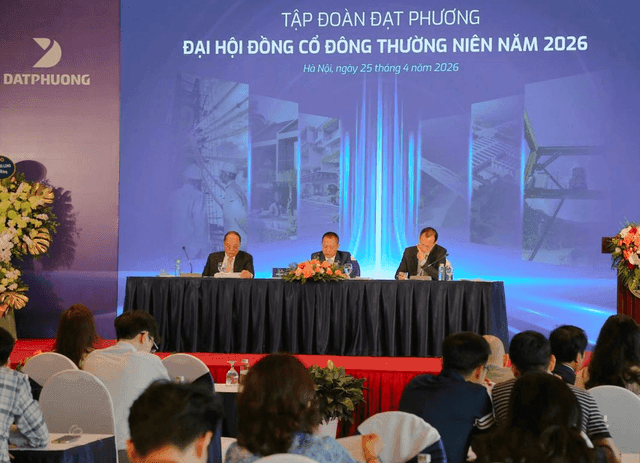
On April 25, Dat Phuong Group (DPG) held its 2026 Annual General Meeting of Shareholders, setting an ambitious revenue target of 8,513 billion VND, nearly double the previous year’s actual figure. Net profit after tax is expected to reach a record 560 billion VND, up 26% year-on-year. The company also proposed a cash dividend of 500–1,000 VND per share, equivalent to 5%–10% of charter capital.
DPG’s 2026 strategy is built around five core sectors: construction, energy, real estate, hospitality and resort services, and the production of ultra-clear glass for solar panels. Management expects growth to be driven primarily by real estate and a turning point in the glass production segment.
In real estate, DPG plans to accelerate project execution, targeting revenue of over 1,361 billion VND. The focus includes Casamia Balanca Hoi An, the Dien Loc Industrial Park in Q2 2026, and the Con Tiến social housing project in Q3 2026. The company also aims to resolve site clearance issues and land compensation policies.
The hospitality and resort segment is highlighted as a bright spot within the group’s ecosystem. Casamia Hoian hotel is scheduled to begin operations in August 2026, while Dong Na hotel is expected to break ground in Q3 2026.
In production, DPG’s ultra-clear glass plant—expected to have a capacity of over 5.17 million square meters—is planned to begin operations in October 2026, earlier than the prior plan for 2027. The company described the project as a key link to complete the materials-energy value chain and support long-term growth.
For the glass segment, DPG expects revenue of nearly 266 billion VND and a net loss of about 39 billion VND in the initial phase, with profitability expected in 2027.
At the AGM, the board approved the appointment of Luong Minh Tuan, Pham Kim Chau, and Le Anh Minh as board members for the 2026–2031 term.
Discussions also covered optimizing the capital structure and sustaining a dividend policy of 10–15% of charter capital. The Chairman noted that while the group remains modest in scale, it has maintained solid financial management, raising capital through a 64% stock dividend and additional issuance last year, pushing charter capital above 1,000 billion.
DPG said it is fully digitizing the supply chain and construction management using ERP and AI to reduce operating costs by about 5%. The Digital Transformation Center has been established to combine digital transformation with AI for smarter and more efficient work, with a 12-month roadmap toward near-completion.
Regarding the glass segment, DPG reported memorandums of understanding and supply contracts with U.S. partners. Exports to the United States are expected to account for a large share of capacity once the plant is operational.
The company said competition with China is mitigated by favorable U.S. tax treatment for suppliers from allied nations and by the U.S. clean-energy policy, which prioritizes these suppliers.
DPG also cited cost advantages from owning a high-purity white-sand deposit, which it said reduces processing costs compared with using sea sand or quartzite.
DPG indicated that domestic demand will be the main focus in 2026 because products require testing and certification. Exports to the U.S. are expected to start later, and losses are anticipated in the initial phase before profitability in 2027.
The company also noted that fuel price volatility can affect construction. To manage margin pressure, it has prepared contingencies, including pre-ordering steel and other materials for major projects.
DPG expects input cost pressures in 2026 from energy, materials, labor shortages, and higher borrowing costs. Management said pricing adjustments and productivity gains are intended to offset part of these effects.
DPG described rail projects as a core area. It has signed memorandums of understanding and collaboration agreements with major groups to participate in roughly 20 km of high-speed rail from Gia Bình to Quảng Ninh. The company also said engineers have been dispatched for rail training, and exchange agreements with large conglomerates are in place to prepare for implementation, including involvement in the Hanoi–Hạ Long rail segment.
Premium gym chains are entering a “golden era” that is ending or already in decline, as rising operating costs collide with shifting consumer preferences toward more flexible, community-based ways to exercise. Long-term memberships are shrinking, margins are pressured by higher rents and facility expenses, and competition from smaller, more personalized…