•
•
•
•
•
•
•
•
•
•
•
•
•
•
•
•
•
•
•
•
•
•
•
•
•
•
•
•
•
•
•
•
•


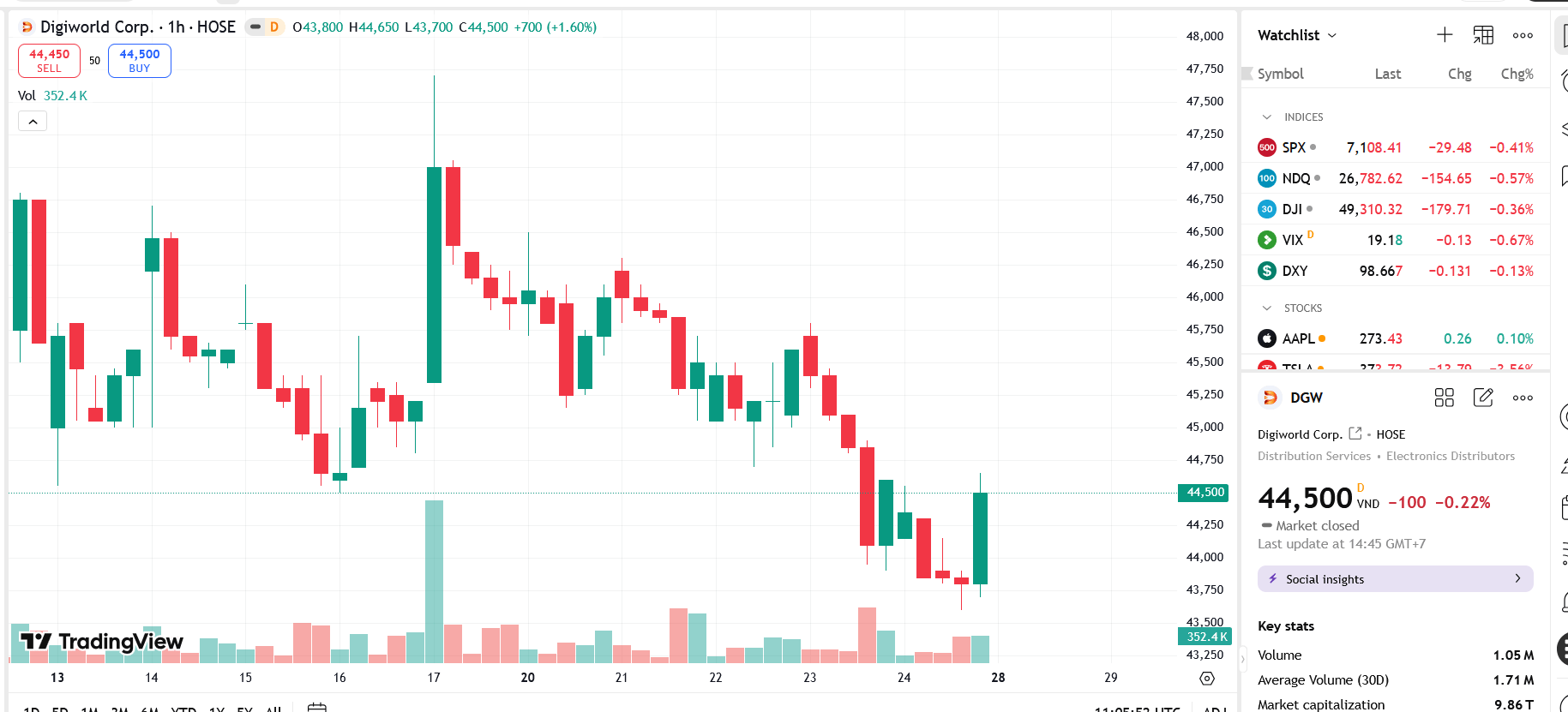
Digiworld (DGW) has announced a cash dividend for 2025 at a 10% rate, equivalent to 1,000 dong per share. The record date for shareholders to exercise rights is 14 May 2026, with the payment date expected on 21 May 2026.
With more than 221.3 million DGW shares outstanding, the company is estimated to pay about 221.3 billion dong in this dividend round. In its 2025 governance report, DGW said Created Future held more than 69.6 million shares, representing 31.45%, and is expected to receive more than 69.6 billion dong in dividends.
At the end of Q1 2026, DGW reported net revenue of over 8,500 billion dong, up 54% year over year. Net profit rose 89% to over 200 billion dong.
DGW attributed the growth to stronger performance across its laptop and tablet business. In Q1 2026, the laptop and tablet segment rose 102% year over year to more than 2,800 billion dong, accounting for 33% of total revenue. Mobile phones contributed 27% of revenue, reaching 2,278 billion dong. Office equipment grew 92% to 2,447 billion dong (29% of revenue), household appliances rose 80% to 722 billion dong (8%), and consumer goods increased 14% to 250 billion dong (3% of revenue).
Shareholders approved DGW’s 2026 business plan with revenue of 31.5 trillion dong, up 18% year over year, and net profit after tax of 660 billion dong (+20% year over year; 103% of VCSC’s 2026 forecast). DGW said it has completed 27% of the revenue plan and 30% of the profit plan.
VCSC noted that the plan excludes potential impairment reversals from securities investments. It also cited segment growth expectations versus the prior year: laptop & tablet +16%, mobile +2%, office equipment +32%, household appliances +71%, and consumer goods +9%. VCSC further said there may be upside to revenue forecasts, but it does not expect significant changes to net profit forecasts.
For cash dividends for 2025, DGW will distribute 1,000 dong per share, implying a dividend yield of 2.2%, with payment expected in 2026.
At the AGM, DGW also approved an ESOP program for 2026 for board members and staff. The company plans to issue 2.2 million shares (1% of outstanding) at 10,000 dong per share, with a one-year transfer restriction. The issuance is expected in Q2–Q3 2026.
The AGM approved DGW’s transition to a holding company structure. Under the plan, the parent company will focus on capital allocation and oversight, while subsidiaries will operate each business line. DGW said the restructuring is administrative and designed to address foreign-ownership regulatory constraints, and it expects no material changes to operations or financials.
Management also outlined a plan for Q2 2026, targeting revenue up 29% year over year and net profit up 38% year over year.
On mobile phones, management said long-term revenue growth is expected to be driven by price realization. For laptops and tablets, management noted that the entire category is seeing price increases. In Q1 2026, laptop revenue rose 102% year over year due to front-loaded demand as prices were expected to continue increasing. Management remains confident in a full-year 2026 laptop revenue growth target of about 10% annually.
For other existing segments, DGW plans to add two major brands to the fast-moving consumer goods and household appliances categories in 2026.
Regarding the automotive-related business, management said entering EV distribution is premature due to consumer readiness and third-party charging infrastructure. In the short term, DGW will focus on automotive consumables (oil, tires, batteries, and accessories). It also plans to enter lubricant distribution in Q2 2026 to lay the foundation for expansion into related consumables.
On the impact of the Middle East conflict, management generally expects no significant impact on DGW’s profits and anticipates no direct supply-chain disruption, citing that sourcing is concentrated in China, Korea, and Japan.
Management said logistics-cost risk is mitigated by long-term contracts with price-cap mechanisms, and that transportation costs represent a small portion of operating costs. It believes a 20%–30% rise in freight costs is unlikely to materially affect profits. While indirect inflation-related demand risks exist, management expects market share gains, new brands, and new business lines to offset weaker purchasing power.








Premium gym chains are entering a “golden era” that is ending or already in decline, as rising operating costs collide with shifting consumer preferences toward more flexible, community-based ways to exercise. Long-term memberships are shrinking, margins are pressured by higher rents and facility expenses, and competition from smaller, more personalized…


