•
•
•
•
•
•
•
•
•
•
•
•
•
•
•
•
•
•
•
•
•
•
•
•
•
•
•
•
•
•
•
•
•


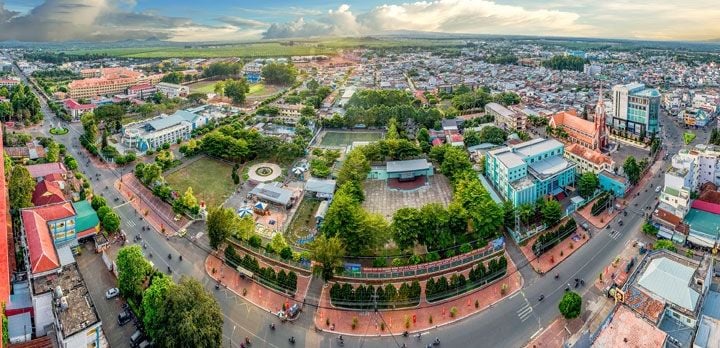
The Ministry of Construction has signed a decision recognizing Đồng Nai Province as meeting the criteria for Class I urban status, satisfying all seven criteria to become a city directly under the central government. Under the decision, Đồng Nai’s entire administrative boundary, covering a natural area of more than 12,000 square kilometers, including 95 administrative units at the commune/ward level and a 2025 population of nearly 4.5 million, is recognized as meeting Class I urban criteria. According to Resolution 112/2025/UBTVQH15 on the standards for administrative units, to become a city directly under the central government, a locality must meet seven criteria: population size, natural area, the proportion of wards to total administrative units at the commune level, urbanization rate, location and function in planning as determined by competent authorities, the Class I urban criterion, and the structure and level of socio-economic development. In Q1 2026, Đồng Nai’s economic growth remained high, with GRDP up 9.76%. Growth drivers continued to come from the industrial and construction sectors, rising 11.78%, surpassing the province’s growth scenario. With recognition of meeting all seven criteria, Đồng Nai now meets all seven criteria to consider establishing a central-city. According to the provincial People’s Committee, the orientation to establish a central-city stems from objective development requirements and the need to reorganize the spatial economic-social space in the new context. This is seen as a necessary step to establish a governance model aligned with the development scale, degree of connectivity, and the region’s increasing role in the national economy. Earlier, the interdisciplinary appraisal council reviewing the proposal also assessed Đồng Nai’s role as a gateway connecting inter-regional, inter-national and international links. Đồng Nai currently ranks among provinces with leading GRDP nationwide and is a key industrial, export and logistics hub. In addition, the locality possesses strategic infrastructure with large-scale projects such as Long Thành International Airport, identified as a major driver for national socio-economic development. It also features a network of expressways, national highways, high-speed rail, urban rail, and inter-regional ring roads that are being invested in. With its geographic advantages and development potential, Đồng Nai is expected to become a center connecting economy, logistics and international trade in the Southern region and the Southeast region, while also playing a supporting role alongside Ho Chi Minh City. Earlier, on 14 April, at the first session reviewing the government’s proposal to establish ward-level units, Đồng Nai city, and the corresponding judicial bodies, the Standing Committee of the National Assembly approved presenting to the National Assembly a resolution on establishing Đồng Nai city at the first session of the 15th National Assembly. The Center for Land Development of Đồng Nai, Bien Hoa branch, recently issued Notice No. 1059/TN-TTTPQĐ-CNBH on the policy of land recovery for compensation, support, and resettlement for the project extending the Ben Thanh-Suoi Tien metro line to the provincial administrative center and Long Thành International Airport. The project has a total length of 44.6 km, passing through Trấn Biên, Biên Hòa, Long Hưng, Phước Tân, Tam Phước, An Phước, Nhơn Trạch, Long Thành wards. The total land area used is about 192.5 ha (excluding TOD positions). In April 2026, the Bien Hoa branch will coordinate with related units and the People's Committees of the wards Trấn Biên, Biên Hòa, Long Hưng, Phước Tân, Tam Phước to conduct field surveys, collecting data on land, housing, structures, trees, schools, religious facilities, companies, and factories within the land-recovery area to estimate total compensation, support, and resettlement costs for the project.
Premium gym chains are entering a “golden era” that is ending or already in decline, as rising operating costs collide with shifting consumer preferences toward more flexible, community-based ways to exercise. Long-term memberships are shrinking, margins are pressured by higher rents and facility expenses, and competition from smaller, more personalized…