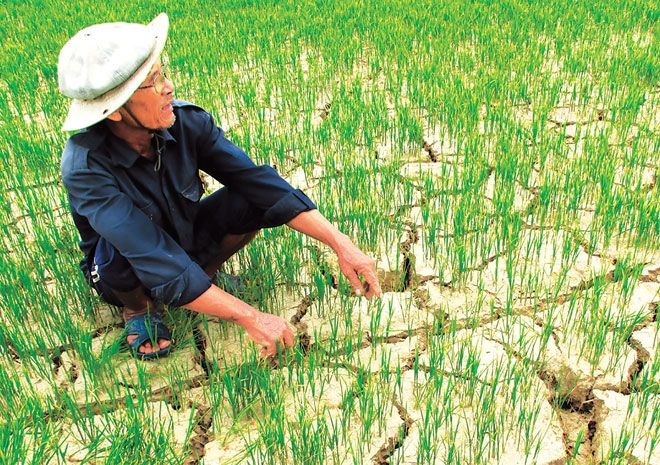
Forecasts for the period from late 2026 to early 2027 indicate rainfall could fall sharply by about 25-50%, creating a very high risk of drought and severe saltwater intrusion in Vietnam’s South Central Coast, the Central Highlands, and the Mekong Delta during the 2026-2027 dry season. Localities are also urged to prepare for extreme rainfall events that could trigger floods, landslides, and storms with complex tracks over the East Sea.
On 17 April 2026, the Ministry of Agriculture and Environment sent a letter to the National Civil Defense Steering Committee outlining early assessments of potential water shortages linked to El Niño conditions.
The letter states that the ENSO system is transitioning from La Niña to neutral and is likely to shift to El Niño in the June–August 2026 period, with an 80-90% probability. After that, it may continue to develop, reaching moderate to strong intensity by late 2026. The Ministry also notes a possibility of a very strong El Niño (about 20-25% probability) in the latter months of 2026 extending into 2027.
In Vietnam, hot and dry conditions have appeared early in 2026. The number of hot days has risen earlier than the long-term average in many years. Rainfall from the start of the year to mid-April has been generally 10-40% below normal nationwide, while river flows and water levels in many basins are at the lowest on record for the same monitoring period—an early warning sign of potential water shortages at the start of the season.
If El Niño forms as described, the Ministry expects the nationwide average temperature to be higher than normal, with more hot days and greater intensity than in 2025. Rainfall could be deficient during the coming dry months of 2026, especially from late 2026 to early 2027, with typical reductions of 25-50%. At the same time, the rainy season is expected to end earlier.
Water resources across basins are forecast to continue declining. For major reservoirs—especially those on the Da River system—total runoff from May to July 2026 could be 10-25% below the long-term average. The Ministry warns of a high risk of water shortages due to reduced cross-border inflows combined with dry-season rainfall deficits, potentially affecting downstream water supply and energy security.
The Ministry highlights a high risk of drought and saltwater intrusion, particularly in the South Central Coast, the Central Highlands, and the Mekong Delta during the 2026-2027 dry season. It also warns that water shortages could occur nationwide in the early months of 2027.
Even during El Niño periods, reduced total rainfall can still coincide with heavy localized downpours in short durations, which may cause flash floods, landslides, and urban flooding.
Tropical cyclone activity over the East Sea is expected to be lower than the long-term average, but the Ministry stresses vigilance for strong storms with complex trajectories that can produce large short-term impacts.
The Ministry said it will continue directing forecast agencies to closely monitor meteorological-hydrological developments, especially ENSO, water resources, and dangerous weather phenomena. It will promptly update and issue forecast bulletins to support the Government’s, ministries’, and local authorities’ operations.
The content also notes activation of an early-action package to respond to drought and saltwater intrusion, including in the Mekong Delta where saltwater intrusion is increasing.