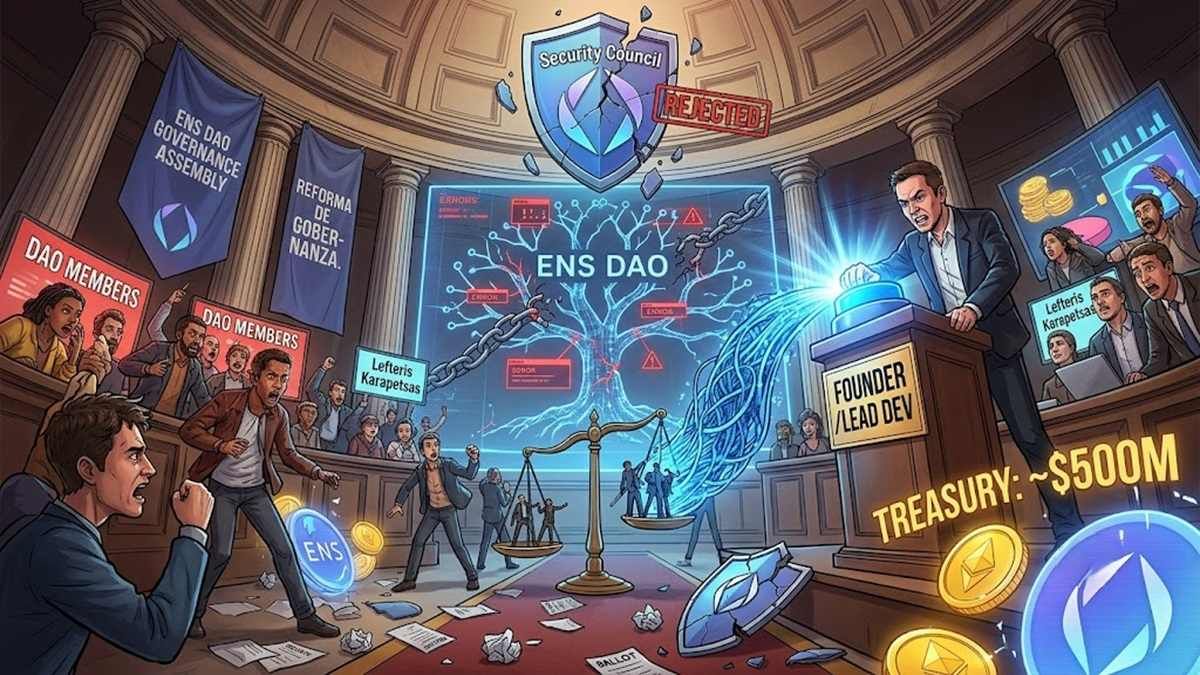
Ethereum Name Service (ENS) co-founder Nick Johnson is pushing back against community claims that he rigged a recent governance vote in his favor. The controversy stems from votes on renewing the ENS DAO’s Security Council, a 4-of-8 multisig body with limited powers to cancel malicious proposals in the DAO’s timelock. Johnson told The Block that his participation followed standard process and reflected substantive concerns rather than manipulation.
The measure involved two stages, including an off-chain Snapshot vote followed by an on-chain executable proposal. The goal was to renew the Security Council for another two-year term ahead of its current authority expiring on July 24, 2026, along with other changes. The Snapshot vote passed, but the executable on-chain vote has not, and it currently stands at 82% "no." The vote is set to officially close on July 5 at 8:59 PM.
Johnson abstained on the Security Council vote with a message explaining that he supported SC renewal but not with the current slate of members. He also voted against the executable vote because nothing was done to address those concerns.
In a comment on the voting platform, Johnson noted that "members of the current SC have made it clear that they intend to use their veto power to stop proposals they personally disagree with." "The security council must exist as a backstop against compromise and violations of the ENS constitution, not as political officers," he added.
Community backlash has intensified debates about governance centralization and voting power concentration within the ENS DAO. Brantly Millegan, a longtime ENS contributor who was controversially fired from ENS Labs, said on X that Johnson’s influence signals a “moral and usage implosion of ENS” and posted screenshots showing Johnson’s nick.eth address dominating the executable vote.
“The moral and usage implosion of ENS is a catastrophe for Ethereum,” Brantly Millegan said on X, adding screenshots showing Johnson’s nick.eth address dominated the executable vote.
Lefteris Karapetsas, a longtime Ethereum commentator, said on X, referencing Johnson's voting concentration, “And with that, ENS DAO is dead.”
“And with that, ENS DAO is dead,” Lefteris Karapetsas said on X, referencing Johnson's voting concentration.
Some observers highlighted concerns about voting concentration and governance dynamics. Colludingnode, an Ethereum commentator, said on X, “If a crisis like this is even remotely possible, it’s not good enough for Ethereum. ENS is done.” He also updated his X profile to colludingnode.gwei, showcasing an alternative Ethereum address service for .gwei names.
“If a crisis like this is even remotely possible, it’s not good enough for Ethereum. ENS is done,” colludingnode said on X, referencing the governance situation. He also updated his X profile to colludingnode.gwei, showcasing an alternative Ethereum address service for .gwei names.
ENS, founded in 2017, is a decentralized domain name system built on Ethereum that allows users to register human-readable names (like yourname.eth) that resolve to Ethereum addresses, websites, content, or other data.
The episode has intensified ongoing debates within the ENS DAO about governance centralization, voting power concentration, and decision-making processes. Critics have questioned Johnson’s influence, especially amid discussions about expanding the ENS Foundation’s role in treasury management.
Earlier this month, ENS Labs COO Katherine Wu submitted a temp check proposal to consolidate day-to-day treasury management, endowment oversight, grant administration duties, and other operations from the ENS DAO to the ENS Foundation, which is governed by a five-seat board including Johnson.
Wu also submitted another Security Council proposal on Tuesday to establish an eight-member successor council, arguing the current arrangement had granted "extraordinary power" to the SC. The new organization would still have the power to reverse DAO votes, but would require a stricter 5/8 approval threshold, up from the current 4/8. In a comment on that proposal, which is seeking feedback until July 3 at 11:59 PM UTC, Johnson said he agreed with "the new security council mandate and charter."
Earlier this year, ENS Labs canceled the launch of its bespoke Namechain Layer 2, which began development in 2024 to support the forthcoming ENSv2 update. The updated ENSv2 protocol, featuring hierarchical registries and other improvements, will deploy on the Ethereum mainnet instead.
The unfolding episode highlights tensions around decentralization, control of treasury and governance processes, and the role of large token holders in ENS voting. While supporters argue that Johnson raised substantive concerns and followed established procedures, critics say concentration of voting power and perceived influence over governance decisions pose risks to the DAO’s legitimacy and Ethereum’s broader ecosystem.