•
•
•
•
•
•
•
•
•
•
•
•
•
•
•
•
•
•
•
•
•
•
•
•
•
•
•
•
•
•
•
•
•


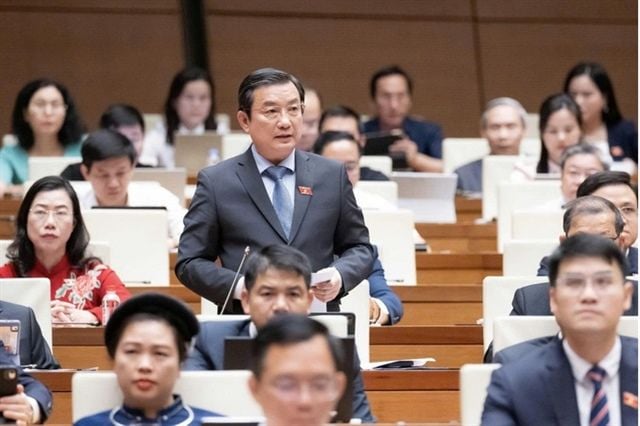
On the afternoon of April 20, during the continuation of the second session of the first extraordinary session, the National Assembly discussed an assessment of the results of implementing the socio-economic development plan and the state budget in 2025, the implementation status in the early months of 2026, and the five-year socio-economic development plan for 2026–2030.
In the discussion, 25 deputies raised solutions and expectations for strong commitments from the Government and the Prime Minister to develop the socio-economic development plan for the next period, particularly the goal of double-digit growth.
Deputy Hoang Minh Hieu (Nghe An) said many administrative procedures remain burdensome for citizens and businesses. He cited the 2024 Provincial Competitiveness Index (PCI), noting that nearly 24% of enterprises must spend more than 10% of working time to understand and implement administrative rules. He proposed treating simplification of administrative procedures not only as an administrative task, but as a central solution to unlock resources, raise competitiveness, and strengthen market confidence.
“We need to review to distinguish clearly: procedures still necessary should be simplified, while obsolete ones should be abolished,” Hieu said.
Deputy Pham Trong Nhan (Ho Chi Minh City) analyzed the private sector’s role and barriers. He cited the Government’s report that GDP in 2025 reached 8.02%. He said the growth was supported not only by the state sector and foreign direct investment (FDI), but also by the resilience of the private economy.
According to Nhan, the private economy accounts for about 51% of GDP per year, more than 30% of the state budget, provides jobs for over 82% of the labor force, and contributes nearly 60% of total social investment. However, while the private sector contributes more than half of GDP, it accounts for about 30% of exports, with the remainder largely coming from FDI.
He said this reflects a structural reality: the private sector is mainly active in the domestic market and in processing or low-value segments, while high-value, strategic, and infrastructure sectors still lack private-sector leadership.
Deputy Nhan also pointed to credit access as a major difficulty over the past five years. He said that currently only about 30% of enterprises have access to official credit.
He noted that while there are existing legal frameworks—including the Enterprise Law, the Investment Law, and the Small and Medium Enterprise Support Law—these laws mainly regulate specific areas. What is missing, he said, is a cross-cutting, foundational principle that guarantees rights and builds trust for the private sector across the legal system.
“Urgently the National Assembly should include in the legislative program a foundational framework law, the Law on Ensuring the Right to Develop the Private Economy, and it cannot be delayed any longer,” Nhan said.
Deputy Nguyen Dai Thang, Vice-Chairman of the Committee on Delegation Affairs, argued that to achieve double-digit growth, the growth model should shift from breadth to depth, with productivity and science- and technology-based innovation as the central driver.
He proposed increasing investment in research and development to at least 1.5% of GDP. He also suggested encouraging enterprises to allocate funds to a Science-and-Technology Fund, offering tax exemptions for applied research, and establishing a National Innovation and Creativity Support Fund to support technology enterprises, the supporting industry, and digital transformation.
On FDI, Thang said attracting FDI should shift from quantity to quality, prioritizing projects with commitments to technology transfer, domestic workforce utilization, and links with domestic enterprises.
Deputy Tran Van Lam (Bac Ninh) argued for sparing state budget spending and increasing revenue to maximize efficiency for socio-economic development. He said that if higher taxes dampen production and business incentives, shrink the economy, or trigger social problems affecting long-term growth potential, the effectiveness of such tax increases should be reconsidered.
Lam proposed budgeting with a holistic, inclusive, substantive approach rather than a mechanical, administrative command, tying it to the overarching goal of improving resource use efficiency to support fast and sustainable socio-economic development.
On April 21, the National Assembly continued discussions in the hall on the status of implementing the socio-economic development plan and the state budget in the early months of 2026, the five-year socio-economic development plan for 2026–2030, the medium-term public investment plan, and the five-year financial plan for 2026–2030.
Earlier, on the morning of April 20, the National Assembly heard the Government’s proposal to establish Dong Nai City as a centrally administered city. After group discussions, most deputies agreed with the proposal and the appraisal report, requesting that the effective date of the resolution be April 30, 2026.
Premium gym chains are entering a “golden era” that is ending or already in decline, as rising operating costs collide with shifting consumer preferences toward more flexible, community-based ways to exercise. Long-term memberships are shrinking, margins are pressured by higher rents and facility expenses, and competition from smaller, more personalized…