•
•
•
•
•
•
•
•
•
•
•
•
•
•
•
•
•
•
•
•
•
•
•
•
•
•
•
•
•
•
•
•
•



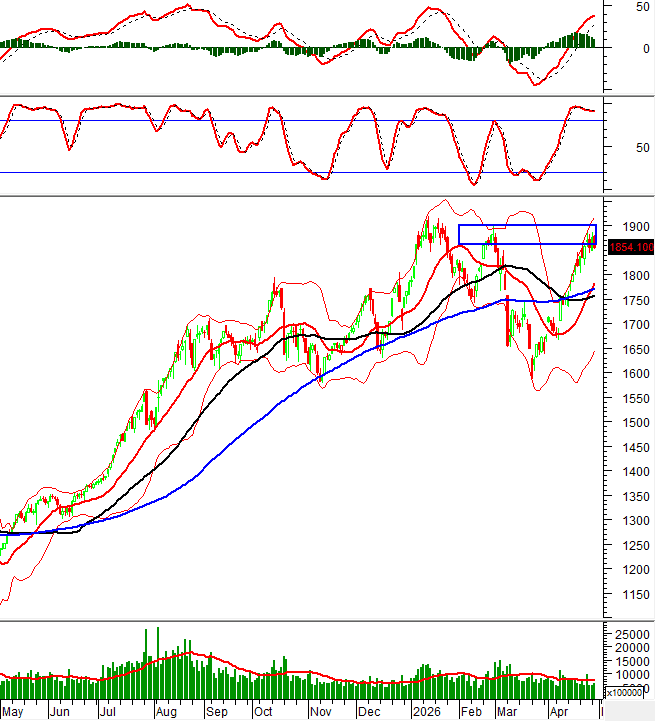
VN-Index closed April 2026 at 1,854 points, up nearly 180 points and representing a 10.7% month-on-month gain. The rally was driven mainly by the Vingroup stock group and a broader consensus among several pillar stocks, with VIC and VHM together contributing about 170 points to the increase.
Market observers said the gap between index performance and investors’ day-to-day experience can widen risk in the next period. When the rally depends too heavily on one leading stock group, the VN-Index may become more sensitive to profit-taking or adverse external developments.
“Broad-based declines are a scenario to consider,” said Nguyen Anh Khoa, Director of Analysis at Agriseco Securities.
Mr. Khoa noted there is reason to watch for VN-Index volatility and a near-term pullback, particularly because the blue-chip stocks that led the market’s gains over the past month have risen sharply.
A broad-based decline could materialize if blue-chips face selling pressure. However, the analyst expects that in any scenario, roughly 10–20% of stocks will still rise, supported by expectations around capital raises, capacity expansion, M&A, divestment, or restructuring that the market has not fully priced in.
Historical data since the VN-Index began operating shows the number of years with gains and losses in May is about equal. This indicates the “Sell in May” effect has little practical meaning.
The May 2026 outlook suggests the domestic market may enter an “information void,” with geopolitical developments remaining unpredictable. As a result, investor sentiment carries notable risk in the near term.
Support is expected around 1,800–1,830 points. The base scenario is that the VN-Index will hover and find support near this zone, then test the 1,900 level again to assess whether the main trend remains upward or shifts into a broad sideways range.
In a negative scenario, if liquidity disperses and the market becomes dichotomous—where only a small number of stocks rise while liquidity and the index weaken—support could fall to around 1,740–1,750.
In the information-void environment, supporting narratives are expected to be more stock-specific, centered on business plans approved at annual general meetings as a basis for investors to reassess and rebalance in the coming period.
Sectors favored by foreign net buyers could provide positive signals, especially if domestic liquidity remains fragile and earnings performance lags the market. The article also noted that medium-term international efforts toward geopolitical stabilization could help improve sentiment.
Investors were advised to focus on managing stock exposure, set short-term expectations accordingly, and be prepared to rebalance as market money flows confirm a clearer trend.
Banking is highlighted as a sector with 2026 earnings expected to be supported by loan growth of around 16% across the system this year, rising non-interest income, and potential reductions in the cost-to-income ratio through digitization and AI. The article recommends favoring banks with a positive 2026 outlook, quarterly results that beat expectations, and planned capital-raising activities.
For steel and coated steel, net profit is forecast to rise about 25–30% year on year in 2026. The outlook is supported by a mid-term bottoming of steel prices, along with public investment and accelerating real estate projects expected to boost demand. Internationally, steel prices rose to around 3,195 CNY/ton during the holiday period, the highest since August 2025.
Retail’s outlook is supported by the expansion of new retail chains such as Bach Hoa Xanh and Long Chau, alongside improving performance at traditional retail chains. Retail sector profits are forecast to rise by more than 20% in 2026. The article also cited potential IPOs of retail chains as a factor that could further strengthen re-rating expectations for related stocks.






Premium gym chains are entering a “golden era” that is ending or already in decline, as rising operating costs collide with shifting consumer preferences toward more flexible, community-based ways to exercise. Long-term memberships are shrinking, margins are pressured by higher rents and facility expenses, and competition from smaller, more personalized…




