•
•
•
•
•
•
•
•
•
•
•
•
•
•
•
•
•
•
•
•
•
•
•
•
•
•
•
•
•
•
•
•
•


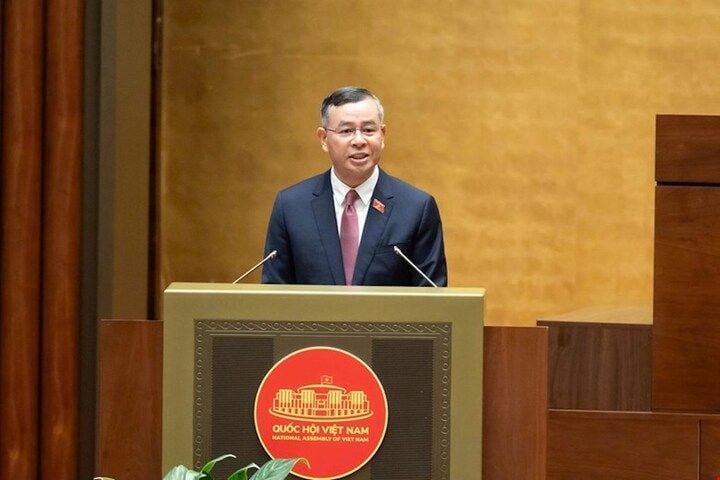
On the morning of April 21, the National Assembly discussed in the chamber the five-year socio-economic development plan for 2026-2030, the 2025 measures for thrift and waste prevention, and the status of meeting the national gender equality target for 2025.
Responding to and clarifying opinions raised by deputies, Finance Minister Ngo Van Tuan said the government is actively implementing assigned tasks, including a nationwide conference chaired by the Prime Minister this week to accelerate public investment disbursement and meet the 2026 timeline.
The minister said the government is also prioritizing the resolution of backlog projects, describing them as both a bottleneck and a potential growth driver.
“According to statistics, there are currently about 200,000 hectares of land backlog and about 3.3 quadrillion dong,” Mr. Tuan said. He added that compared with total public investment in 2026 of about 1.1 quadrillion dong, the backlog is about three times that amount.
Mr. Tuan urged the National Assembly to continue supporting and supervising implementation to handle backlog projects effectively in line with relevant resolutions.
In the chamber, the minister also presented solutions to achieve the two-digit growth target. He said the target is “extremely challenging” but is the path chosen with broad consensus.
He noted that the government has set the target with 59 sector indicators, 11 groups of measures for the next period, and “92 very specific tasks for 2026.”
The minister said that in Q1 the economy recorded several positive signals, including growth of 7.9%, exports up over 19%, public investment disbursement up 1.2% year-on-year, and the number of newly established enterprises up more than 31.7%.
However, Mr. Tuan warned that “from the second quarter onward, we will feel the impact of the Middle East conflict.” He cited expert views that every 10% increase in crude oil prices would reduce growth by 0.4% and raise inflation by 0.5%.
He said higher oil prices affect energy costs and can also push up prices of petrochemical products and production inputs such as fertilizers and materials.
As a concrete example, he referenced Viettel, saying the price of a fiber optic cable has risen sixfold compared with the same time.
To reach growth above 10% in 2026, with Q1 at only 7-8%, Mr. Tuan said the remaining quarters would need to grow 10-11%. He said the Finance Ministry will advise the Government to implement a coordinated set of measures.
The minister added that small and medium-sized enterprises currently account for about 96% of total enterprises and contribute more than 50% of GDP.






Premium gym chains are entering a “golden era” that is ending or already in decline, as rising operating costs collide with shifting consumer preferences toward more flexible, community-based ways to exercise. Long-term memberships are shrinking, margins are pressured by higher rents and facility expenses, and competition from smaller, more personalized…