•
•
•
•
•
•
•
•
•
•
•
•
•
•
•
•
•
•
•
•
•
•
•
•
•
•
•
•
•
•
•
•
•


Vietnam’s stock market ended Week 17 of 2026 with the VN-Index closing at 1,853.29 points, up 36.12 points (+1.99%). However, the week’s gains remained highly concentrated in a small number of blue-chip stocks, while overall liquidity softened, suggesting investors had not yet confirmed a sustainable uptrend.
The VIC group (VIC and VHM) was the main driver, contributing up to 44.23 points (about 2.43%). Despite the index gain, liquidity weakened, indicating that trading activity did not broaden meaningfully beyond leading names.
On HOSE, the average matched trading value reached 20,477 billion VND per session, down 2.43% from the previous week and 2.93% below the 5-week average. Across all three exchanges, the average total value traded was 25,407 billion VND, with matched value at 21,946 billion VND—down 3.40% versus Week 16 and 4.90% versus the 5-week average.
Foreign investors net-sold 4,690.2 billion VND over the week. Excluding matched trades, they net-sold 3,419.9 billion VND.
By matched trades, foreign investors’ main net purchases were in the Financial Services and Basic Resources groups. The top net-buying stocks included FUEVFVND, HPG, MSN, MWG, HCM, VJC, VPL, VPI, KBC, and LPB.
Foreign investors’ net selling via matched trades was concentrated in the Banking group. The top net-sold stocks included FPT, ACB, VCB, VHM, VPB, BID, CTG, GAS, and PVD.
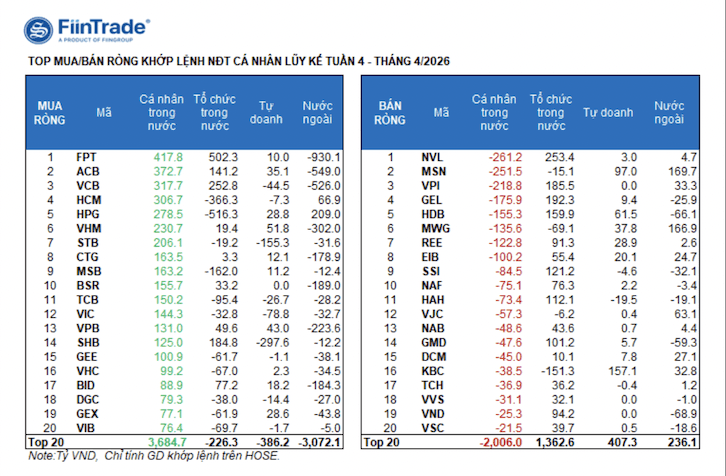
Individual investors net-bought 3,101.2 billion VND, including 2,892.6 billion VND via matched trades. Excluding matched trades, they net-bought in 10 of 18 sectors, led by Banking.
The top individual net-buys included FPT, ACB, VCB, HCM, HPG, VHM, STB, CTG, MSB, and BSR.
On the matched-trades sell side, individuals posted net-sells in 8 of 18 sectors, mainly Retail and Construction and Materials. The top net-sold stocks included NVL, MSN, VPI, GEL, HDB, MWG, EIB, SSI, and NAF.
Self-directed trading net-sold 704.8 billion VND, including 460.8 billion VND via matched trades. On matched trades, they bought net in 11 of 18 sectors, with the strongest net buys in Real Estate and Food & Beverages. The top stocks bought by proprietary traders via matched trades included KBC, MSN, HDB, VHM, VPB, MWG, ACB, MBB, REE, and HPG.
The top net-sellers by proprietary trading were in Financial Services. The top sold stocks included FUEVFVND, SHB, STB, VIC, VCB, TCB, TPB, HAH, DGC, and VRE.
Domestic institutional investors bought net 2,293.8 billion VND, including 988.1 billion VND via matched trades. Excluding matched trades, they net-sold in 6 of 18 sectors, with the largest net-sellers including HPG, HCM, MSB, KBC, TCB, VPL, MBB, VIB, MWG, and VHC. The largest net-buys were in Banking, with top net buyers including FPT, NVL, VCB, GEL, VPI, SHB, HDB, ACB, SSI, and HAH.
In Week 17/2026, cash-flow allocation increased in Banking, Real Estate, Steel, Food & Beverages, Retail, and Electrical Equipment. It declined to a 10-week low in Securities, Chemicals, Oil & Gas, and weakened in Construction, Poultry & Fisheries.
The cash-flow share by market cap continued to tighten around blue-chip stocks. The share of cash flowing into VN30 rose to 56.5% (from 53.7% in Week 16), while VNMID fell to 36.0% and VNSML to 4.6%, indicating money moving away from mid- and small-cap stocks toward large caps.
Price action showed clear dispersion: VN30 rose 1.17%, while VNMID and VNSML fell 1.32% and 0.60%, respectively—consistent with gains being driven mainly by blue chips.
In liquidity terms, average trading value increased slightly for VN30 (+2.6%, about +297.4 billion), but fell sharply for VNMID (-9.0%, -731.3 billion) and VNSML (-7.7%, -77.7 billion). This reinforced the pattern of concentrated capital and weaker participation outside the large-cap segment.





Premium gym chains are entering a “golden era” that is ending or already in decline, as rising operating costs collide with shifting consumer preferences toward more flexible, community-based ways to exercise. Long-term memberships are shrinking, margins are pressured by higher rents and facility expenses, and competition from smaller, more personalized…