•
•
•
•
•
•
•
•
•
•
•
•
•
•
•
•
•
•
•
•
•
•
•
•
•
•
•
•
•
•
•
•
•


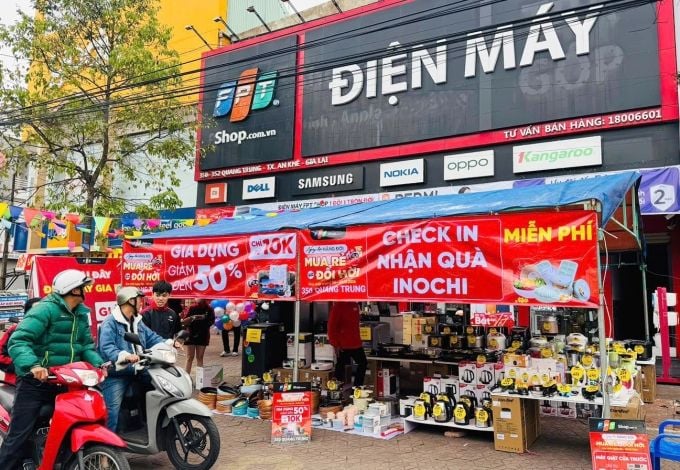
Executives of FPT Shop, a unit of FPT Retail, said the company sees itself as a “latecomer” in Vietnam’s home appliance retail segment. While revenue still trails the market leader, management outlined a strategy to narrow the gap through an installation-focused model and improvements to the customer shopping experience.
FPT Shop previously concentrated on digital devices such as smartphones, laptops, accessories, and SIM cards. The chain entered the home appliances category only two years ago, when Dien May Xanh already had more than 2,000 stores and revenue of nearly 60,000 billion VND.
At the annual shareholders’ meeting on April 17, some investors questioned the rationale and plan for FPT Retail to deepen its involvement in home appliances given the distance from the leader.
Nguyen Viet Anh, Deputy General Director of FPT Retail, said the home appliance market has a development path and scale comparable to ICT, at roughly 5–6 billion USD per year. He added that while ICT is close to saturation, penetration rates for key appliance categories such as air conditioners and washing machines are still only about 60–70%, leaving further growth potential.
He also pointed to seasonality differences: ICT sales tend to peak at the start and end of the year, while home appliances attract more customers during the hottest period in Q2.
Although he did not name Dien May Xanh directly, Nguyen Viet Anh referred to the leader as a “giant” with around 50% market share. He said no other competitor holds a firm second position, leaving the market fragmented and creating room for late entrants such as FPT Shop.
Management argued that being new and smaller gives the chain agility. FPT Shop positions itself as a replacement destination for customers and focuses on optimizing the shopping experience.
Management acknowledged it cannot yet directly compete with the top player. When FPT Shop first entered the category, the rival already had more than 5,000 installation staff.
Instead of rapidly expanding its own workforce, the chain adopted a shared economy model by building an app to connect installers with customers. Management said that during peak sales periods, the rival may struggle to meet installation demand, while FPT Shop can still guarantee a 1–2 day installation timeline.
“This approach has helped many ridesharing companies overtake traditional taxi firms in just a few years,” Nguyen Viet Anh said.
Speaking to VNExpress after the meeting, company leaders said home appliances last year contributed about 8% of FPT Shop’s revenue, or around 1,400 billion VND.
Management said the segment improved store-level performance. As a result, the number of stores declined, but annual revenue rose 11% to over 16,800 billion VND. Leaders also said the home appliances segment did not report losses.
They noted that last year FPT Shop completed the conversion of more than 130 stores from the standard model to “FPT Shop Home Appliances.”
FPT Retail said 2025 is a year of restructuring and rapid expansion, with a push in home appliances and consumer electronics supported by installation services. The company plans to diversify product categories and add more brands in Vietnam.
Beyond FPT Shop, management said the main growth driver at FPT Retail comes from the Long Châu pharmacy chain and vaccination centers. The company leads the pharmaceutical segment with more than 2,400 pharmacies and 220 vaccination centers.
Last year, the pharmaceutical segment generated over 34,500 billion VND, equivalent to roughly 1.2 billion VND in monthly revenue per store.
FPT Retail targets revenue growth of 16% this year to 59,500 billion VND. Pretax profit is expected to reach 1,550 billion VND, up 27% from last year.
Management expects revenue in the first quarter to rise 30% and pre-tax profit to increase 70% year on year. It also flagged challenges in Q2 due to negative factors such as higher interest rates and weakening purchasing power.
The company estimated last year’s average borrowing rate was about 5%. For Q1 this year, it rose to 6%, and management expects it to climb to 7% in Q2.
FPT Retail Chair Nguyễn Bạch Điệp said that amid rising geopolitical tensions, inflation, and interest rates, people are tightening spending. The company said it must prepare for multiple scenarios, including pausing some nonessential projects, negotiating rent, and deferring payables with suppliers.
He added that the company will not hire additional staff even as it expands the number of stores.
“When the market is volatile, our top priority is protecting business efficiency, customer traffic, growth quality, and cash flow rather than expansion at all costs.”


Premium gym chains are entering a “golden era” that is ending or already in decline, as rising operating costs collide with shifting consumer preferences toward more flexible, community-based ways to exercise. Long-term memberships are shrinking, margins are pressured by higher rents and facility expenses, and competition from smaller, more personalized…




