•
•
•
•
•
•
•
•
•
•
•
•
•
•
•
•
•
•
•
•
•
•
•
•
•
•
•
•
•
•
•
•
•


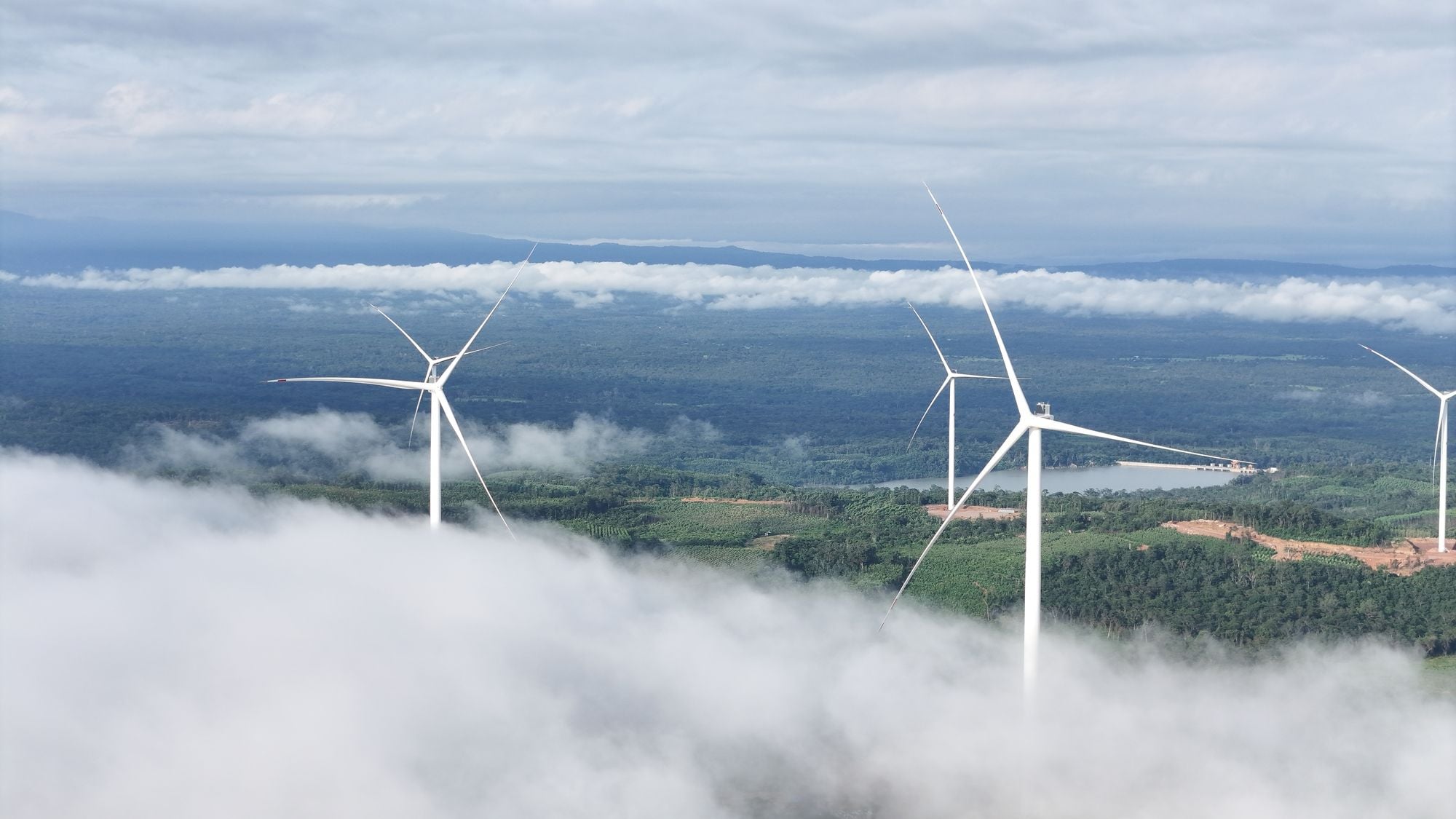
To date, the Savan 1 wind power plant has been operating steadily, delivering about 0.9 billion kWh per year to the national grid. On December 26, 2025, the Savan 1 wind farm officially reached Commercial Operation Date (COD). Power is generated from the Savannakhet wind plateau and transmitted along a dedicated 220 kV line across the border to connect to Vietnam’s grid at Lao Bao. Since COD, the plant has continued to deliver 0.9 billion kWh per year.
On January 9, 2025, the Lao PDR Ministry of Planning and Investment awarded the concession for Savan 1 Wind Power Co., Ltd., a subsidiary of the T&T Group. The concession runs for 25 years. The project capacity is 495 MW, with total investment of about USD 768 million.
At the time of signing, the project established three key pillars: a power purchase agreement with EVN, a financing plan, and a policy to invest in a dedicated 220 kV transmission line to bring electricity to Vietnam.
T&T Group set an ambition to complete Phase 1 of the project—planned capacity 300 MW—by December 2025. The company described this pace as rare for wind projects of this type, noting that cross-border Lao–Vietnam electricity export projects previously required many years, largely due to grid timelines and intergovernmental procedures.
From Vietnam, a five-member task force was formed to conduct on-site surveys, draft detailed plans, and prepare early steps for delivering wind power from Laos to Vietnam.
According to project accounts, the initial survey and construction period faced major access constraints. The plant is located in Phin District, Savannakhet Province, about 100 km southwest of Lao Bao. When the field team arrived, Route 9E extended only to Keng Huapa. To reach the site, the team had to follow jungle trails more than 50 km wide enough for a single vehicle.
Project representatives recalled that there were “three no’s” at the outset: no infrastructure, no water, and no utilities. There was no housing, no mobile signal, no clean water, and no proper access. Early surveying was carried out by manpower, and the team reported that in the first week one person returned to Vietnam, while a second left three months later. Nguyen Quoc Hanh and two others remained, driven by belief in the project’s direction.
With roads absent, entry of heavy machinery into the forest was not possible, requiring the creation of access routes. Tong Van Binh, Deputy General Director of Savan 1, said that 27.7 km of access routes were created to allow heavy trucks to reach the project, along with over 45 km of internal roads for construction support. When the Tangatay Bridge was completed, heavy rain washed away the road below, but the bridge remained the sole passage to keep the site operational.
Alongside ground works, the 220 kV transmission line from the plant to Vietnam was initiated soon after concession signing. The nearly 70 km line, connected directly to the Lao Bao 220 kV substation, was completed in just over six months.
On the ground, more than 1,000 engineers and workers from the investor and contractors continued work under daily schedule pressure. The project also faced logistical challenges, including water shortages. The site reportedly had to buy water from a district 60 km away at high prices for cooking. With no local produce, food was stockpiled weekly, and seeds were brought from Dong Ha to cultivate vegetables.
The project reported that the Lao winds averaged 11 m/s, presenting both an asset for wind generation and a logistical challenge for workers. The first turbine, No. 34, was erected after a few months, followed by 47 more turbines. The operations building and 220 kV substation were also constructed. Commercial operation began on December 26, 2025.
After nearly four months of operation, the plant has delivered hundreds of millions of kWh to Vietnam. In total, the project is expected to provide up to 0.9 billion kWh per year to the national grid.
The project is presented as a model in which a private enterprise invests not only in generation but also in transmission and commercial operation. The article notes that many cross-border wind projects in Laos typically take 24–36 months from concession signing to COD due to infrastructure, transmission, and intergovernmental procedures. Against this backdrop, completing Phase 1 (300 MW) in roughly 16 months is described as a record pace.
Overall, Savan 1 is described as a practical case of private sector energy infrastructure development tied to formalizing energy cooperation between Laos and Vietnam, expanding transmission infrastructure, and supporting broader economic development.






Premium gym chains are entering a “golden era” that is ending or already in decline, as rising operating costs collide with shifting consumer preferences toward more flexible, community-based ways to exercise. Long-term memberships are shrinking, margins are pressured by higher rents and facility expenses, and competition from smaller, more personalized…