•
•
•
•
•
•
•
•
•
•
•
•
•
•
•
•
•
•
•
•
•
•
•
•
•
•
•
•
•
•
•
•
•


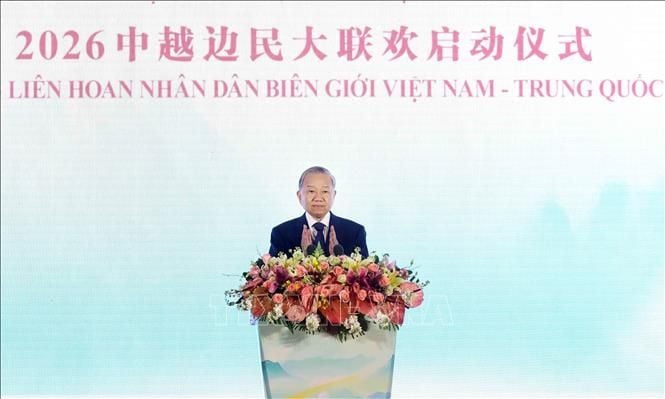
General Secretary and President To Lam called for intensified people-to-people exchanges between Vietnam and China, especially in border areas and among the younger generation. He urged both sides to renew the content and methods of cooperation, linking cultural exchange with science and technology, promoting innovation, and raising living standards for the people.
The Vietnam–China border peoples’ festival was organized by the Vietnam Union of Friendship Organizations in cooperation with the China Association for Friendship with Foreign Countries and the People’s Government of Guangxi Zhuang Autonomous Region. Delegates included representatives from central and local levels, border communities, and youths from both countries.
Speaking at the ceremony, Tran Cuong, a member of the Communist Party of China Central Committee, Secretary of the Party Committee and head of the Standing Committee of the Guangxi Zhuang Autonomous Region’s People’s Congress, said border residents of the two countries have long lived in harmony and provided mutual assistance, reflecting the spirit of “comrades and brothers.” He noted that Guangxi is the only Chinese province bordering Vietnam on land and at sea, and said it will cooperate with Vietnamese border provinces under the guidance of the two countries’ friendship organizations to promote solidarity, cooperation, and mutual support, aiming to realize the overall goal of “six more.”
To Lam said the festival is held in a land rich in historical ties between the two peoples, and that many places in Guangxi have become symbols of unity and shared hardship. On behalf of the Party, State and people of Vietnam, he expressed gratitude to the Chinese Party, State and people, and to Guangxi authorities, for preserving sites connected to President Ho Chi Minh and the Vietnamese revolution and turning them into “red heritage” for generations to learn from.
He said that after more than a century of partnership and 76 years since the establishment of diplomatic ties, the Vietnam–China comprehensive strategic partnership continues to be strengthened and developed, guided by the 16-character motto and the four-principles spirit, opening a new phase through building a Community of Shared Future for China and Vietnam.
To Lam emphasized the important role of the people in building a solid social foundation for bilateral ties, and urged both sides to continue intensifying people-to-people exchanges, especially in border areas and among youth. He also called for renewing cooperation by linking cultural exchange with advancing science and technology, promoting innovation, and improving people’s living standards. He expressed confidence that, with joint efforts by agencies, localities, and the people of both countries, Vietnam–China friendship will continue to develop sustainably and substantively for the benefit of both peoples, contributing positively to peace, stability and development in the region and the world.
On the morning of April 17 in Nanning, Guangxi, To Lam and the high-level Vietnamese delegation visited the Nam Ninh Duc Tai School Campus site, also known as the Nam Ninh Central School. Guangxi University leaders welcomed and accompanied the delegation to a photo exhibition illustrating the school’s history.
At the site, To Lam said he was moved by visiting a historic location closely linked to the friendship “comrades and brothers” between the two Parties, states, and peoples of Vietnam and China. He described Duc Tai School as evidence of heartfelt assistance from the Chinese Party, State and people to the Vietnamese revolution during difficult years, when thousands of Vietnamese students and cadres were nurtured and trained under challenging conditions. He said Vietnam continues to treasure and remember that support, and thanked Guangxi authorities and people for preserving Duc Tai School and other sites connected with Ho Chi Minh and turning them into red heritage sites for future generations.
To Lam also expressed hope that Guangxi University and other educational institutions in Guangxi will continue to serve as knowledge bridges, expanding cooperative education with Vietnamese universities and helping nurture a solid social foundation for Vietnam–China friendship.
Continuing the state-visit program on the morning of April 17 in Nanning, the delegation visited the China–ASEAN Center for AI Innovation Cooperation.




Premium gym chains are entering a “golden era” that is ending or already in decline, as rising operating costs collide with shifting consumer preferences toward more flexible, community-based ways to exercise. Long-term memberships are shrinking, margins are pressured by higher rents and facility expenses, and competition from smaller, more personalized…