•
•
•
•
•
•
•
•
•
•
•
•
•
•
•
•
•
•
•
•
•
•
•
•
•
•
•
•
•
•
•
•
•


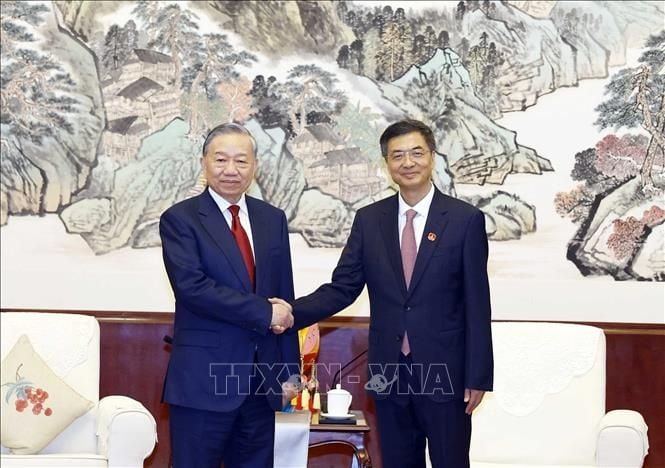
During a state visit to China, General Secretary and President To Lam and his wife, together with a high-level Vietnamese delegation, arrived in Nam Ninh in the Guangxi Zhuang Autonomous Region on the evening of April 16 to continue activities within the visit, at the invitation of Chinese General Secretary and President Xi Jinping and his wife.
In Nam Ninh, To Lam met Tran Cuong, a member of the CPC Central Committee, Secretary of the Guangxi Party Committee, and Head of the Standing Committee of the People’s Congress of Guangxi. The leaders congratulated Guangxi on its development achievements and expressed confidence that the region would continue moving toward modernization and prosperity.
They also recalled that Guangxi was once a “major rear base” of the Vietnamese revolution, where President Ho Chi Minh returned to Cao Bang to directly lead the revolution. To Lam urged Guangxi to leverage its geographic advantages and leadership role to drive breakthroughs in strategic links with Vietnamese localities.
Tran Cuong said he was honored to host To Lam, adding that Vietnam is a close neighbor and top partner of Guangxi. He noted that the Guangxi Party Committee and government attach importance to relations with Vietnamese localities and pledged to implement the common understanding reached between the two General Secretaries.
The two sides said exchanges and cooperation have been positive, with frequent contacts across levels. They highlighted that economic cooperation, trade, and science–technology collaboration have been promoted, and that Vietnam has consistently been Guangxi’s largest trading partner for 27 years.
For future cooperation, To Lam proposed breakthroughs in five strategic connections: development policy; economy and trade; infrastructure and logistics; science and technology; and the social foundation.
To Lam emphasized strengthening economic linkages and ensuring smooth border clearance. He also proposed linking bilateral trade with infrastructure, logistics, supply chains, and markets, while accelerating multi-modal connectivity. He gave priority to rail cooperation, including the Lang Son – Hanoi and Mong Cai – Ha Long – Hai Phong corridors.
On science and technology, To Lam proposed accelerating cooperation to apply artificial intelligence. He also called for implementing green agriculture projects, clean energy initiatives, and high-tech processing, alongside strengthening border management to support people-to-people exchanges and tourism cooperation. He linked this to the Vietnam–China Year of Tourism Cooperation 2026–2027.
Tran Cuong agreed to implement concrete action programs, stating that Guangxi will develop a specific action plan and promote substantive cooperation. He said this would focus particularly on railway infrastructure and high-tech fields such as AI and big data. He added that Guangxi is ready to expand imports of Vietnamese agricultural products, accelerate pilots for smart border gates, and strengthen people-to-people exchanges between Guangxi and Vietnamese localities.
Earlier on the morning of April 16, To Lam and his wife and the delegation traveled by high-speed train from Beijing to Nam Ninh. On the train, Chinese railway industry leaders briefed To Lam on the development of China’s railway industry.
By early 2026, China’s railway system in operation spans 165,000 km, including about 54,000 km of high-speed rail. The briefing said China’s high-speed rail network leads the world and accounts for more than 70% of total global high-speed rail length.
Since the release of the “Medium- and Long-Term Railway Network Plan” in 2004, China has built a railway network connecting major modern urban areas, achieving 99% connectivity for cities with populations over 200,000 and providing rail access to more than 130 county-level areas. Total operational railway length has grown from 68,700 km in 2000 to 165,000 km today, about 2.4 times.
By 2035, China aims to form a modern, high-quality transport network with total length around 700,000 km, of which rail will reach about 200,000 km and play a leading role in the transport system, connecting all county-level administrative units, border gates, and key infrastructure areas.
To Lam said he admired China’s rapid development of the high-speed rail network, describing it as the longest and most widely used in the world, and said he expects continued expansion. He urged continued cooperation with China on rail connectivity for green growth and national development.
He also stressed the importance of collaboration with China in high-speed rail and called on leadership and Chinese enterprises to share experience and support technology transfer for major rail projects in Vietnam.

Premium gym chains are entering a “golden era” that is ending or already in decline, as rising operating costs collide with shifting consumer preferences toward more flexible, community-based ways to exercise. Long-term memberships are shrinking, margins are pressured by higher rents and facility expenses, and competition from smaller, more personalized…