•
•
•
•
•
•
•
•
•
•
•
•
•
•
•
•
•
•
•
•
•
•
•
•
•
•
•
•
•
•
•
•
•


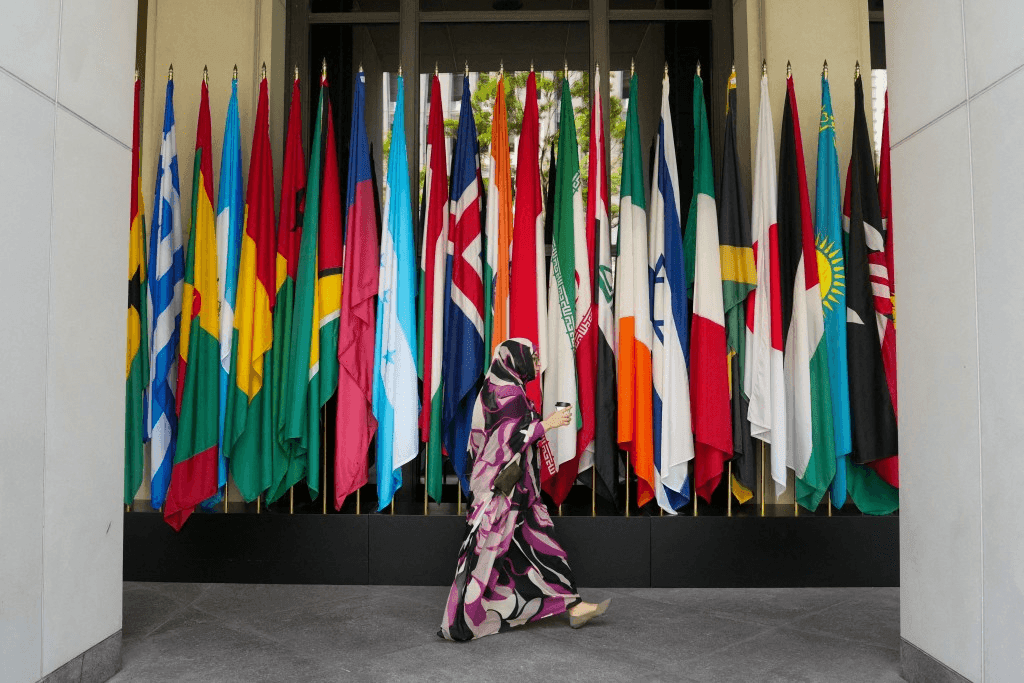
At the IMF and World Bank Spring Meetings in Washington last week, global financial leaders argued that the United States no longer plays the leading role in shaping international order as before, and is no longer seen as the party likely to provide solutions to crises. A long row of flags at IMF headquarters during the IMF/World Bank Spring Meetings in Washington, D.C., on April 16, 2026 — Photo: Reuters Caption: A long row of flags at IMF headquarters during the IMF/World Bank Spring Meetings in Washington, D.C., April 16, 2026 — Photo: Reuters During the week, global finance chiefs repeatedly revised their view on the world growth outlook in line with developments in the Iran crisis. This reality shows their room to mitigate economic losses from geopolitical shocks is narrowing. In addition, the belief that the U.S. will always play a decisive role in resolving crises is no longer as certain as before. At the IMF and World Bank Spring Meetings in Washington held April 14–18, 2026, delegates’ sentiment shifted rapidly as energy markets moved. NARROWING ROOM FOR POLICY ACTION Concerns about the global economic outlook worsening due to sharp energy price increases and supply disruptions only eased temporarily when signals emerged that Iran might reopen the Hormuz Strait, thereby restoring flows of oil, gas, fertilizers, and many other commodities. However, on Saturday (April 18), that optimism quickly faded as tensions along the Hormuz route intensified again. IMF and WB pledged up to $150 billion in financial support for developing countries most affected by energy price shocks. They also welcomed resuming working relations with the interim Venezuelan government after seven years of interruption. IMF and WB also warned countries not to stockpile oil and to avoid expensive, poorly targeted fuel subsidies. Yet even so, IMF and WB have limited room to intervene, because decisive developments at this moment depend mainly on signals from Tehran and Washington. "In practice, the biggest decisions affecting the global economy were not taken at this meeting. The factor with the greatest impact on the global economy now lies in the dynamics between the United States and Iran. We hope for positive signals, but we must wait," said Josh Lipsky, President for International Economics at the Atlantic Council, when referring to the IMF/WB spring meeting. While stock markets rose sharply and oil prices fell on Friday (April 17) as Iran announced it would fully reopen the Hormuz Strait, Saudi Finance Minister Mohammed Al-Jadaan cautioned that it is too early to forecast improvement. He said improvement would only occur when ships can move freely again through Hormuz, insurance costs fall to reasonable levels, and energy prices cool in the physical market. "If this shipping lane is truly opened, that would be the factor enough to change my assessment of the outlook," Al-Jadaan said at a press conference. Soon after IMF lowered its global growth forecast for 2026 to 3.1% in the most optimistic scenario among the three built scenarios, the organization also admitted that the figure quickly ceased to be compatible with newer developments. According to IMF, the world economy is gradually tilting toward the downside scenario, with growth possibly only at 2.5%. In the IMF’s latest World Economic Outlook published at the spring meetings, IMF warned that a prolonged Iran conflict could push the global economy into a recession. CONTINUING SHOCKS AMID SHOCKS Analysts say that before the U.S. and Israel began airstrikes on Iran in late February, the global economy had just begun to recover from the tariff shocks that the Trump administration had imposed on trading partners worldwide in the previous year. At this year’s spring meetings, topics of trade tensions and the Ukraine conflict had cooled somewhat. Nevertheless, the G7 finance ministers still pledged to keep pressuring Russia. However, Lipsky noted that the sequence of shocks—from the Covid-19 pandemic in 2020 to the Russia-Ukraine conflict in 2022—has made many countries realize that the U.S. no longer leads the international order as before and is no longer seen as the party that provides crisis solutions. On Friday, U.S. Treasury Secretary Scott Bessent launched an initiative urging the G20, IMF and World Bank to coordinate actions to secure fertilizer supply amid disruptions to exports from Gulf states. After seven weeks of conflict, this move has yet to ease shortages and high fertilizer prices farmers in the Northern Hemisphere face during the spring planting season. According to Kevin Chika Urama, Chief Economist of the African Development Bank (AfDB), the Middle East crisis once again shows that African countries need to push for regional trade and economic integration, develop alternative energy sources, broaden domestic tax bases, and better exploit large natural gas reserves. "Geopolitical tensions have become the new normal, while policy uncertainty now seems almost a certainty," Urama said in a session at the Spring Meeting. GLOBAL OIL SUPPLY DAMAGE AFTER MORE THAN 7 WEEKS OF US-IRAN WAR 10:27, 21/04/2026 (The article continues with related headlines on the page.) CEASEFIRE AGREEMENT NEAR EXPIRY, TRUMP STEPS UP PRESSURE ON IRAN 10:13, 21/04/2026 5 BIGGEST CONCERNS OF CENTRAL BANK CHIEFS AMID THE MIDDLE EAST CONFLICT 07:38, 21/04/2026 THE MIDDLE EAST CRISIS HIGHLIGHTS THE INTERNATIONAL ECONOMY’S VULNERABILITIES (Additional headlines and keywords follow in the original page.)






Premium gym chains are entering a “golden era” that is ending or already in decline, as rising operating costs collide with shifting consumer preferences toward more flexible, community-based ways to exercise. Long-term memberships are shrinking, margins are pressured by higher rents and facility expenses, and competition from smaller, more personalized…