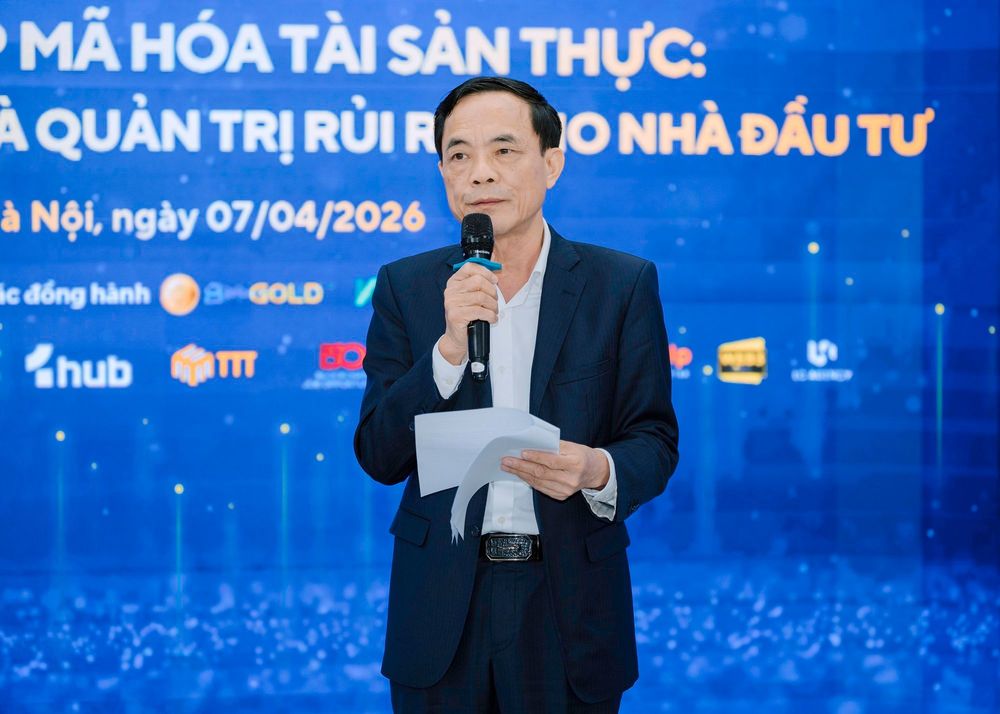
At a conference on April 7 organized by the Vietnam Blockchain and Digital Assets Association (VBA) on Real Asset Tokenization (RWA): Balancing benefits and risk governance for investors, Major General Dang Vu Son, former head of the Government Cipher Bureau and senior VBA advisor, said that if designed correctly, tokenized assets can open a new investment channel and also serve as digital trust infrastructure for the economy in the digital era.
“The biggest opportunity for Vietnam is not just to move fast, but to move correctly from the start. In a global capital market restructuring under blockchain technology, a methodical approach to institutions, standards, and governance will determine Vietnam’s ability to participate deeply in the new digital financial structure,” he emphasized.
From an investment perspective, Mr. Nghiem Minh Hoang, Head of RWA - VIDA under VBA, cited Boston Consulting Group (BCG) projections that the global RWA market is expected to reach $19,000 billion, equivalent to about 10% of global GDP by 2033. He also noted Vietnam is viewed as a market with strong growth potential, with expected momentum reaching $70–80 billion by 2030.
Mr. Hoang further said that the real assets tokenization platform (RWA platform) has been identified as a key product in the national blockchain program under Prime Minister’s Decision 2815/QĐ-TTg.
Speakers said achieving these targets requires the RWA market to develop a legal framework and market infrastructure linked to transparent risk governance. Risk governance was described as a top priority not only for investors, but also for issuers, exchanges, and regulators.
Experts at the workshop discussed tokenization of gold and other assets, stressing that the core focus should be designing a multi-layer risk-control system. They said real assets must be custodied separately with clearly defined ownership, supported by independent audits to ensure reserve transparency.
On that foundation, blockchain would be used to record and track transactions, while the financial application layer would determine how the assets operate.
Dr. Do Van Thuật, Director of Solutions and Architecture Blockchain at 1Matrix, highlighted the central challenge of ensuring authenticity between real assets and on-chain data. He said this requires a combination of reliable real-world data feeds (oracles), independent audits, stringent technical standards, and real-time price synchronization to maintain market confidence.