•
•
•
•
•
•
•
•
•
•
•
•
•
•
•
•
•
•
•
•
•
•
•
•
•
•
•
•
•
•
•
•
•

The bid-ask spread for gold has narrowed significantly, now at about 2 million VND per tael, down from as high as 5 million VND per tael last week.
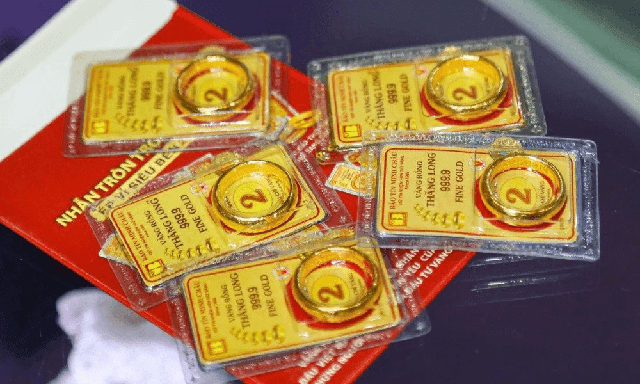
At SJC, bullion prices rose by 1.5 million VND per tael for buying and by 1 million VND per tael for selling. Bullion is currently quoted at 149.5–151.5 million VND per tael. The price of plain gold rings was also adjusted higher to 149.4–151.4 million VND per tael.
At DOJI, bullion is quoted at 149.5–151.5 million VND per tael, while plain gold rings are at 150.0–152.0 million VND per tael.
In early morning trading on June 16 at SJC, bullion was quoted at 148.0–150.5 million VND per tael, and plain gold rings at 147.9–150.4 million VND per tael. Bao Tin Minh Chau quoted bullion and plain gold rings at 148.0–150.5 million VND per tael.
At DOJI, bullion was also at 148.0–150.5 million VND per tael, while ring prices were slightly higher at 148.5–151.0 million VND per tael. At PNJ, bullion was quoted at 148.0–150.5 million VND per tael, but ring prices were lower at 147.5–150.5 million VND per tael.
On the international market, gold was quoted at 4,328 USD per ounce, little changed from early trading. The spot price was 4,314 USD per ounce, equivalent to about 138 million VND per tael based on the bank’s USD rate, excluding taxes and fees.
Gold prices rose again in Monday trading after a preliminary agreement between the US and Iran to reopen the Hormuz Strait helped oil slide, easing inflation fears and pulling U.S. Treasury yields lower.
Brent crude fell 4.8% to $83.17 per barrel, returning to early-March levels after the US and Iran reached a preliminary agreement to extend the ceasefire and reopen the Hormuz Strait. This reduced the risk of global energy supply disruptions and eased inflation pressures.
U.S. government bond yields also declined as oil fell. The 10-year U.S. Treasury yield dropped to 4.47% from 4.48% at last Friday’s close.
The Hormuz Strait remains a key geopolitical link affecting gold, oil, interest rates, and risk assets. Markets view the latest US–Iran developments as cooling tensions, though risks remain in implementing the agreement.
Under the preliminary agreement, the route will be opened again and the US will lift its naval blockade. However, the deal does not resolve disputes over Iran’s nuclear program, and further negotiations are expected to take about 60 days.
For the gold market, the impact is mixed but overall positive: lower oil prices ease inflation pressures, which helps pull yields lower and supports gold. At the same time, safe-haven demand softens as geopolitical tensions ease, partly limiting the metal’s upside.
Equities and credit markets are benefiting more clearly, as lower oil prices improve the corporate profit outlook, ease rate pressures, and boost investors’ risk appetite. For the energy market, the initial reaction was a sharp drop in oil prices, and restoring full oil and gas flows through the Gulf region is expected to take several more months.

Bitcoin (BTC) investors who use steady dollar-cost averaging (DCA) may be underperforming versus strategies that adjust exposure to the market’s cycle, according to new research arguing that Bitcoin’s behavior differs from traditional long-duration assets.
In a report cited by Markus Thielen of 10x Research, Bitcoin’s market…