On Kitco
News,
market analysts said that
gold prices could continue to rise next week after having posted three weeks of gains.
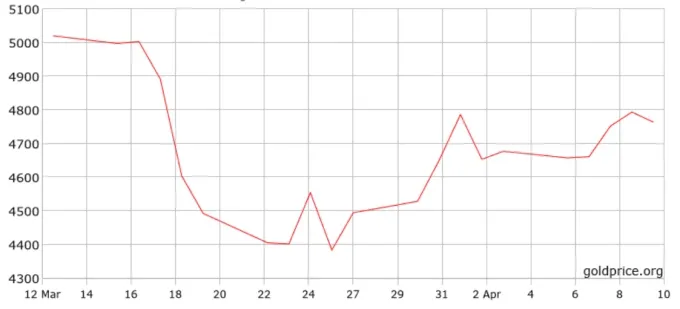
The gold market this week remained influenced by news of the conflict in the Middle East. Prices jumped on April 8 and 9, surging past $4,800 an ounce after the United States and Iran announced a ceasefire lasting two weeks. The precious metal then eased, fluctuating in the $4,700-$4,800 range in the remaining sessions.
Nevertheless, this week's Kitco News survey of bank executives, analysts and investors shows they are ready to return to the market after the precious metal marked its third consecutive weekly gain.
According to the survey results, 50% of participants expect prices to rise next week. Only 14% forecast a decline and 36% expect the market to move sideways.
Caption: Price movements of world gold over the past month. Chart: Goldprice.
Adrian Day, president of Adrian Day Asset Management, said, 'If the ceasefire holds, monetary factors, such as inflation, will again drive the market. If the conflict escalates, gold's role as a safe-haven instrument will be further emphasized.'
On April 11, U.S. Vice President JD Vance said negotiations with the Iranian delegation in Pakistan ended after 21 hours without reaching an agreement. He said the U.S. clearly outlined red lines, concessions offered and non-negotiable terms, but Iran 'chose not to accept these terms'.
Rich Checkan, director of operations at Asset Strategies International, said, 'gold has been sold off too aggressively recently'. 'Gold prices are likely to continue higher, targeting $5,000 and above,' he expects. However, Checkan warned that if the ceasefire agreement proves fragile, gold could decline. Gold could be sold off in the short term if market liquidity diminishes.
In contrast, Darin Newsom, a market analyst at Barchart.com, projects a short-term decline. He argues that gold futures for June are approaching a high, signaling the downtrend beginning to form.
Colin Cieszynski, chief market economist at SIA Wealth Management, maintains a neutral stance on gold in the near term, but emphasizes that prices are unlikely to stabilize. 'I think gold could swing sharply, but it's hard to tell the direction. Prices could reverse a few times in a single day,' he said.
Looking at recent inflation data, he thinks the previous rally in gold largely reflected this. On April 10, the U.S. Bureau of Labor Statistics said the CPI rose 3.3% in March—the highest in nearly two years. Much of the increase was driven by energy prices, which have risen since the Middle East conflict began.
Cieszynski says the gold trend is shifting from upward to sideways. The current trading range could span hundreds of dollars, but determining the near-term trend is nearly impossible. 'That depends on the evolution of the conflict. This week, ceasefire news boosted gold, while earlier, when President Donald Trump threatened to attack Iran, prices fell,' he said.
Next week, investors will receive several U.S. economic data releases, including the producer price index, March existing home sales and weekly unemployment claims.
— Hà Thu (according to Kitco, Reuters)