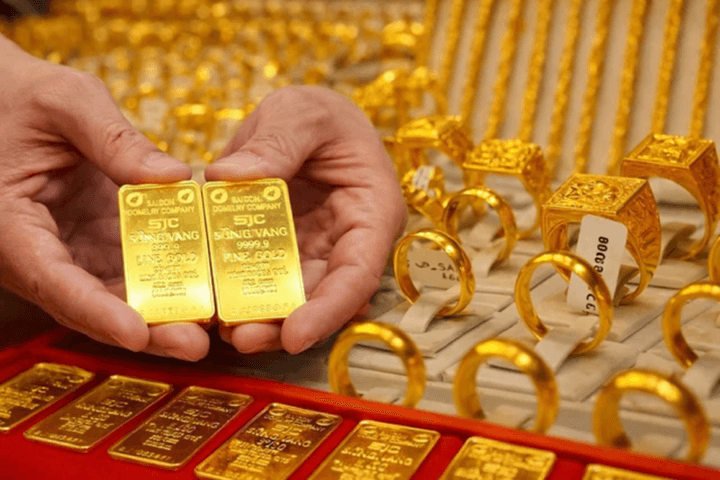
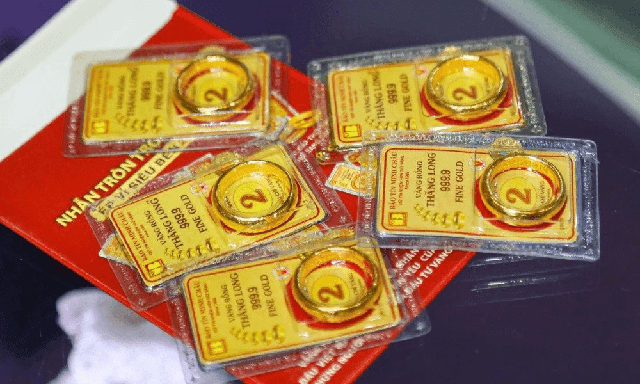
Gold prices fell sharply as global prices faced pressure in late Friday trading, with U.S. Treasury yields stabilizing, the U.S. dollar strengthening, and hawkish Federal Reserve commentary on inflation weighing on sentiment. In line with the global trend, domestic gold prices also eased. Specifically, SJC gold bars quoted by Saigon Jewelry, Bao Tin Minh Chau, and Doji stood at 159–162 million VND per tael for buy/sell, down 400,000 VND per tael from the morning session. Gold jewelry bars were listed at 58.5–161.5 million VND per tael (buy/sell), down 400,000 VND per tael from the prior session.
The world price of gold was around 4,504 USD per ounce on Kitco, down about 38 USD per ounce from the previous session. The domestic market followed lower, as the gold market slid for a second straight week, pressured by higher oil prices, rising inflation concerns, and expectations that the Fed may continue to tighten monetary policy. If central banks maintain high interest rates, gold demand could remain pressured, even though gold has historically served as a safe-haven asset.
Experts say the trajectory of oil is a key driver for gold movements. Rhona O’Connell of StoneX noted investors are particularly worried about potential global supply disruptions related to the Hormuz Strait, a critical oil shipping route. She added that rising energy costs are fueling inflation fears, which in turn keep expectations for additional Fed rate hikes alive.
Fed Chair Kevin Warsh was sworn in on May 22 at the White House with a pledge to pursue reform at the U.S. central bank, while President Trump asserted the Fed operates with complete independence.
Gold remains volatile, and investors are urged to exercise caution in allocating capital. Nguyen Quang Huy, CEO of the Finance-Banking Faculty at Nguyen Trai University, said that, according to CME’s FedWatch, the market currently assigns about a 58% probability that the Fed will raise rates at least once more by 0.25 percentage points before year-end.
This view is reinforced after Fed Governor Christopher Waller suggested removing the tilt toward monetary easing, leaving open the possibility of higher rates if inflation persists.
After a period of rapid gains and a sustained run to new highs, the gold market is now showing a notable pullback. The international price sits around 4,504 USD/oz, down roughly 38 USD/oz from the early session, while domestic prices have also moved lower by around 400,000 VND per tael.
The pullback is largely attributed to profit-taking after a prolonged rally. Additionally, a stronger USD and fluctuations in U.S. Treasury yields have weighed on gold prices. In a climate of evolving expectations for policy rates, capital flows have shifted more flexibly across asset classes, contributing to near-term volatility in gold.
Nonetheless, the current decline does not signal a complete reversal of the longer-term trend. The gold market remains supported by fundamentals such as inflation risk, geopolitical uncertainty, central-bank diversification of reserves, and demand for risk-off assets amid ongoing global economic uncertainty.
Looking ahead to next week, gold could continue to exhibit substantial volatility as markets track Fed policy signals, the dollar’s direction, and international data releases. In the near term, gold may experience technical corrections, but the high price level currently suggests a cautious stance remains prudent for investors.
"The most important thing for investors now is risk management and psychology control. After a sharp rally, the gold market is entering a more volatile phase, and chasing gains or using high leverage could entail significant risks," according to Mr. Huy.
Gold remains a vital long-term hedge, but given the current environment, a prudent allocation, risk-aware strategy, and capital preservation are deemed more appropriate than short-term speculative behavior.
Source: Pham Duy. [Source: VTC News] 05/23/2026 11:53 (GMT +7)