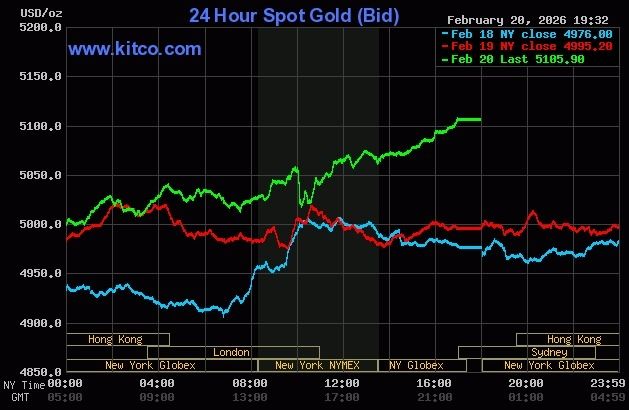
Gold prices rose worldwide and U.S. stock indices gained after U.S. GDP data and a Supreme Court ruling on tariffs boosted market sentiment. At the close of February 20, spot gold rose by $111 to $5,105 per ounce, as markets reacted to weaker-than-forecast Q4 2025 GDP growth of 1.4% (down from economists’ expectations of 3%). The slowdown was attributed in part to a government shutdown and softer consumer spending. The personal consumption expenditures (PCE) price index—the Federal Reserve’s preferred inflation gauge—also rose more than expected in December 2025.
Bob Haberkorn, a market strategist at RJO Futures, said: “The data show inflation remains, but the weak GDP suggests the economy has not yet reached a turning point. There are too many unknowns and risks. This is supportive for gold.”
Other precious metals also rallied. Silver rose nearly 6% to $82.9, platinum added 4.5% to $2,163, and palladium gained 4% to $1,751.
U.S. stock markets increased as the Supreme Court ruling was seen as potentially easing costs for companies. The S&P 500 advanced 0.7% to 6,909, the Nasdaq Composite rose 0.9% to around 22,900, and the Dow Jones Industrial Average closed at 49,625, up roughly 0.5%.
Amazon shares climbed more than 2% following the ruling, while Home Depot and Five Below also rose on expectations of benefiting from the decision.
The Supreme Court has not yet ruled on whether the government must reimburse tariffs paid by companies. Michael Brenner, a market analyst at FBB Capital Partners, said that if refunds occur, it could be a major economic stimulus. Estimates from the Penn-Wharton Budget Model put refunds at up to $175 billion.
Hà Thu (Reuters, CNBC).