•
•
•
•
•
•
•
•
•
•
•
•
•
•
•
•
•
•
•
•
•
•
•
•
•
•
•
•
•
•
•
•
•


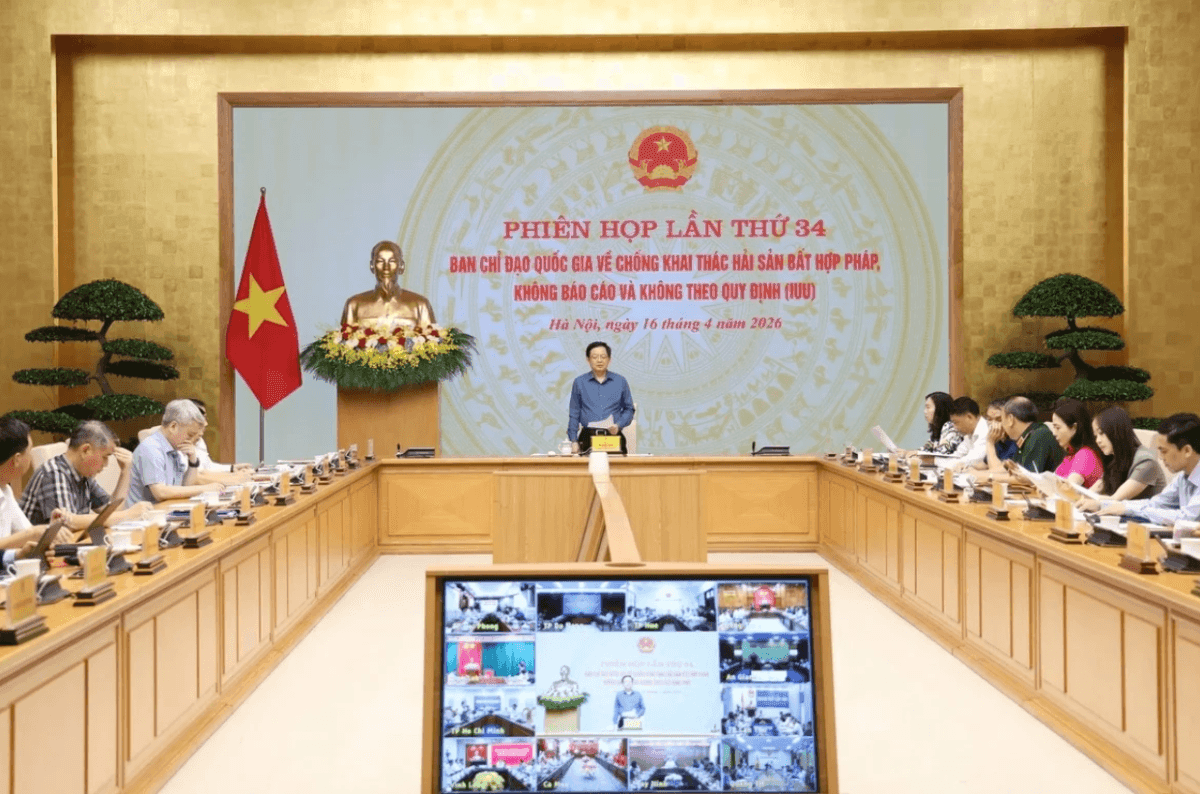
On April 16, 2026, Deputy Prime Minister Ho Quoc Dung chaired the 34th meeting of the National Steering Committee on combating IUU fishing at the Government Office, with participation from leaders of central ministries and agencies and representatives from 21 coastal provinces, held both in person and online.
Vietnam has not yet received the European Commission’s “green light” to remove the IUU “yellow card” for its fisheries. In March 2026, EC inspectors visited Vietnam, but the yellow card remains in place.
Deputy Minister of Agriculture and Rural Development Nguyen Hoang Hiep said that after more than eight years of implementing anti-IUU measures, Vietnam’s legal framework has been largely completed and aligned with international regulations and practical conditions.
He also reported that Vietnam has built a relatively comprehensive fisheries management database, including the National Fisheries Database (VNfishbase), a fishing vessel monitoring system, an electronic seafood traceability system, and an administrative violations database. These systems have been connected and shared from central to local levels and linked with the national population database.
As of 14/4/2026, Vietnam has 80,350 fishing vessels of 6 meters and above registered in the system, of which over 76,700 vessels still hold valid fishing licenses.
Regarding port infrastructure supporting origin traceability, the Deputy Minister said Vietnam has 86 ports eligible to operate, 72 ports eligible to receive distant-water vessels, and 51 ports eligible to verify the origin of harvested seafood.
He added that electronic logbooks and electronic traceability have been deployed to meet full traceability requirements, ensuring transparency and legality of seafood products and enabling connection with EU and FAO systems.
The meeting noted positive changes in law enforcement, including a significant decline in the number of Vietnamese fishing vessels violating IUU rules abroad.
In particular, during the fifth inspection round (March 2026), the EC recorded progress in handling IUU violations, especially illegal fishing in foreign waters, and said fishermen’s compliance with the law has improved.
Despite reported progress, the Ministry of Agriculture and Rural Development said several issues have not been fully resolved and remain the main causes preventing removal of the yellow card.
According to the ministry, some localities still do not strictly implement vessel marking, record registration numbers, and control outbound and inbound activities at ports. Monitoring of seafood production at ports was also described as lax.
The meeting further cited that control and traceability of imported seafood raw materials by container ships are not tight and are not uniformly implemented across enterprises. It also said the pace of violation handling is slow, coordination is insufficient, and data are not fully updated as required by the EC.
The ministry attributed the remaining problems to limited law enforcement capacity in some localities, non-decisive leadership, and resource shortages. It also pointed to gaps in port infrastructure, surveillance technology, and management personnel, and said the lack of alternative livelihoods for fishermen hinders resolution of violations.
Concluding the meeting, Deputy Prime Minister Ho Quoc Dung said the problems have been raised repeatedly but persist, and that the main reason for not achieving results lies in implementation rather than the availability of regulations.
He required changes in how implementation is organized, clearer assignment of responsibilities, and stronger inspection and follow-up. Ministries and localities were asked to review previous directives, especially tasks already assigned, while the Government Office was tasked with consolidating and reporting progress clearly.
For the Ministry of Agriculture and Rural Development, the Deputy Prime Minister requested expedited restructuring and the establishment of an inter-agency task force operating regularly, conducting direct inspections and prompting at the local level. He also asked for finalization and submission of a new decree to replace Decree No. 38/2024/ND-CP to increase penalties and strengthen deterrence as requested by the EC.
He further called for a comprehensive review of the fisheries legal framework and management procedures to address shortcomings and ensure alignment with international integration requirements.
To improve effectiveness, the Deputy Prime Minister called for increased checks and supervision at the local level, with accountability tied to local leaders. The Ministry of National Defense was asked to cooperate to tighten sea control and prevent new IUU violations in foreign waters, while border guards were instructed to monitor from the moment vessels depart, combining outreach and early prevention.
The Public Security Ministry was directed to continue investigations and strictly handle violations, especially networks facilitating foreign-flag fishing. The Ministry of Finance was asked to review seafood import-export processes, clarify violations in line with EC recommendations, and propose resources to support anti-IUU work.
Local coastal areas were told to focus on fully addressing remaining issues, including installing voyage-tracking devices, controlling port entry and exit, tracing seafood origins, and penalizing violations. The meeting also raised the option of establishing interagency port committees to strengthen on-site supervision.

Premium gym chains are entering a “golden era” that is ending or already in decline, as rising operating costs collide with shifting consumer preferences toward more flexible, community-based ways to exercise. Long-term memberships are shrinking, margins are pressured by higher rents and facility expenses, and competition from smaller, more personalized…