•
•
•
•
•
•
•
•
•
•
•
•
•
•
•
•
•
•
•
•
•
•
•
•
•
•
•
•
•
•
•
•
•


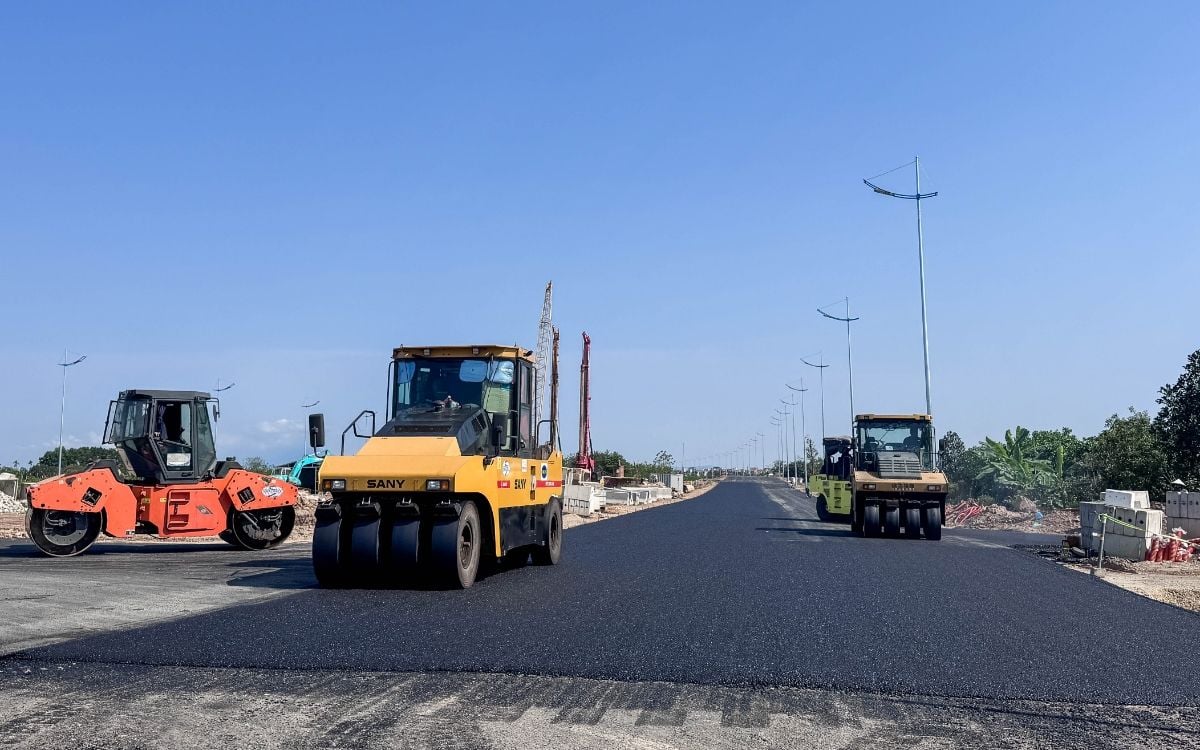
On the afternoon of April 15, the Hanoi People’s Committee held an online conference with 17 localities to review the progress of major transport projects in the city. Hanoi Chairman Vu Dai Thang urged departments, agencies, and localities to promptly remove obstacles, accelerate implementation, and treat transport infrastructure as a key driver of the capital’s economic and social growth.
According to a report from the city’s Project Management Board for transport construction, the Hanoi segment of Beltway 4 - Inner Hanoi (Vành đai 4 - Vùng Thủ đô) runs 59.2 km through 17 communes.
To date, land clearance is basically complete, with more than 800 hectares reclaimed. All 13 resettlement areas have completed construction, and over 9,000 graves have been relocated as planned. The high-voltage transmission system from 110kV to 500kV has been largely relocated, with only a few minor items still being finalized.
On construction, Component 2.1 (the parallel road) has achieved about 85% of the project’s output value and is expected to complete an engineering handover in June 2026. Component 3, invested via BOT, is being accelerated to meet the schedule supporting the APEC 2027 summit.
For national railway projects, Hanoi is at the initial stage of land clearance for two key lines: the Hanoi–Bắc Nam high-speed rail and the Lao Cai–Hanoi–Hai Phong line.
The Hanoi section of the Bắc Nam high-speed line through Hanoi is nearly 28 km long, with an anticipated land acquisition of about 126 hectares. The Lao Cai–Hanoi–Hai Phong line, spanning more than 43 km through the city, requires about 310 hectares.
Related localities have established steering committees and compensation councils, reviewed the scope of land withdrawal, and prepared resettlement. The city plans to allocate 11 resettlement areas totaling about 70 hectares and 9 cemetery sites.
However, boundary demarcation cannot yet proceed due to the absence of an official request from the investor and relevant localities.
Regarding the urban rail system, the Hanoi Department of Construction said the planned metro network comprises 14 lines totaling about 616.9 km and could be expanded to 18 lines, nearly 1,000 km in the long term.
To date, only 21.55 km (about 3.5% of the plan) are in operation. A total of 54.42 km are under construction, while most of the remaining portions have not yet started.
At the conference, leaders of various departments and localities proposed measures to remove bottlenecks and speed up progress.
Vice Chairman Nguyen Xuan Luu urged agencies to take initiative and act without waiting for a perfect mechanism, while ensuring consistency of information from the city to the grassroots level.
Permanent Vice Chairman Duong Duc Tuan emphasized resolving long-standing issues, diversifying investment sources, combining the budget with public-private partnerships, issuing bonds, and pursuing international cooperation.
In concluding remarks, Chairman Vu Dai Thang said transport infrastructure development is a key task in Hanoi’s development strategy, aligned with the Hanoi Master Plan for 100 years and the implementation of the revised Capital Law.
The city is directly directing major projects including beltways, urban rail, and national rail, viewing them as decisive for improving connectivity and shaping the urban development space.
The Chairman urged agencies to continue reviewing and promptly address issues related to land, materials, prices, and construction. Matters beyond their authority should be reported immediately for resolution.
For national rail, the focus is on speeding up land clearance and coordinating closely with ministries to determine routes and boundaries soon. For urban rail, Hanoi identified it as a pillar for the next phase, prioritizing finalizing planning, technical standards, and the investment roadmap for key lines such as Line 1 and Line 6. The city will also prioritize completing Beltways 3 and 3.5 and study Beltway 5 in a practical manner to strengthen regional linkage.

Premium gym chains are entering a “golden era” that is ending or already in decline, as rising operating costs collide with shifting consumer preferences toward more flexible, community-based ways to exercise. Long-term memberships are shrinking, margins are pressured by higher rents and facility expenses, and competition from smaller, more personalized…