•
•
•
•
•
•
•
•
•
•
•
•
•
•
•
•
•
•
•
•
•
•
•
•
•
•
•
•
•
•
•
•
•


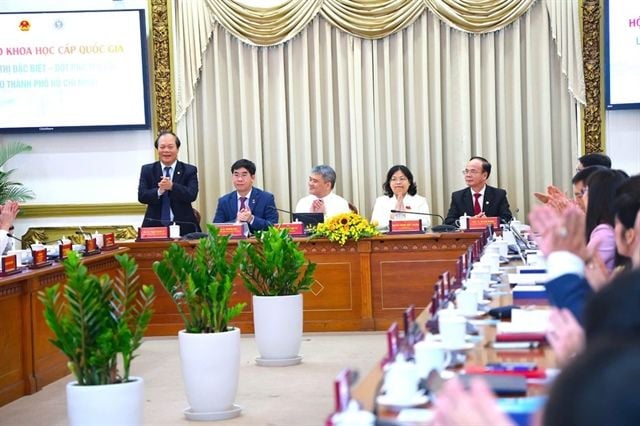
On the morning of May 8, the Standing Board of the Ho Chi Minh City People’s Council, in cooperation with Ho Chi Minh City University of Law, held a scientific conference on the Special City Law, described as a breakthrough instrument for the city. Deputy Justice Minister Nguyen Thanh Tu said the law’s main focus is decentralization and substantive empowerment, aimed at unlocking Ho Chi Minh City’s development potential as a super-metropolis.
Nguyen Manh Cuong, a full member of the Central Committee of the Communist Party and Vice Chairman of the Ho Chi Minh City People’s Committee, said the Special City Law is expected to play a significant role in the city’s development. He noted that the City’s Standing Committee has formed a drafting team and a steering committee to draft a new resolution to replace Resolution 31 and the Special City Law, and to report to central authorities.
Cuong said Ho Chi Minh City faces strong expectations from the Party, authorities, and people, as well as leadership at the central level, for a stronger legal framework suited to the city’s development. He pointed to challenges linked to growth transformation, digital transformation, green transformation based on science and technology, and innovation, which require a more unified and coherent legal framework.
The law is expected to define the city’s development model as a super metropolis and leading unit in economic and social development, while increasing decentralization and delegation from the city government to the grassroots to maximize the use of resources and authorities.
Dr. Nguyen Thi Thien Tri of Ho Chi Minh City University of Law argued that the Special City Law should function as a general instrument for special cities, using Ho Chi Minh City as the benchmark. She said it could also apply to Hanoi if designed with greater advantages.
Tri noted that, under National Assembly Standing Committee rules, there are only two special cities: Hanoi and Ho Chi Minh City. She proposed using Ho Chi Minh City’s practical experience to set a normative framework.
She said the law should be a lean and special statute and operate as a mechanism law, where issues in special cities are resolved through mechanisms rather than prescriptive regulations. On the delineation of powers, she suggested combining top-down and bottom-up decentralization to ensure genuine devolution through a reasonable allocation of powers.
Tri said some areas would retain a traditional centralized model for key sectors controlled by the central government, including macro fiscal policy, national security, foreign affairs, human rights, procedures, and land issues uniquely relevant in Vietnam. She also proposed determining which issues belong to the locality and which are national, applying bottom-up mechanisms accordingly, and using decentralization through the Parliament rather than through the Government and ministries.
To address institutional bottlenecks and prevent situations where localities must seek permission, Tri proposed mechanisms for exemption from liability and for oversight of the city government to ensure strong decentralization does not lead to abuse while boosting initiative and creativity. She emphasized the need for bold thinking and action, noting that the city differs from rural areas and requires the government to frequently identify problems and propose breakthrough solutions.
Tri also said the law currently provides exemptions but not at a scale sufficient to unlock human resources, and that additional special exemptions for city governments are needed. She called for stronger oversight mechanisms, replacing traditional pre-approval approaches with post-audit style controls and increasing citizen involvement in supervision, inspection, and audit. She stressed that decentralization must go hand in hand with accountability.
Deputy Minister Nguyen Thanh Tu said building the Special City Law for Ho Chi Minh City is urgent, difficult, and time-constrained. He said the city has many special characteristics, making the design of a separate mechanism highly complex.
He said the city must follow the conclusions of the General Secretary and President that the country is for Ho Chi Minh City and Ho Chi Minh City is for the country, to determine the law’s name and scope. He listed six key priorities: breaking through governance and decentralization; concretizing strategic resolutions; reforming planning; mobilizing resources for infrastructure development; strengthening regional linkages; and addressing bottlenecks such as traffic, floods, and environmental pollution.
Tu said the aim is to focus on mechanisms and policies that can deliver rapid progress. On planning, he said the law should adopt a 100-year holistic time horizon rather than separating city planning from urban planning as currently practiced. He added that expanding development space will rely on regional linkages because the current area does not offer enough room for a true super city.
At the same time, Tu said the law must define clear limits, avoiding implications for national defense, security, foreign affairs, or religion. He also emphasized granting additional powers to the City People’s Council to issue normative legal documents to proactively address local issues.
Tu distinguished between sandbox and policy testing. He said sandbox applies to specific projects, while policy testing empowers the City People’s Council to enact normative legal documents to test new mechanisms.
He said regional coordination is essential to broaden the city’s development space and that Ho Chi Minh City could study a regional council model to coordinate cross-regional projects and allow cross-regional projects to benefit from the law’s special mechanisms.
Tu urged identifying Ho Chi Minh City’s unique features, including the maritime economy and space development, as potential breakthrough areas.
Tu said a framework of decentralization is a general condition, but rapid change requires concrete tasks that can be implemented immediately to boost economic and social development. He cited experience from drafting the Capital Law, suggesting implementing three elements: political basis, legal basis, and long-term development planning.
He said the city should work closely with ministries and experts to craft regulations that are practical and reflect real conditions. He added that building the Special City Law for Ho Chi Minh City is not only a local issue but a national mission, and that the Ministry of Justice and other ministries will accompany the city through the drafting process.
Thanh Tuyền – Le Thoa contributed to this report.
Premium gym chains are entering a “golden era” that is ending or already in decline, as rising operating costs collide with shifting consumer preferences toward more flexible, community-based ways to exercise. Long-term memberships are shrinking, margins are pressured by higher rents and facility expenses, and competition from smaller, more personalized…