•
•
•
•
•
•
•
•
•
•
•
•
•
•
•
•
•
•
•
•
•
•
•
•
•
•
•
•
•
•
•
•
•


At a fundamental level, institutions tend to evaluate core infrastructure metrics such as transaction speed, execution costs, and settlement finality when choosing a Layer-1 network. The logic is straightforward: faster confirmation times and lower fees allow a blockchain to handle higher transaction throughput, supporting a smoother user experience.
Viewed through this lens, Solana stands out. Over the past week, Solana processed 696 million transactions, while every other chain combined processed about 593 million. One network alone generated more activity than the rest of crypto, accounting for 54% of total on-chain transactions (Source: Token Terminal).
High transaction volume is often a reflection of a chain’s underlying metrics. Comparing Solana with Ethereum highlights the gap. According to Chainspect data, Solana’s transaction fees are nearly 100% lower than Ethereum’s. In addition, the first successful Alpenglow upgrade reportedly cut finalization times from roughly 12.8 seconds to around 100–150 milliseconds, moving Solana closer to near-instant settlement speeds.
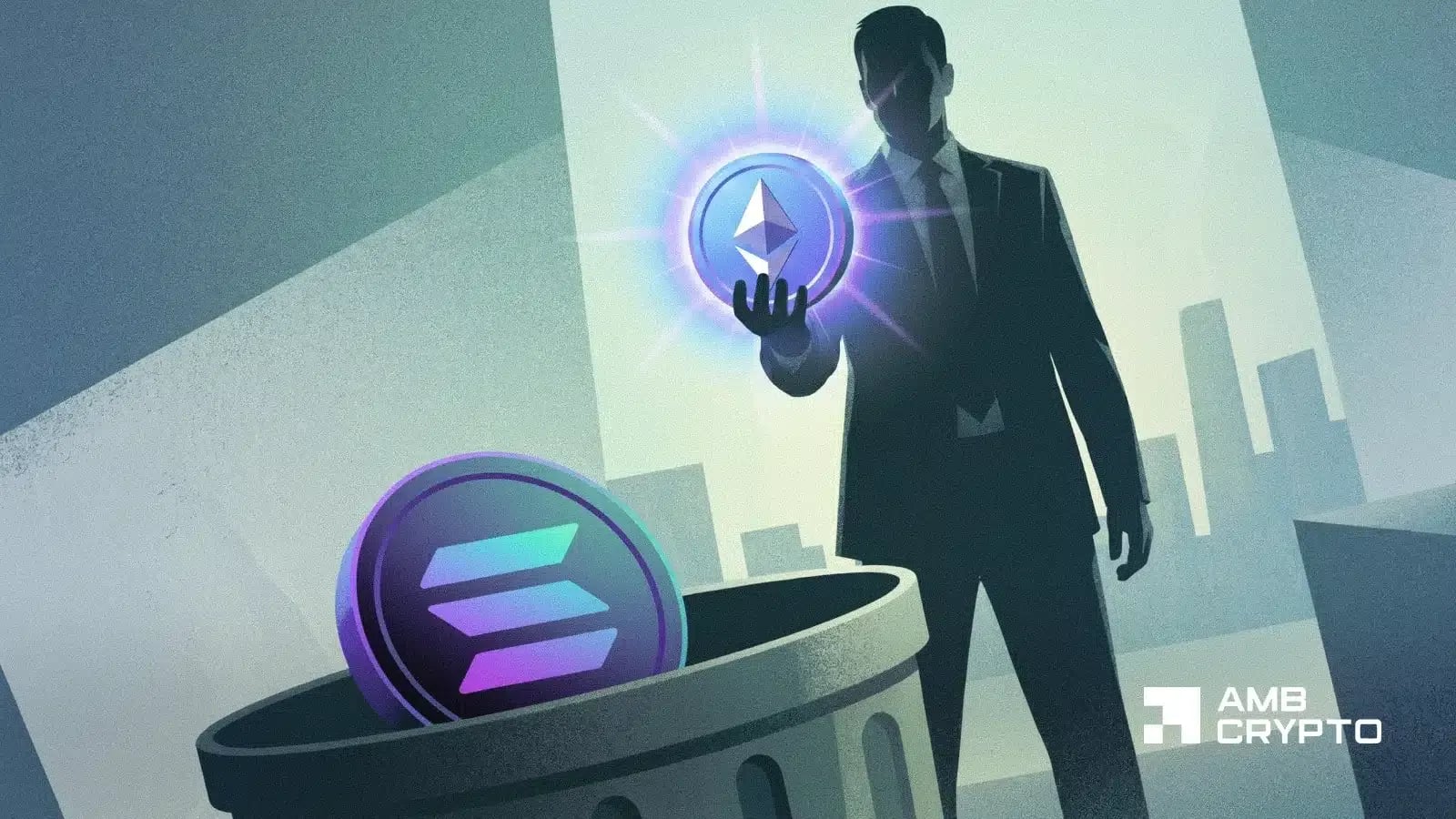
Given Solana’s efficiency advantages, one might expect large institutional players to favor it for product launches. However, BlackRock opted for Ethereum for its money market fund launch instead. This raises a key question: does institutional capital still hesitate to price Solana as fundamentally undervalued?
One takeaway from BlackRock’s move is the importance of trust for institutions. BlackRock is launching two tokenized money market funds. One fund is tied to a $6.1 billion Treasury liquidity vehicle and is designed primarily for stablecoin holders rather than bank account users, reflecting a broader shift toward integrating TradFi with DeFi to move capital more efficiently on-chain.
Despite Solana’s stronger on-chain efficiency, BlackRock chose Ethereum. The article attributes this divergence largely to liquidity. Even amid a recent market crunch, Ethereum still dominates total value locked (TVL), holding over 50% of on-chain liquidity compared with Solana’s 6.7%. For institutions, deeper liquidity can translate into greater confidence when launching large financial products.
In this framing, Solana’s perceived undervaluation may not stem from weaker technical performance. Instead, institutions may be assigning a premium to liquidity depth and ecosystem trust over pure performance advantages.
Premium gym chains are entering a “golden era” that is ending or already in decline, as rising operating costs collide with shifting consumer preferences toward more flexible, community-based ways to exercise. Long-term memberships are shrinking, margins are pressured by higher rents and facility expenses, and competition from smaller, more personalized…