•
•
•
•
•
•
•
•
•
•
•
•
•
•
•
•
•
•
•
•
•
•
•
•
•
•
•
•
•
•
•
•
•


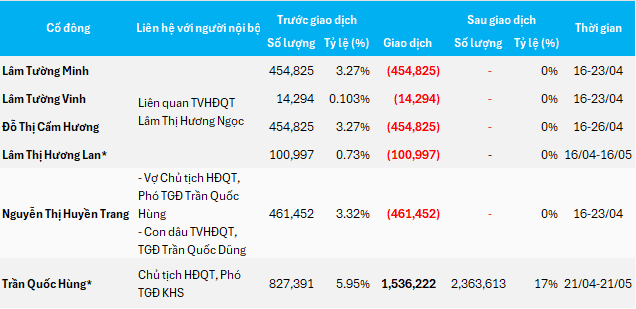
Insiders at Kiên Hùng Joint Stock Company (KHS) listed on the Hanoi Stock Exchange have privately sold all of their shares ahead of the ex-dividend date to qualify for cash dividends. Several of the sellers are closely connected to the company’s leadership.
The transactions include individuals linked to Chairwoman Lam Thi Huong Ngoc. The reported sales were conducted during 16–23/04, with one case extending to 26/04:
In addition, Lam Thi Huong Lan (Ngoc’s sister) registered to sell nearly 101,000 KHS shares during 16/04–16/05.
Ngoc, the female leadership at KHS, directly held over 221,200 shares, equivalent to about 1.59% of the company’s charter capital.
In the period 16–23/04, shareholder Nguyen Thi Huyen Trang sold all of nearly 461,500 KHS shares, reducing her ownership to 0%. Trang is connected to KHS leadership as the wife of Tran Quoc Hung—Chairman and Deputy CEO, and also a Board member and CEO of KHS—and as the daughter-in-law of Tran Quoc Dung, a Board member.
Tran Quoc Dung’s father and son are major shareholders of KHS, directly owning nearly 3.5 million shares (24.91%) and nearly 827,400 shares (5.95%), respectively.
With the completed and expected transactions, the market may record nearly 1.5 million KHS shares—about 10.69% of capital—changing hands.
Notably, Tran Quoc Hung, Chairman and Deputy CEO, recently registered to buy more than 1.5 million shares, to be executed during 21/04–21/05. Therefore, a share-swap scenario cannot be ruled out.
According to VietstockFinance, the relationships between Lam Thi Huong Ngoc, Tran Quoc Dung and Tran Quoc Hung and the other shareholders involved in the trades above are tightly related by family ties.
KHS has also recorded other notable insider trades.
Premium gym chains are entering a “golden era” that is ending or already in decline, as rising operating costs collide with shifting consumer preferences toward more flexible, community-based ways to exercise. Long-term memberships are shrinking, margins are pressured by higher rents and facility expenses, and competition from smaller, more personalized…