•
•
•
•
•
•
•
•
•
•
•
•
•
•
•
•
•
•
•
•
•
•
•
•
•
•
•
•
•
•
•
•
•


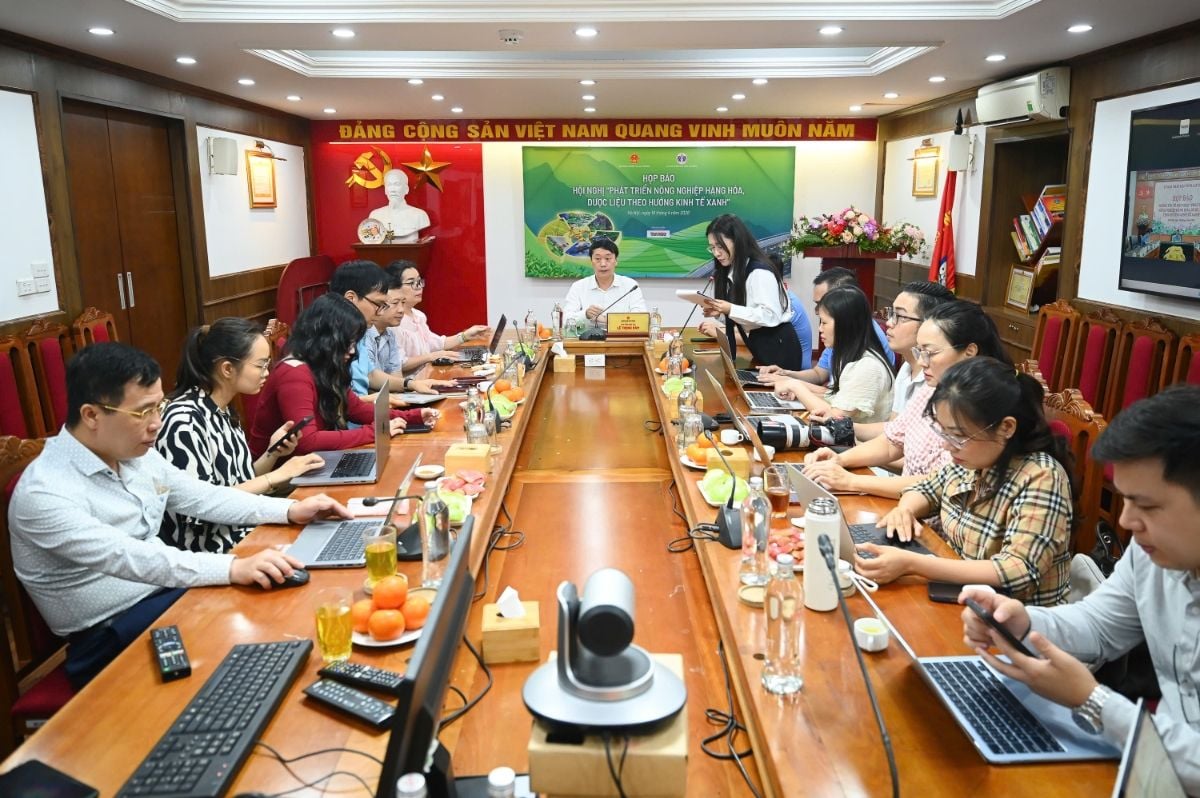
Lai Châu is seen as having strong potential to develop commodity agriculture and medicinal herbs, supported by its diverse ecosystem, distinctive climate and high-value endemic products. A conference titled “Developing Commodity Agriculture and Medicinal Herbs in the Green Economy direction” will be held over two days on April 23–24, 2026, to discuss orientations and solutions for green, sustainable agriculture in the locality.
On the afternoon of April 16, 2026, in Hanoi, a press briefing was held to introduce the conference. The event is organized by the Agricultural and Environment Newspaper in coordination with Lai Châu Province’s Department of Agriculture and Environment and the Department of Culture, Sports and Tourism.
Speaking at the briefing, Le Trong Dam, Deputy Editor-in-Chief of the Agricultural and Environment Newspaper, said that in recent years, developing commodity-oriented, sustainable and environmentally friendly agriculture has become an unavoidable trend and a necessary requirement to raise the agricultural sector’s value added and competitiveness.
For mountainous provinces such as Lai Châu, he said the approach is not only an economic development orientation but also a solution to effectively exploit land, climate and biodiversity—helping improve living standards for highland communities. He also noted ongoing challenges, including small-scale production, unsustainable value chains, limited processing capacity and unstable markets.
Nguyen Thanh Dong, Deputy Director of Lai Châu’s Department of Agriculture and Environment, said the province has identified the development of commodity agriculture and medicinal herbs toward the green economy as a breakthrough for the 2025–2030 period.
Lai Châu has a diverse ecological system and altitude-based climate zoning that supports high-value agricultural products and medicinal herbs such as tea, macadamia, cinnamon, specialty rice, cold-water fish and medicinal herbs. While production scale is not large, these products have distinct value linked to local advantages.
The province’s direction is to deepen green growth, improve production efficiency, and manage and exploit resources while protecting the environment, focusing on typical products. Lai Châu also aims to build a multi-value agriculture model that combines agriculture with tourism and cultural preservation.
A key challenge highlighted by officials is the fragmented terrain and long distances to economic centers, which contribute to high transport costs, difficulty forming large-scale production areas and limited investment attraction. The Government has prioritized connecting expressways, which is expected to create new momentum for development.
Nhat Minh Dong, Deputy Director of Lai Châu’s Department of Agriculture and Environment, said Lai Châu ginseng is a precious medicinal herb with a unique gene pool and high saponin content, offering substantial economic potential and being oriented to become a local landmark product. He emphasized that research, process standardization and branding are crucial for the product to reach international markets.
For the medicinal herb sector, Lai Châu identifies ginseng as the flagship product. In Vietnam’s ginseng development program, the government has identified two core products: Ngoc Linh ginseng and Lai Chau ginseng. Lai Châu has issued targeted resolutions, conducted ecological region assessments, and built mechanisms for conservation, propagation and ginseng development.
To achieve this goal, Lai Châu proposes stronger coordination among ministries—including the Ministry of Science and Technology, the Ministry of Agriculture and Rural Development and the Ministry of Health—to establish standards, develop branding and raise the status of Lai Chau ginseng on both the Vietnamese and global medicinal herb maps.
The conference “Developing Commodity Agriculture and Medicinal Herbs in the Green Economy direction” will take place in Lai Châu on April 23–24, 2026. It is organized by the Agricultural and Environment Newspaper in coordination with Lai Châu’s Department of Agriculture and Environment and Department of Culture, Sports and Tourism, under directives from the Ministry of Agriculture and Environment and Lai Châu’s People’s Committee.
Organizers expect about 250–300 delegates to attend in person and 300–400 online. Participants include representatives from central agencies and ministries, local authorities, research institutes, universities, experts, businesses, cooperatives and media.
The conference will focus on sustainable agricultural development aligned with green transformation, circular economy, emissions reduction and climate change adaptation. It will also seek solutions to enhance value addition for the province’s key crops and medicinal herbs, covering the full chain from production and processing to consumption.
Discussions will center on three main topics: developing commodity agriculture and medicinal herbs toward a green economy; enhancing product value chains through raw material areas, deep processing, trade, logistics, origin tracing and branding; and strengthening linkages, attracting investment and expanding markets.
During the conference, around 50 booths will showcase OCOP products (3–5 stars), key agricultural products, deep-processed goods, eco-friendly products, green packaging and origin tracing. The exhibition is intended to connect producers, enterprises and the market, promoting Lai Châu’s agricultural products and the Northwest region.
The conference is also expected to sign memoranda of understanding (MOUs) between regulatory agencies, research institutes, businesses, cooperatives and partners to advance development of raw material areas, technology transfer and supply chain linkages for production, processing and distribution.
Organizers said several international organizations are expected to participate, broadening cooperation and supporting efforts to promote products to global markets. This is expected to help Lai Châu connect businesses, cooperatives, scientists and regulators, supporting expanded output for local agricultural products and medicinal herbs.





Premium gym chains are entering a “golden era” that is ending or already in decline, as rising operating costs collide with shifting consumer preferences toward more flexible, community-based ways to exercise. Long-term memberships are shrinking, margins are pressured by higher rents and facility expenses, and competition from smaller, more personalized…