•
•
•
•
•
•
•
•
•
•
•
•
•
•
•
•
•
•
•
•
•
•
•
•
•
•
•
•
•
•
•
•
•


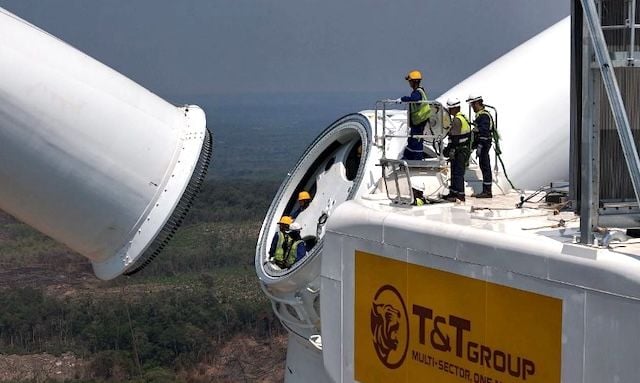
With Vietnam’s power system entering a peak period amid rising demand, weather conditions, and global energy volatility, securing a reliable supply has become more urgent. In this context, the cross-border wind-energy project Savan 1, developed by T&T Group, completed in 16 months and delivering 0.9 billion kWh annually, has drawn attention for both its schedule and its approach to energy development.
In late December 2025, energy experts focused on the Savan 1 wind farm in Laos, owned by T&T Group, which formally began commercial operation and started exporting power across the border to Vietnam.
The project has a total designed capacity of 495 MW, including Phase 1 of 300 MW. Total investment is reported at about 768 million USD. Savan 1 is described as one of the rare large onshore wind projects in Southeast Asia completed in a remarkably short time, with the stated objective of delivering electricity to Vietnam.
After receiving the concession from the Lao government in January 2025, T&T Group began implementing the project’s main components at the same time. This included both generation assets and transmission infrastructure within a single integrated project, allowing the developer to manage schedule and grid integration more directly.
The project was built across challenging hillside terrain. It also faced logistical and weather-related difficulties, including transporting equipment across the border and working under harsh conditions.
According to the account, hundreds of workers worked around the clock to accelerate completion. They reorganized and reinforced access roads and bridges and carried out construction across multiple fronts. Key activities—ranging from foundation and turbine installation to transmission-line stringing—were executed in parallel to maintain continuous progress across the site.
Results were reflected in early milestones. On August 31, just over six months after construction began, the 220kV transmission line—nearly 70 km from the plant to the connection point in Vietnam—was completed.
The project also invested in dedicated transmission infrastructure, aiming to avoid the common bottleneck where generation is completed but power cannot be delivered due to transmission delays. In the electricity industry, the gap between project completion and actual power supply is often linked to transmission readiness.
In the closing days of 2025, the Savan 1 wind farm officially started commercial operation (COD). From the wind-rich Savannakhet plateau, electricity is transmitted along the dedicated 220 kV line, crosses the border, and feeds into Vietnam’s grid at Lao Bao.
To date, Savan 1 has operated steadily, delivering 0.9 billion kWh annually to the national grid. The grid-connection rate has exceeded 90%.
Experts say the Savan 1 case reflects an evolving Vietnam–Laos energy partnership supported by measurable outcomes. They also highlight the role of private sector participation in translating energy policy into observable results through project execution.





Premium gym chains are entering a “golden era” that is ending or already in decline, as rising operating costs collide with shifting consumer preferences toward more flexible, community-based ways to exercise. Long-term memberships are shrinking, margins are pressured by higher rents and facility expenses, and competition from smaller, more personalized…