•
•
•
•
•
•
•
•
•
•
•
•
•
•
•
•
•
•
•
•
•
•
•
•
•
•
•
•
•
•
•
•
•


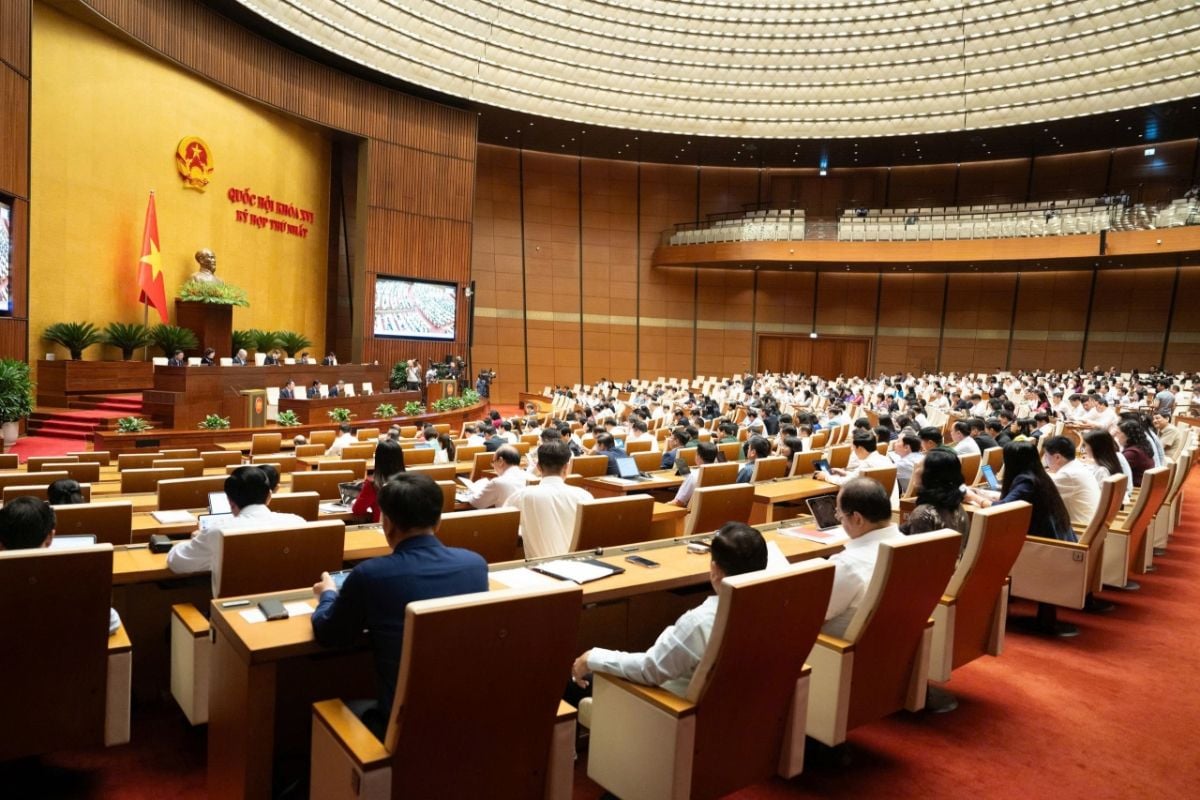
Continuing the First Session of the 16th National Assembly, the National Assembly on the morning of April 21 discussed evaluating and supplementing the results of the socio-economic development plan and the state budget for 2025, as well as the progress of implementing these plans in the early months of 2026. Central Committee member and Vice Chairman of the National Assembly Nguyen Thi Hong presided over the session.
Speaking on the wage policy reform process, Deputy Thach Phuoc Binh of the Vinh Long provincial delegation said that adjusting the base salary is not only a technical issue, but also a decisive factor for living standards, work motivation, and the quality of civil servants and public employees.
In recent years, the state has increased the base salary from 1.49 million to 1.8 million and then to 2.34 million VND per month. The plan is to continue raising it to 2.53 million VND from July 1, 2026.
Deputy Thach Phuoc Binh said the question is no longer whether to increase wages, but how much to raise them to ensure living standards while aligning with the budget and maintaining incentives for public-sector development.
The deputy said the 2.53 million VND per month from July 1, 2026 is technically reasonable, but may not be strong enough to guarantee living standards for most public-sector workers.
He cited that a new entrant with a coefficient of 1.86 earns about 4.7 million VND per month before insurance. At the same time, urban minimum living costs are commonly around 6–7 million VND per month, creating a significant gap between income and basic needs.
As a result, workers may struggle to live independently on salary alone and often need supplemental income, which affects motivation and living standards. In his view, the 2.53 million figure may provide stability but not a secure living.
From January 1, 2026, the regional minimum wage in the private sector is set to increase to:
The four-region average is about 4.47 million VND per month.
Deputy Thach Phuoc Binh said that if the new base salary of 2.53 million VND is applied with a starting coefficient commonly seen (1.86), pay under the old formula would be about 4.706 million VND per month. With a coefficient of 2.10, it would be about 5.313 million VND per month.
In other words, the lowest group would barely exceed the regional minimum wage, while those at coefficient 2.10 would barely reach Region I—levels he described as “bare survival” rather than secure living standards in urban areas.
Deputy Thach Phuoc Binh also pointed to substantial cost pressures. In 2025, several essential cost groups rose faster than the CPI, including:
He said these are non-discretionary expenses for households of civil servants. Therefore, even with an 8.12% nominal wage increase, many people may feel relief without achieving a sense of security—particularly when supporting families, renting housing, commuting, schooling, and healthcare.
Based on practical analysis of income versus living costs, he argued that a base salary in the range of 2.65–2.70 million VND per month would be more reasonable and feasible at this stage.
In real income terms, Deputy Thach Phuoc Binh said that with a base salary of 2.65–2.70 million VND:
Compared with 2.53 million VND, this represents an increase of roughly 200,000–400,000 VND per month. He said this would be a meaningful improvement for low-income groups and would help narrow the gap with private-sector regional minimum wages while reducing pressure on essential expenditures.
He added that raising the base salary to 2.65–2.70 million VND per month, while not fully guaranteeing “living on wages” in large urban areas, would still have important effects: it would reduce dependence on additional income, provide a clearer sense of real income improvement rather than only nominal increases, and support psychological stability and higher motivation at work.
In the context of rising costs for essentials such as housing, healthcare, and utilities—costs that outpace CPI—he said a wage increase large enough to be perceptible is necessary.
From a budget perspective, Deputy Thach Phuoc Binh said the 2.65–2.70 million VND range has the advantage of not placing excessive pressure on the state budget. He said it could be implemented if civil service headcount is streamlined, public spending is reorganized, and inefficient expenditures are cut.
The key, he concluded, is to balance affordability with improved living standards.
Projected calculation methods for wages and allowances under the new base salary from July 1: 09:34, 20/04/2026.







Premium gym chains are entering a “golden era” that is ending or already in decline, as rising operating costs collide with shifting consumer preferences toward more flexible, community-based ways to exercise. Long-term memberships are shrinking, margins are pressured by higher rents and facility expenses, and competition from smaller, more personalized…